
Travel insurance generally should not be assumed to pay for scheduled dialysis abroad. A senior traveler needs a confirmed receiving dialysis center, clinical transfer records, a direct payment plan, medication and supply logistics, and a backup treatment schedule before departure. Travel insurance may address an unexpected covered emergency, cancellation, interruption, delay, baggage, or evacuation, but the certificate’s pre-existing-condition and planned-treatment rules decide the result.
This article is educational, not medical, legal, insurance, or financial advice. Dialysis travel requires individualized approval and coordination with the treating nephrology and dialysis teams. Never change a treatment schedule, fluid plan, medicine, or equipment arrangement based on general travel content.
Key takeaways
- Secure destination dialysis appointments before committing to nonrefundable travel.
- Scheduled treatment and an unexpected complication are separate insurance claims.
- Original Medicare generally does not provide routine dialysis coverage abroad except under narrow foreign-care rules.
- Pre-existing-condition exclusions and waiver requirements must be reviewed against the purchase timeline.
- A viable plan includes payment, records, supplies, transport, and backup centers—not only a policy limit.
Reviewed: August 16, 2026.
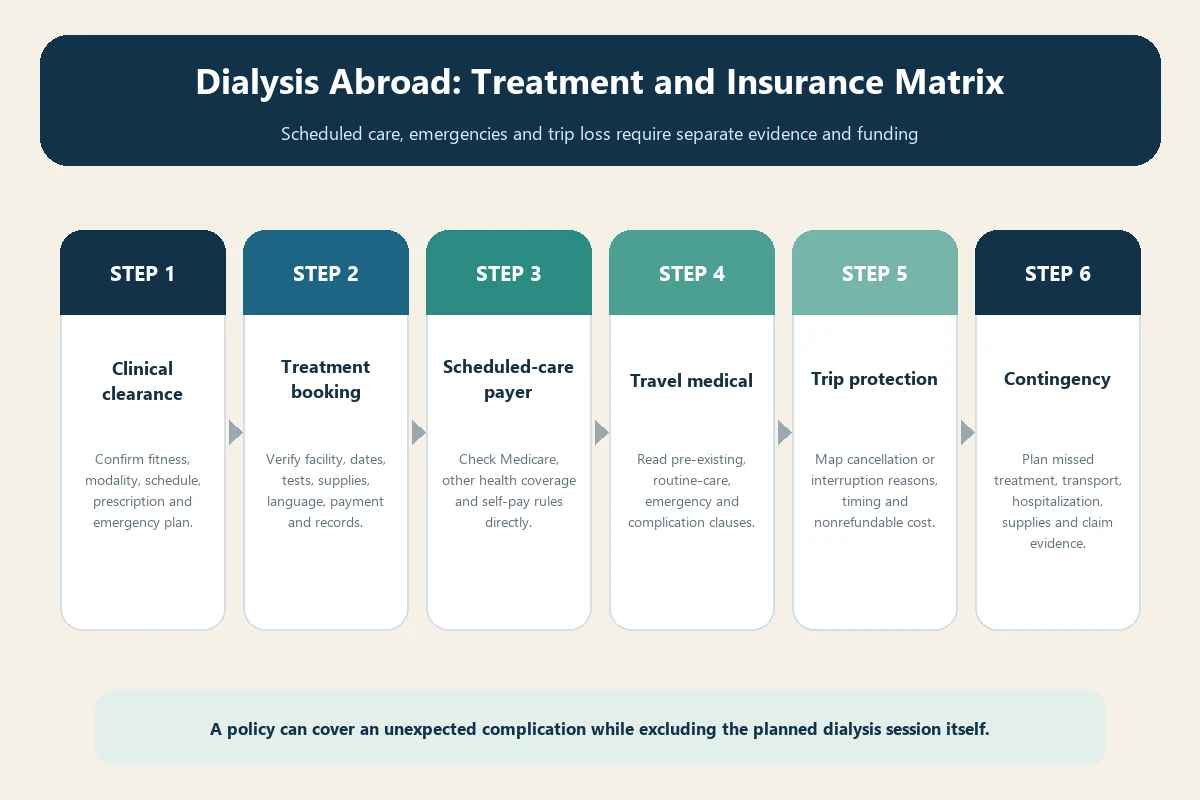
Begin with clinical clearance, not an insurance quote
The home dialysis team should assess whether travel is appropriate, what treatment schedule can be supported, what records the receiving center needs, and how complications should be handled. Planning may begin weeks or months ahead because destination capacity, screening, documentation, payment, and supply shipping can take time.
Insurance cannot create an available dialysis chair or make an unsuitable itinerary safe. Do not buy a nonrefundable cruise, tour, or lodging package until treatment appointments and essential logistics are confirmed.
Scheduled dialysis is usually planned care
Travel medical insurance is commonly designed for unexpected illness or injury during a covered trip. Dialysis that the traveler knows will be required is ongoing, planned treatment. A policy’s emergency medical benefit should not be read as routine dialysis payment unless the certificate explicitly provides it.
Ask the receiving center for the price, deposit, payment deadline, cancellation rule, included services, physician charge, laboratory cost, medications, and supplies. Obtain the plan insurer’s written position on scheduled dialysis. A sales representative’s general statement that “medical care is covered” is too broad.
Original Medicare abroad
Original Medicare generally does not cover health care outside the United States. Its limited foreign hospital rules involve a closer foreign hospital during a qualifying U.S. emergency, certain direct Alaska travel through Canada, or a U.S. resident whose nearest capable hospital is across a border. Routine dialysis during an overseas vacation ordinarily does not fit those situations.
Inside the United States, Medicare dialysis coverage follows its own end-stage renal disease rules. Do not project domestic benefits into another country. Medicare Advantage plans may add worldwide emergency or urgent benefits, but scheduled dialysis overseas still requires explicit confirmation in the current Evidence of Coverage.
Separate six money questions
| Expense | Primary question |
|---|---|
| Scheduled dialysis | Who pays the planned recurring treatment? |
| Unexpected complication | Does travel medical coverage treat it as an eligible emergency? |
| Local ambulance | What medical-necessity and destination rules apply? |
| Evacuation | Who authorizes the route and endpoint? |
| Cancelled or interrupted trip | Is the reason covered and the condition eligible? |
| Supplies or equipment | Is loss medical, baggage, property, or an excluded maintenance cost? |
A single “medical limit” does not answer all six. Create a payer and document owner for each line.
Pre-existing-condition language
Kidney disease and dialysis are known before purchase. A travel policy can exclude losses connected to a pre-existing condition unless a waiver applies. Waivers commonly depend on buying within a defined period after the initial trip payment and satisfying other eligibility conditions, which may include covering the required trip cost and being medically able to travel at purchase.
Definitions vary. Review symptoms, diagnoses, treatment, testing, prescriptions, and medication changes during the look-back period. Use our senior pre-existing-condition questions and obtain a written explanation from the insurer.
A waiver does not turn planned treatment into an emergency
A pre-existing-condition waiver can remove an exclusion for an otherwise covered loss. It does not automatically add a benefit for routine dialysis, expected supplies, or treatment booked before travel. The loss must still satisfy every other provision.
Ask the insurer to compare two examples in writing: a scheduled treatment session at the receiving center and an unexpected hospitalization caused by a new complication. The answers may be different.
Confirm the receiving center
The home and destination clinics may need to exchange recent treatment orders, laboratory results, dialysis prescription, access information, medication list, medical history, and infectious-disease screening. The receiving center determines its requirements and whether it can safely accept the traveler.
Record the appointment dates, local time, address, transportation, clinical contact, after-hours number, payment receipt, and cancellation policy. Reconfirm shortly before departure. A directory listing is not an appointment.
Hemodialysis itinerary design
Clinic-based hemodialysis fixes parts of the travel schedule. Flights, cruises, tours, and ground transfers must leave enough time for the prescribed treatments and recovery. A missed connection can become a medical issue rather than a normal inconvenience.
Test every treatment day against local holidays, port calls, transfer times, and time-zone changes. Identify a backup center and emergency hospital. Do not independently compress, postpone, or combine sessions to fit sightseeing.
Peritoneal dialysis logistics
Peritoneal dialysis travel can involve solution, cycler, consumables, power, storage, sterile workspace, waste disposal, shipping, customs, and technical support. The manufacturer, dialysis team, supplier, carrier, lodging, and destination rules may all affect the plan.
Confirm delivery dates and inventory at the destination before departure. Have a contingency for delayed or damaged supplies without using products that may be unsafe. Travel insurance may treat shipping or property loss differently from medical treatment; verify each benefit.
Medication and laboratory planning
Carry an approved supply of prescriptions with original labels and check destination laws. Medicare Part D generally does not cover retail prescriptions purchased outside the United States. Ask the clinical team about travel quantities, storage, time-zone dosing, and emergency substitutions.
The chronic medication travel guide helps map refills and monitoring. Laboratory tests required by the receiving center may be planned care and should be priced in advance.
Medical records packet
- Dialysis prescription and recent treatment summary
- Access type and relevant procedure history
- Recent laboratory and screening results requested by the receiving center
- Medication, allergy, and comorbidity list
- Clinician and clinic contact details
- Insurance cards and travel policy certificate
- Receiving-center confirmation and payment terms
- Emergency hospital and backup-center contacts
- Supply inventory and shipment records
- Trip itinerary and emergency contact authorization
Share medical information securely and only with authorized parties. Keep a concise paper emergency summary plus encrypted or portal-based access to full records.
Direct billing versus reimbursement
A foreign dialysis center may require advance payment. A travel insurer’s assistance vendor may help locate a provider but decline payment for scheduled care. Even during a covered emergency, the hospital may require a deposit and the insurer may reimburse later.
Our direct-billing guide explains payment guarantees, network labels, and reimbursement. Confirm the currency, refund rules, wire or card fees, itemized invoices, and receipts.
Emergency and evacuation planning
Identify a destination hospital capable of handling likely complications and the route from the lodging or dialysis center. A travel evacuation benefit may pay only when local care is inadequate and the assistance company approves the transfer. The endpoint may be the nearest appropriate facility, not home.
Use the evacuation destination guide to evaluate geography and evacuation claim checklist for records. Ask whether dialysis during a covered evacuation or delay is addressed.
Trip cancellation and interruption
If the treating clinician determines the traveler cannot depart, cancellation coverage may reimburse eligible prepaid nonrefundable costs when the condition is covered and documentation rules are met. If treatment availability disappears after departure, interruption coverage depends on the policy’s covered reasons and definitions.
Supplier refunds, credits, rebooking, and the unused trip portion affect the loss. Buy only after comparing the dialysis center’s cancellation terms and the travel policy purchase-timing requirements.
Delay and missed treatment
A weather delay can extend the gap between treatments or separate the traveler from supplies. The clinical response belongs to the dialysis team; the insurance response depends on delay triggers, required duration, covered expenses, and medical benefits.
Do not wait for a claim decision before seeking urgent care. Contact the insurer as soon as reasonably possible, but follow clinical instructions first. Save delay evidence, airline notices, extra lodging, transport receipts, and medical records.
Dialysis travel rehearsal
- Center cancellation: the destination clinic cannot accept the traveler two days before departure.
- Flight diversion: arrival shifts past a scheduled session.
- Unexpected hospitalization: a complication requires inpatient care.
- Supply failure: peritoneal dialysis materials are delayed or damaged.
- Medical transfer: the local hospital cannot provide adequate specialty care.
For each event, identify the clinical contact, backup center, insurer contact, payment source, transport, documents, and decision-maker.
Questions for the travel insurer
- Is kidney disease disclosed as the application requires?
- Does a pre-existing-condition exclusion or waiver apply?
- Is scheduled dialysis explicitly excluded or covered?
- How is an unexpected dialysis-related complication treated?
- Are treatment supplies or equipment covered under any benefit?
- What cancellation reason applies if the traveler becomes medically unable to go?
- What happens if the receiving center cancels?
- Does emergency evacuation cover this destination and condition?
- Who authorizes transfer and chooses the endpoint?
- Is direct payment available?
- Which payer is primary?
- What claim records and deadlines apply?
Questions for the dialysis team and receiving center
- Is the traveler clinically ready for the itinerary?
- Which appointments are confirmed?
- What records, screenings, and orders are required?
- What exactly is included in the quoted price?
- What is the cancellation and refund policy?
- Which emergency hospital and backup center should be used?
- How will supplies, storage, and waste be handled?
- Who provides after-hours clinical support?
FAQ
Does travel insurance pay for dialysis abroad?
Do not assume it does. Scheduled dialysis is planned care and is often outside emergency travel medical benefits. Obtain explicit written confirmation.
Does Medicare cover dialysis in another country?
Original Medicare generally does not cover routine health care abroad. Narrow foreign hospital exceptions exist but ordinarily do not cover planned vacation dialysis.
Can a senior with dialysis get a pre-existing-condition waiver?
Eligibility depends on the policy’s purchase timing and other conditions. A waiver removes an exclusion only for otherwise covered losses; it does not create planned-treatment coverage.
Should treatment be booked before the trip?
Yes. Coordinate and confirm the receiving center, clinical records, schedule, payment, supplies, and backup plan before committing to travel.
Bottom line
Dialysis travel is a treatment plan with an insurance layer, not an insurance purchase with a treatment add-on. Confirm clinical readiness and destination care first. Then use travel insurance to address clearly defined emergency, trip-loss, delay, transport, and assistance risks—without assuming it pays for the scheduled dialysis itself.
Sources
- National Kidney Foundation — Travel Tips for Kidney Patients
- American Kidney Fund — International Travel on Dialysis
- Medicare — Dialysis Services and Supplies
- Medicare — Coverage Outside the United States
- U.S. Department of State — Insurance Coverage Overseas
- CDC Yellow Book — Immunocompromised Travelers
