

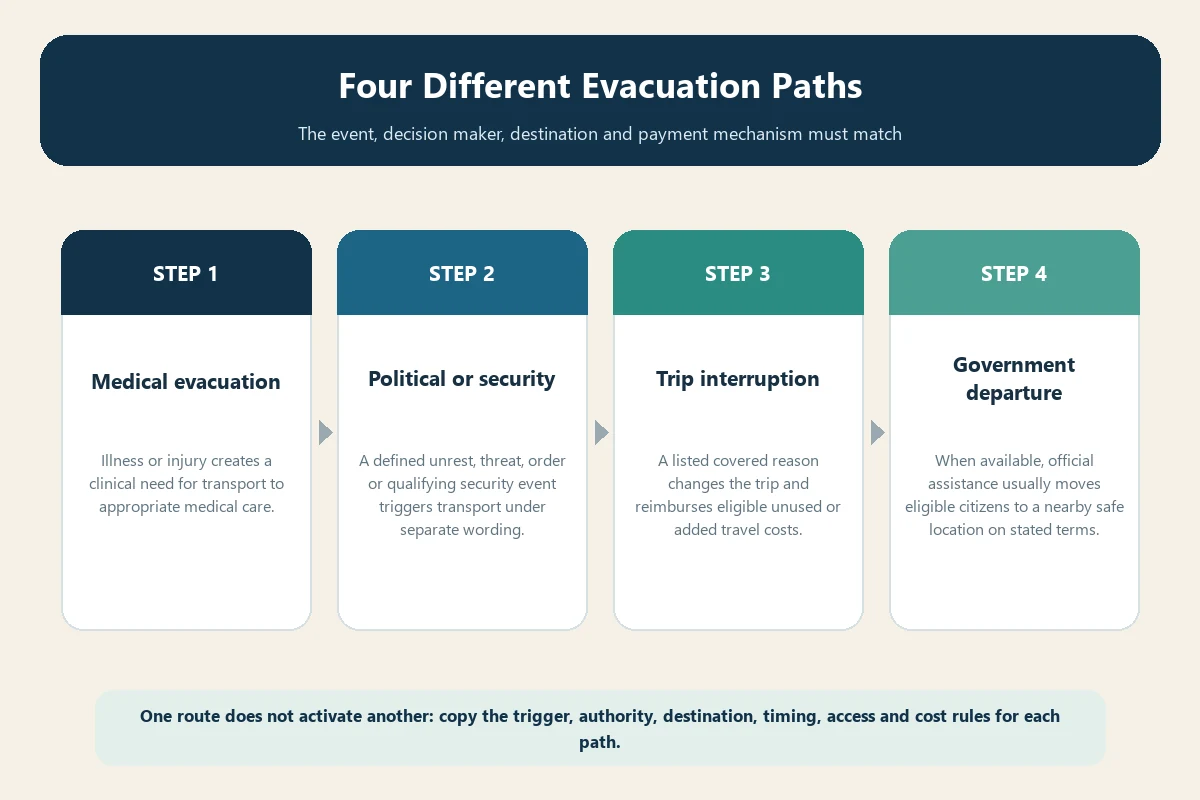
Medical evacuation insurance and political evacuation are different benefits even when one assistance company coordinates both. Medical evacuation begins with illness or injury and a clinical transport need. Political, security, or non-medical evacuation begins with a defined crisis, threat, government action, or contract trigger—not with the need for hospital care.
Trip interruption and government-assisted departure are different again. A traveler can qualify for one route and not the others. This guide is educational, not medical, insurance, security, legal, or government advice. In immediate danger, follow local authorities and emergency instructions.
Key takeaways
- Medical transport and security departure start from different events.
- Political coverage may require a defined order, threat, or purchased upgrade.
- An advisory that predates arrival can affect eligibility under some forms.
- A safe location is not necessarily the United States or the traveler’s home.
- Government-coordinated transportation can be unavailable and reimbursable.
Reviewed August 16, 2026. Political evacuation, security event, travel warning, evacuation order, place of safety, home country, medical necessity, covered reason, and trip interruption are document-specific terms.
Use four separate paths
| Path | Typical starting question | Possible endpoint |
|---|---|---|
| Medical evacuation | Does illness or injury require medically necessary transport? | Appropriate medical facility |
| Political or security evacuation | Has a defined crisis or threat activated the service? | Safe location or permitted home territory |
| Trip interruption | Is a listed covered reason forcing the trip to change? | Revised trip or return itinerary |
| Government departure | Is official transport available for eligible citizens? | Usually a nearby safe location |
The membership-versus-policy guide separates service agreements from insurance. Here, the key separation is the event and route: one product can contain multiple paths without making their triggers interchangeable.
Medical evacuation starts with the patient
A medical evacuation benefit responds to a covered illness or injury when the patient needs transport to a facility capable of appropriate care. The assistance and medical teams can decide medical necessity, timing, destination, transport mode, receiving capability, and whether the patient is stable enough to move.
The medical evacuation destination guide explains the nearest-adequate-facility rule. Political conditions can affect access, but they do not turn a security departure into a clinical evacuation.
Political evacuation starts with a non-medical event
Political, security, or non-medical evacuation wording can refer to civil unrest, political instability, expulsion, personal threat, armed conflict, natural disaster, an evacuation recommendation, or a government order. The exact event, authority, severity, and timing must match the contract.
Do not substitute news coverage, personal fear, canceled tourism, a demonstration, an airline schedule change, or a general advisory for the defined trigger. Those facts may be serious and justify leaving, but coverage still depends on the issued wording.
A plan-specific political clause shows the trigger problem
One 2026 IMG sample contract illustrates political evacuation wording tied to a government organization ordering evacuation of non-emergency government personnel after the insured arrived. The example requires timely contact, an order applicable to people from the insured’s country of residence, and company approval. It also contains a limitation involving an advisory already in effect before arrival.
That is one plan form, not a universal trigger. Another policy can cover different events, require a different authority, use a different look-back period, exclude war, or provide no political evacuation at all.
A security membership can use a different test
A Global Rescue consumer member-services agreement gives a different provider-specific example. Its described security service applies only to members who selected and paid for the security upgrade. The agreement defines qualifying events, requires a prompt request, reserves provider control over access and transport mode, and excludes self-arranged reimbursement.
This demonstrates why “political evacuation included” is incomplete. Ask whether the service is core, optional, insured, membership-based, reimbursement-based, or provider-arranged, and which version applies to the traveler.
Corporate political evacuation is another market
An AIG WorldRisk overview describes a corporate endorsement for eligible employees, directors, officers, and guests under specified commercial coverage. It cites political unrest, personal threats, and armed conflict and says actual policy language and underwriting govern availability.
A business product example should not be used to describe a consumer trip policy. It is useful only to show that trigger authority, who is covered, advance authorization, payment mechanism, and return options can differ across product classes.
Trip interruption pays a different type of loss
Trip interruption can reimburse eligible unused trip costs and added transportation after a listed covered reason. It may help a traveler leave early without providing an extraction team, security convoy, air ambulance, or access into a dangerous area.
Read whether civil unrest, terrorism, natural disaster, mandatory evacuation, airline cessation, destination uninhabitability, or government advisory is actually listed. The country exclusions and advisories guide shows why advisory level, timing, geography, and policy purchase date should be tracked separately.
Government evacuation is not an insurance benefit
The U.S. Department of State’s crisis-response and evacuation guidance says travelers should use commercial transportation while it is safely available. When commercial options are unavailable and conditions permit, the government may facilitate departure for private U.S. citizens.
Such assistance is situation-dependent, generally does not include in-country transport, may not be available to non-U.S. family members, and usually moves people to a nearby safe location rather than the United States. Travelers generally arrange lodging and onward travel themselves.
Government-coordinated transport can create a debt
State Department guidance explains that coordinated transportation is normally reimbursable under U.S. law. Travelers can be asked to sign a form agreeing to repay the government and be billed later. The cost, destination, schedule, baggage, and ability to carry pets can be constrained by the operation.
Do not describe government help as free insurance or a guaranteed flight home. Build an independent exit plan and funds for the safe-location handoff.
The destination clause changes the whole promise
Medical evacuation may end at an appropriate hospital. Political insurance may name the nearest place of safety or the country of residence. A security membership may name the home country. Government movement usually ends at a nearby safe location. Trip interruption may reimburse a return or continuation itinerary.
The home-country evacuation guide explains why country of residence, home country, trip origin, preferred hospital, and safe location must not be merged. Copy the endpoint for each path word for word.
Commercial transport is often the first exit
Waiting for an official evacuation order or private extraction can narrow options. If authorities and the assistance provider say it is safe to leave commercially, compare available air, land, or sea routes early. Confirm visas, transit permission, border status, curfews, road access, payment systems, fuel, baggage, medications, and family eligibility.
Never move through active danger based on a general article. Use current official instructions, local authorities, the embassy, and the contracted assistance team.
Known-risk and prior-advisory clauses need timestamps
Some policies exclude an event that was foreseeable, underway, publicly known, or the subject of an advisory before purchase or arrival. A membership may exclude knowingly entering a region where a qualifying event or imminent harm was already evident. The relevant timestamp can differ by contract.
Create a file with purchase time, effective date, deposit dates, departure, arrival, advisory changes, government messages, incident commencement, request time, approval, and movement. The pre-authorization guide shows why late notice and self-arrangement are especially risky in expensive transport cases.
War, civil disorder, and terrorism are not interchangeable
A policy may define war, civil war, insurrection, riot, civil disorder, terrorism, political threat, or security event separately. One can be covered in a non-medical evacuation clause and excluded elsewhere. Participation as a combatant or security professional can trigger additional exclusions.
Do not summarize this area with “war is covered” or “war is excluded.” Quote the named event, covered section, exclusion, exception, traveler role, destination, and controlling endorsement.
Medical and security events can happen together
A traveler can be injured during unrest. The medical team may need an appropriate hospital while the security team assesses access, route, curfew, and imminent harm. Neither discipline automatically overrides the other.
Open separate case tracks: clinical status and receiving care; security event and safe access; immigration and border documents; family and pet logistics; insurer or membership authorization; and government messages. One coordinator should reconcile the timelines without collapsing the benefits.
Authorization and access are separate gates
A provider may approve a covered event but still be unable or unwilling to enter a region that is unsafe, inaccessible, closed, or prohibited. It may choose the safest feasible mode and timing rather than the traveler’s requested aircraft or route.
The evacuation route-cost guide maps ground, airport, aircraft, medical crew, permits, and receiving handoffs. Political evacuation adds security assessment, staging, communications, and safe-location logistics.
Use this trigger-authority worksheet
- What happened: illness, injury, unrest, threat, order, disaster, or trip disruption?
- Which exact defined event matches?
- Who must declare, recommend, diagnose, or approve it?
- Did the event and advisory begin before purchase, effective date, or arrival?
- Which people and nationalities are eligible?
- What starting location must be accessible?
- Where does the authorized route end?
- Who chooses timing, mode, and provider?
- Must costs be arranged in advance?
- Who funds lodging and onward travel after the handoff?
Prepare a crisis evidence file
- Policy, endorsements, membership agreement, and benefit schedule
- Assistance, security, insurer, employer, and embassy contacts
- Passports, visas, residence documents, and family nationality
- Medical records and medication supply
- Official advisory, alert, order, and timestamp archive
- Commercial availability and route screenshots
- Case numbers, approvals, denials, and call notes
- Safe-location entry and transit requirements
- Funds, cards, cash, and emergency loan information
- Lodging, onward itinerary, receipts, and handoff record
The State Department’s travel-insurance guidance recommends separate planning for health, medical evacuation, trip cancellation, and other travel risks. Use that separation before a crisis compresses the decision time.
The practical conclusion
Medical evacuation insurance and political evacuation solve different emergencies. One is organized around a patient and appropriate medical care. The other is organized around a defined non-medical threat and movement to a permitted safe destination. Trip interruption reimburses a trip change; government assistance is an official, conditional, often reimbursable departure mechanism.
For every path, write down the trigger, authority, start point, destination, advisory timing, eligibility, access rule, transport controller, authorization method, and costs after arrival. A combined product can be useful, but only a path-by-path audit reveals which emergency it can actually move.
A natural disaster can trigger medical transport, non-medical evacuation, trip disruption, emergency lodging, or government departure under different rules. Use the medical evacuation insurance natural disaster guide to match the event, order, timing, access, authorization, endpoint, and cost to the correct path.
A war or military-action exclusion can affect medical treatment and evacuation even when another section names terrorism or political evacuation. Use the medical evacuation insurance war exclusion guide to test causation, preserved benefits, advisories, sanctions, access, authorization, and evidence.