
A senior with epilepsy or a seizure history can often buy travel insurance, but coverage depends on the date and type of recent events, medication changes, hospitalization, underlying cause, travel fitness, and the policy’s pre-existing-condition rules. Build a clinician-approved medication and seizure-response plan, protect sleep and itinerary continuity, carry rescue medicine lawfully, and verify how emergency medical, cancellation, interruption, activity, and evacuation benefits apply.
This article is educational, not neurologic, medical, pharmacy, legal, aviation, or insurance advice. Seizure types, causes, treatments, triggers, and emergencies differ. The treating clinician must decide fitness to travel, medicine, rescue treatment, sleep, activity, and emergency response. Never alter treatment based on general travel content.
Key takeaways
- Create a dated record of seizures, testing, hospitalization, injuries, rescue medicine, and medication changes.
- Crossing time zones and disrupted sleep require a written clinician or pharmacist plan.
- Rescue medicines and devices can have controlled-substance, screening, storage, and administration requirements.
- Pre-existing-condition waivers remove an exclusion only for otherwise covered losses.
- Rehearse a seizure on a flight, cruise, tour, and hotel before choosing the itinerary.
Reviewed: August 16, 2026.
Start with the seizure history
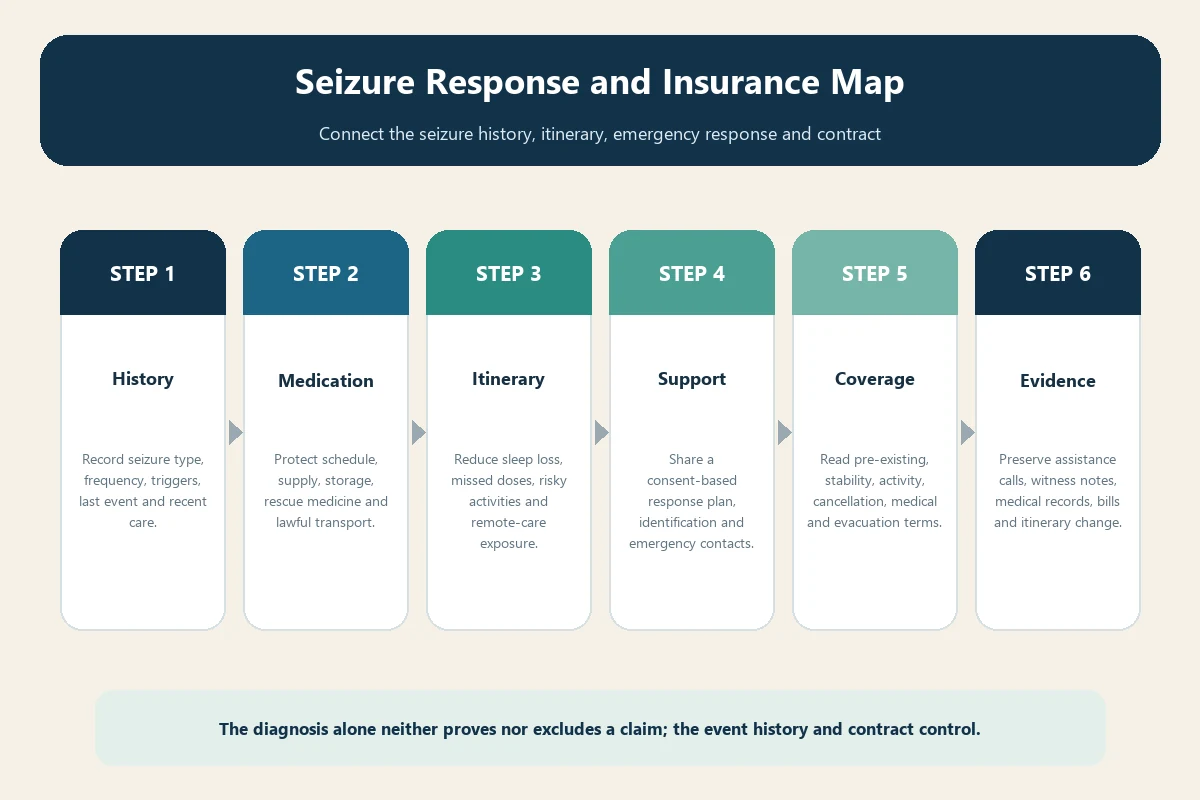
Record the diagnosis, seizure type, date of last event, frequency, known pattern, injuries, emergency visits, hospitalization, tests, medication, dose changes, side effects, rescue treatment, and clinician follow-up. A seizure-free period is relevant, but the policy defines how far it looks back and what care counts.
If seizures are new or unexplained, the clinical team must assess the cause and travel readiness. Do not book a remote or nonrefundable trip while urgent evaluation is incomplete.
Clinical clearance for the itinerary
Ask the neurologist how the flight duration, time zones, sleep disruption, altitude, heat, flashing environments, alcohol, illness, cruise, swimming, and planned activities relate to the individual. The clinician should decide medicine timing, rescue treatment, activity restrictions, and when emergency care is required.
An insurer’s quote is not medical permission. Share the actual route, not just the destination country.
Pre-existing-condition definition
Epilepsy, prior seizures, and treatment are known before purchase. The policy’s look-back period can include symptoms, diagnosis, testing, prescriptions, dose changes, rescue medicine, emergency care, and hospitalization. A later seizure can be treated as related even when it occurs in a new location.
Use the senior pre-existing-condition questions to compare the medical timeline with the certificate. Ask for the insurer’s answer in writing.
Waiver requirements
A waiver may remove the pre-existing-condition exclusion when the policy is bought within the required time after the initial trip payment and other conditions are satisfied. Some plans also require medical ability to travel at purchase.
The waiver does not cover planned neurologic care, make an excluded activity eligible, or guarantee evacuation home. Other benefits and documentation requirements still apply.
Medication supply
Arrange an adequate U.S.-dispensed supply for the door-to-door trip plus a permitted disruption buffer. Keep original labels, generic names, strengths, schedule, prescriber, pharmacy, and storage instructions. Split supplies only if both portions remain lawful, labeled, and usable.
Medicare Part D generally does not cover retail prescriptions bought outside the United States. The chronic medication travel guide helps plan refills and storage.
Time zones and sleep
The safe medicine schedule depends on the exact drug and dosing interval. Obtain a written plan showing home and destination times, departure and return, and what to do after a missed or delayed dose. Do not double or skip by intuition.
Sleep disruption can be relevant for some people with epilepsy. Build realistic rest into connections, red-eye flights, jet lag, cruises, and tours. Only the clinician should define the traveler’s threshold and response.
Rescue medicine
Some travelers carry prescribed rescue medicine. It can require specific storage, controlled-substance documents, trained administration, and emergency follow-up. Ask the prescriber who can give it, when, how, and what happens next.
Check destination and transit laws. Carry a clinician letter when recommended and keep the medicine accessible. A companion should not administer it without proper instruction and authorization.
Medical identification and seizure action plan
Carry a concise seizure action plan with diagnosis, baseline event description, usual duration, medicine, allergies, rescue steps, emergency thresholds, clinician, and contact. A medical identification bracelet or card can help first responders.
Translate key information for the destination when useful. Protect privacy while making urgent facts accessible.
Airport screening
Medicines, liquids, devices, and batteries follow TSA and foreign security rules. Tell the officer about medical supplies and request available accommodations. A vagus nerve stimulator, responsive neurostimulation system, or other implanted device requires manufacturer-specific screening guidance and an identification card.
Allow extra time and contact the return airport. Do not place all essential medicine or device components in checked baggage.
Traveling alone or with a companion
The traveler, clinician, and family should decide whether independent travel is appropriate. Consider medicine management, warning signs, recovery time, communication, navigation, rescue medicine, and the ability to call local emergency services.
Our senior solo travel insurance guide provides check-in and communication planning. Verify whether the policy pays a companion’s stay or return after hospitalization.
Activities and water safety
Swimming, boating, bathing, heights, cycling, skiing, driving, and adventure activities can have individual clinical restrictions and insurance exclusions. The clinician decides safety; the policy decides coverage. A paid activity rider does not override medical advice.
Ask whether the operator has an emergency plan and whether a trained companion is required. Identify the route to medical care.
Original Medicare abroad
Original Medicare generally does not cover health care outside the United States except for narrow foreign hospital and cruise situations. A seizure during an ordinary overseas trip generally needs another payer.
Medicare Advantage or Medigap may add limited foreign emergency benefits. Verify ambulance, hospital, physician, post-stabilization, and evacuation separately.
Emergency medical coverage
A travel medical policy may cover eligible emergency evaluation and treatment, subject to pre-existing-condition rules, deductible, coinsurance, maximum, exclusions, and coordination. Ask how ambulance, emergency department, imaging, laboratory testing, admission, medicines, and follow-up are handled.
A routine neurologist visit or planned diagnostic test is different from an unexpected seizure emergency. Ask when the emergency is considered stabilized.
Direct billing and payment
A foreign hospital can require a deposit. Assistance may locate an appropriate facility, guarantee payment for an eligible claim, or only provide a referral. Use the direct-billing guide to understand the difference.
Keep the ambulance record, witness account, seizure timeline, clinician notes, itemized bills, proof of payment, diagnostic results, medicine administered, and discharge instructions.
Trip cancellation
Cancellation may apply when a covered medical change makes the traveler unable to depart. A seizure, medicine change, injury, or test result can be reviewed under the pre-existing-condition, waiver, and medical-ability provisions.
Keep the initial trip deposit, policy purchase date, clinician record, supplier refund, and nonrefundable balance. A general fear of recurrence is not automatically a covered reason.
Trip delay
A delay can disrupt sleep, medicine timing, meals, and companion support. The delay benefit may reimburse eligible expenses only after a specified trigger, while the health plan must function immediately.
Carry the medicine buffer and written timing plan. Save the carrier notice, changed itinerary, lodging and meal receipts, and any medical records.
Trip interruption
Interruption can address eligible unused arrangements and additional transport after a covered event. A companion’s expenses, new ticket, extended hotel, and unused tour can follow separate limits. Ask who must authorize the return.
Medical evacuation
Evacuation may be authorized when local care is inadequate. The endpoint is generally the nearest appropriate facility, not home. A seizure requiring intensive neurologic care can lead to a transfer decision, but the insurer and medical teams apply necessity, stability, transport, and receiving-facility rules.
Use the evacuation approval guide and the evacuation claim checklist.
Five-scenario rehearsal
- Medicine delayed in checked luggage: use carried supply and the licensed replacement path.
- Red-eye connection is cancelled: preserve sleep and dosing under the clinician’s plan.
- Seizure on an aircraft: the companion follows the action plan and crew instructions.
- Event during an excursion: call local emergency services and document the operator response.
- Hospital recommends transfer: coordinate assistance and receiving-facility acceptance.
Document packet
- Diagnosis and seizure history summary
- Medication, rescue medicine, allergy, and schedule
- Neurologist, pharmacy, and device-manufacturer contacts
- Seizure action plan and medical identification
- Implanted-device card and screening instructions
- Clinical clearance and activity restrictions
- Companion training and communication authorization
- Destination hospitals and assistance contacts
- Travel policy and Medicare-related documents
- Trip payments, refunds, and claim records
Questions for the insurer
- How do seizure history, testing, medicine, and recent care fit the pre-existing-condition definition?
- Is a waiver available and valid?
- What medical-ability requirement applies?
- Would a seizure-related emergency be eligible?
- Are routine neurology and diagnostics excluded?
- How are high-risk activities treated?
- Can assistance arrange direct payment?
- Does interruption cover a companion?
- What evacuation endpoint and authorization apply?
- Which records and deadlines control the claim?
FAQ
Can a senior with epilepsy buy travel insurance?
Often, yes, but availability and coverage depend on recent seizures, treatment, age, destination, and the policy.
Must epilepsy be declared?
Answer all application health questions accurately, including seizures, medication, testing, treatment, or hospitalization when asked.
Will a seizure abroad be covered?
It may be if the medical event is otherwise covered and the pre-existing-condition exclusion does not apply or is validly waived.
Will evacuation fly the traveler home?
Not necessarily. Most benefits use the nearest appropriate facility unless the contract explicitly provides another endpoint.
Bottom line
Travel insurance for epilepsy starts with the seizure and medication plan. Document recent events, protect sleep and dosing, carry rescue instructions, choose appropriate activities, and identify destination care. Then test the policy’s pre-existing-condition, delay, cancellation, emergency, interruption, companion, and evacuation rules. Keep written confirmations with the action plan so a companion can find the correct insurer, clinician, and emergency contacts without searching during a crisis.