

Europe travel insurance for shoulder season should be chosen from the trip’s weakest spring or fall connection, not from the promise of lower prices. Check seasonal timetables, nonrefundable rates, weather definitions, delay waiting periods and the cost of reaching the next usable route. “Shoulder season” is a planning label; it is not a covered event by itself.
Key takeaways
- Shoulder-season dates vary by country, region, route and activity.
- A cheaper trip can still have a high nonrefundable loss.
- Reduced ferry, rail or flight frequency can make one missed service expensive.
- Weather must produce a covered effect; an unfavorable forecast is not enough.
- Carrier refunds, rerouting and credits reduce the insurance claim.
Define shoulder season for the actual itinerary
Travel guides often use shoulder season to describe periods between a destination’s busiest and quietest months, commonly in spring or fall. That shorthand is too broad for insurance. A city route, Mediterranean island, Alpine pass and northern ferry can have different operating calendars on the same date.
Create one operating-calendar record for every destination and transport segment:
- published timetable and its effective dates;
- last service of the day and last service of the season;
- backup carrier or route;
- hotel and attraction opening dates;
- road, pass or trail restrictions;
- ticket refund and change rules; and
- the next safe place to wait overnight.
Save copies rather than relying on a planning app to remain current. A schedule change announced before policy purchase is different from a later unforeseen disruption.
Measure the loss, not the discount
Shoulder-season savings often come from advance-purchase fares and restricted hotel rates. Lower price does not mean lower exposure. A $900 nonrefundable itinerary creates more cancellation risk than a $1,200 booking that remains fully refundable.
For every payment, record:
| Record | Question | Why it matters |
|---|---|---|
| Cash paid | How much has cleared? | Establishes the documented transaction |
| Refundable amount | What would return today? | Separates recoverable value from current exposure |
| Penalty date | When does more become nonrefundable? | Shows when insured trip cost may need updating |
| Supplier credit | Is it transferable, expiring or restricted? | May reduce the eligible loss under policy wording |
| Replacement cost | What would the next viable route cost? | Tests whether delay and interruption limits are practical |
Use the Europe trip insurance checklist to update the declared cost as cancellation penalties increase. Do not insure a refundable booking simply because its headline price is large.
Find the timetable bottleneck
The key shoulder-season risk is often frequency, not distance. A route with six summer departures may have one spring or fall departure. Missing it can require an extra night, a taxi to another port or a completely different sequence of tickets.
Mark every segment that has:
- only one practical departure that day;
- a same-day final connection;
- a separate ticket with no protected transfer;
- a seasonal end date close to the trip;
- limited weekend operation; or
- no accessible replacement for a traveler’s needs.
Then price the fallback. Our Europe train travel insurance guide explains through-tickets, separate tickets and missed connections. For sea routes, the Europe ferry insurance guide separates operator obligations from insurance benefits.
Translate weather into a policy trigger
Cooler temperatures, ordinary rain or a forecast that makes sightseeing less attractive do not automatically trigger cancellation. The relevant question is what the weather causes and whether that effect matches a covered reason.
Examples of potentially relevant effects include a common carrier being delayed, the traveler’s lodging becoming uninhabitable, an authority closing a route or a physician documenting a covered illness or injury. Each benefit uses its own definitions, minimum delay and proof requirements.
Check the certificate for severe weather, natural disaster, mandatory evacuation, uninhabitable accommodation and common-carrier terms. The weather-delay coverage guide shows why a named effect and timeline matter more than the storm label.
Use passenger rights before insurance
When a carrier cancels or delays service, ask it for the remedy required by the ticket and applicable law before buying a replacement. For eligible US flights, the U.S. Department of Transportation refund guidance explains when a passenger is entitled to a refund after cancellation or significant change.
For European travel, the European Commission’s air passenger-rights portal and rail passenger-rights page provide the current framework and claim routes. The exact remedy depends on mode, ticket, jurisdiction and circumstances.
Weather can affect whether standardized compensation is payable, but it does not mean travelers should skip the carrier process. Refund, rerouting, care and insurance are separate questions. Document what the carrier offered, what was accepted and what loss remained.
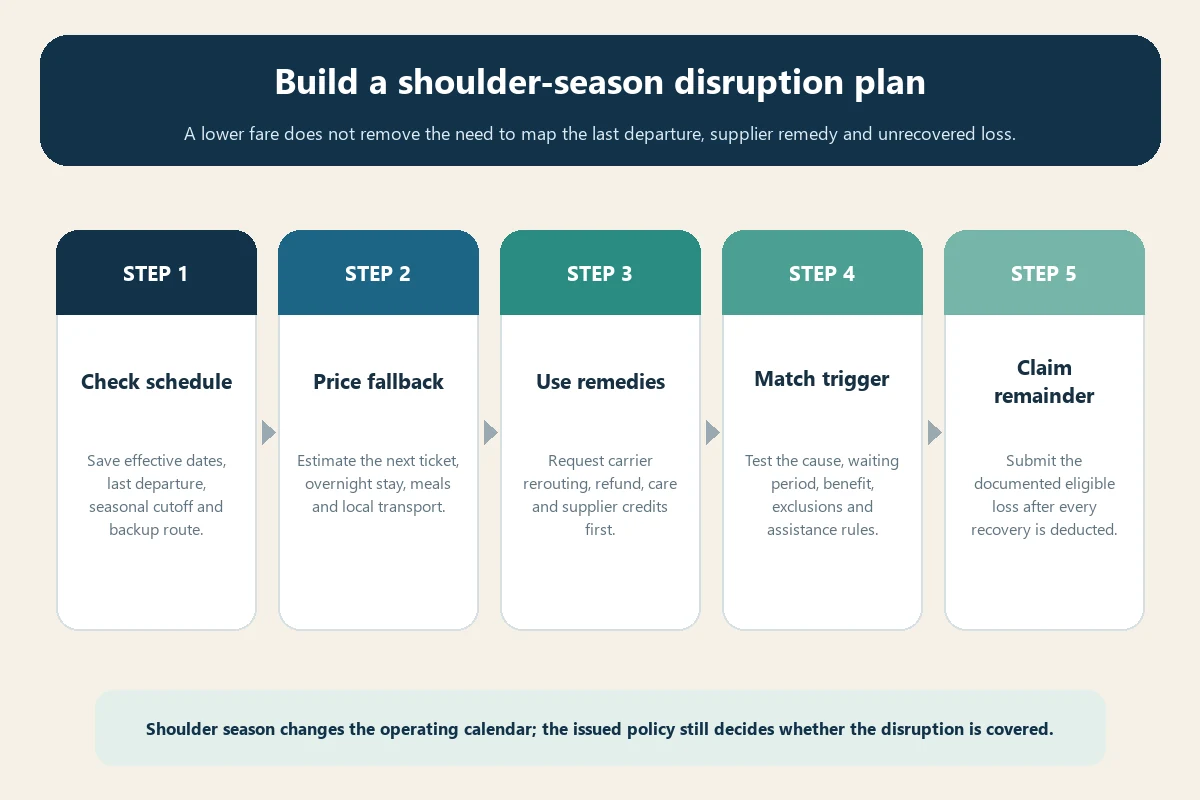
Size trip-delay benefits around the next departure
A delay benefit with an appealing headline limit can still be poorly matched if the waiting period is longer than the disruption or the daily cap cannot cover local lodging. Compare:
- the minimum qualifying delay;
- covered causes;
- per-day and total limits;
- eligible meals, lodging and local transport;
- whether receipts are required; and
- whether the traveler must pursue the carrier first.
Price a realistic night near the missed station, airport or port for the actual dates. The trip delay reimbursement guide provides a worksheet for waiting periods and expense limits.
Check strikes by announcement date and definition
Spring and fall travel plans may intersect with labor action, but the season does not determine coverage. Policies differ on whether a strike is covered, how it is defined and whether the event was known when the policy was bought.
Record the policy purchase date, first public announcement, affected carrier, scheduled service and alternatives offered. If a strike was already announced, it may no longer be unforeseen. Do not assume a general “travel disruption” label overrides the certificate.
If changing routes creates separate tickets, map the protection gap before paying. The separate-ticket missed-connection guide explains why one delayed operator may have no responsibility for the next booking.
Audit roads, mountain routes and coastal links
A shoulder-season road trip can cross regions with different tire, equipment, pass and ferry requirements. Ask the rental company which routes are permitted and whether the vehicle is equipped for the dates. Insurance for the trip does not replace the rental agreement or automobile liability coverage.
Build buffers around mountain passes, island ferries and rural fuel or charging stops. A voluntary detour or unsuitable vehicle is different from a covered closure. The Europe road-trip insurance guide separates travel-policy benefits from vehicle risks.
Do not reduce medical limits because crowds are lower
The season and trip price do not cap the cost of illness, injury or medically necessary transportation. Compare emergency medical, evacuation and repatriation benefits independently from the cancellation amount.
The U.S. Department of State recommends considering travel health and medical evacuation insurance because US health coverage may not apply abroad. Confirm the geographic territory, assistance process, pre-existing-condition terms and whether remote destinations change the evacuation plan.
Also review country-specific exclusions and advisory wording. Our Europe country-exclusions guide provides a destination-by-destination check.
Example: a fall city-and-island itinerary
A traveler flies from Boston to Rome, takes a train south and plans a ferry to an island. The transatlantic ticket operates daily, but the selected ferry has one departure on the travel date. The island hotel is nonrefundable and the next ferry is the following afternoon.
The insurance comparison should not start with “fall weather.” It should start with the single ferry departure. The traveler records the ferry refund rule, alternate port, one-night mainland hotel cost, taxi or rail cost to the alternate port and the policy’s delay trigger.
If the ferry is canceled, the traveler first asks the operator for rerouting or refund. A claim file then shows the cancellation notice, operator response, unused hotel amount and reasonable additional expenses. The insurer decides the remainder under the issued certificate.
Keep a shoulder-season evidence folder
- dated transport timetables and service calendars;
- fare, hotel and tour cancellation rules;
- policy schedule and full certificate;
- official weather or closure notice;
- carrier delay or cancellation confirmation;
- refund, rerouting and credit correspondence;
- receipts for reasonable replacement costs; and
- a single timeline linking cause, response and remaining loss.
Frequently asked questions
Is shoulder season automatically covered by travel insurance?
No. It is a travel-planning term, not an insured event. Coverage depends on a listed cause, benefit conditions, eligible loss and evidence.
Should I buy higher delay coverage for spring or fall?
Choose limits from the cost and timing of the next viable departure. A less frequent route may justify more room for lodging and replacement transport, regardless of season.
Can I cancel because the forecast is rainy?
Standard cancellation generally does not cover an undesirable forecast alone. Review the exact covered reasons and any optional flexibility benefit.
Does the airline pay before travel insurance?
Pursue refunds, rerouting and other carrier remedies first. Insurance evaluates the eligible, unrecovered loss under its own terms.
