

A travel insurance medication change can affect a pre existing condition review, but there is no universal rule that every prescription event resets coverage. The answer depends on the issued certificate, its anchor date, the medical events listed in its definition, any stated medication exceptions, and whether a waiver applies.
This U.S.-focused guide classifies medication events before testing them against policy wording. It is educational, not medical, legal, or coverage advice. Never postpone, stop, or alter necessary treatment to improve an insurance outcome.
Key takeaways
- Classify the event as a start, stop, dose change, drug switch, substitution, or routine refill.
- Record both the medical-event date and the policy’s exact anchor date.
- Do not assume a brand-to-generic substitution is ignored unless the certificate says so.
- Separate pre-existing-condition treatment from routine prescription expense and unrelated new illness.
- A waiver can remove one exclusion only after every stated condition is met.
Reviewed August 16, 2026. Travel insurance forms, endorsements, and state rules vary. The issued certificate controls.
Classify the medication event before reading the policy
Write down exactly what happened. “My medication changed” is too vague for a reliable policy review. The event might be a new prescription, a stopped drug, a higher or lower dose, a switch to a different active ingredient, a brand-to-generic substitution, or an ordinary refill with no clinical change.
That classification matters because certificates do not use identical wording. One form may mention any change in prescribed medication. Another may list an increase or decrease. A third may carve out a routine brand-to-generic substitution or certain adjustments to insulin or anticoagulants.
The chronic medication travel guide addresses supply, loss, flare-ups, and new prescriptions. This article stays focused on how the dated change interacts with pre-existing-condition language.
Use a seven-row medication matrix
Create seven rows and complete only those that apply. Record the old drug and dose, the new drug and dose, the prescriber’s reason, the effective date, related symptoms or tests, and the next planned review.
Starting a medication
A new drug may follow a new diagnosis, recurring symptoms, preventive treatment, or a trial while testing continues. The reason is as important as the prescription date. Preserve the visit note and the order rather than describing the event from memory.
Stopping a medication
A clinician may stop a drug because treatment finished, the condition improved, a side effect developed, or another drug will replace it. Stopping can still be a medication event under a broad definition. It is not automatically evidence that the underlying condition disappeared.
Increasing or decreasing a dose
Record whether the dose changed because symptoms worsened, laboratory values changed, a planned taper continued, or ordinary monitoring called for adjustment. A policy may treat these facts differently only if its wording creates that distinction.
Switching to another drug
A change in active ingredient can signal treatment response, side effects, availability, or insurer formulary rules. Save the clinical reason. A pharmacy receipt alone rarely explains why the switch occurred.
Brand-to-generic or generic-to-brand substitution
Some sample forms expressly address a change from a brand drug to a generic equivalent. Other forms do not. Do not import an exception from a competitor’s certificate. Find the clause in the form actually offered for your state.
Routine refill
A refill at the same dose may involve no clinical change. Yet a recent appointment, symptoms, laboratory test, or treatment recommendation can still matter independently. Review the entire medical encounter, not only the label on the bottle.
As-needed or rescue medicine
A newly issued rescue drug can reflect a change in symptoms even if the daily medication stayed the same. Record why it was prescribed and whether its use triggered follow-up advice.
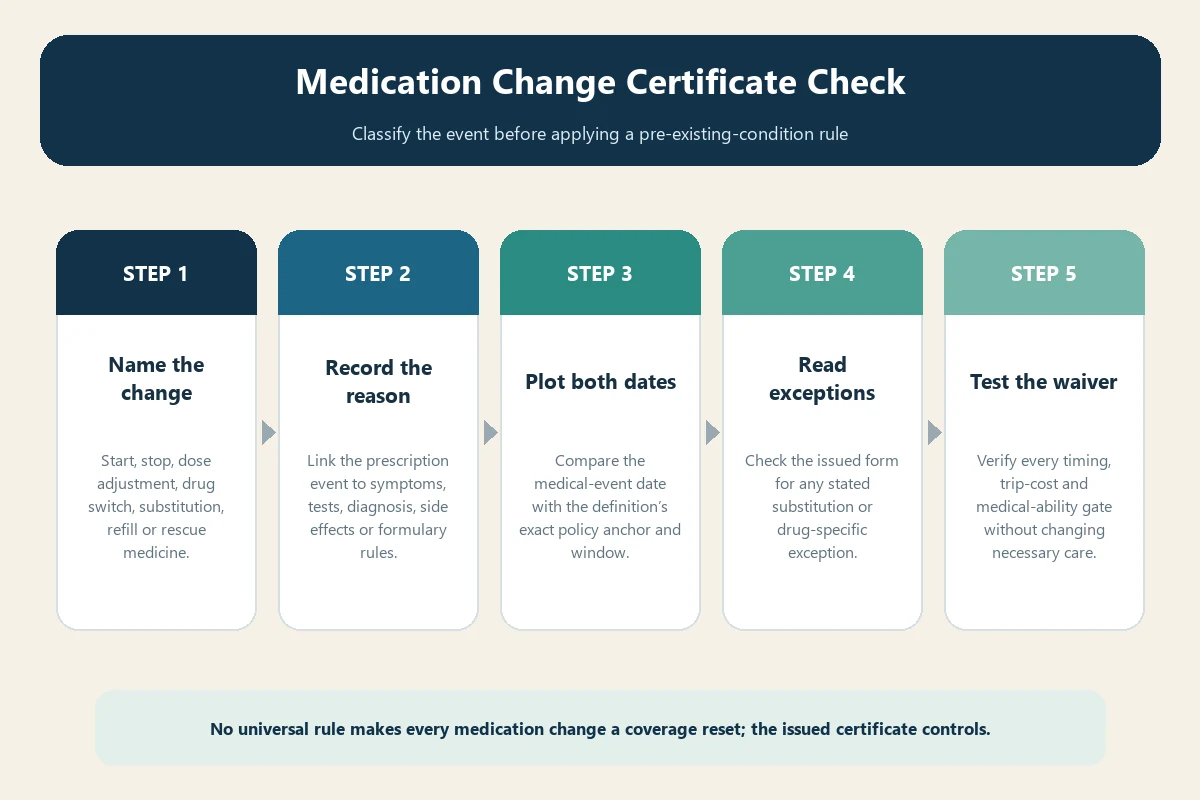
Build a two-date worksheet
The first date is the medical event: when the clinician ordered the change, when the prescription became effective, or when treatment was recommended. The second is the policy’s anchor date. Depending on the benefit and form, that date may be purchase, the coverage effective date, initial trip payment, or scheduled departure.
Do not choose the anchor date yourself. Copy it from the definition. Then count backward by the exact number of days in the certificate. The pre-existing condition look-back guide explains this calculation.
For example, imagine a dose changed on March 8 and the relevant policy definition looks back 60 days from purchase on April 20. The change falls inside that window. That establishes only that a listed event occurred during the dates. It does not decide whether the definition applies, whether an exception exists, or whether a waiver removes the exclusion.
Read the definition word by word
Search the certificate for “pre-existing condition,” “prescribed medication,” “treatment,” “medical advice,” “symptoms,” and “look-back.” Then follow every cross-reference and endorsement. An exclusion summary is not a substitute for the operative definition.
A current Travel Guard Minnesota sample form illustrates why exact text matters. Its rider-specific definition addresses treatment and medication changes and includes stated exceptions. The sample certificate is useful as an example, not as evidence of what another plan covers.
Likewise, Allianz publishes an explanation of pre-existing-condition coverage and waiver conditions. Its consumer guide reinforces the need to meet the selected plan’s requirements. Neither source replaces the purchaser’s issued state form.
Do not turn “stable” into a universal rule
People often say a condition is stable when symptoms feel controlled. A clinician may also use “stable” in a medical sense. Insurance language can apply a narrower defined test, a look-back definition, or a medically-able-to-travel requirement.
Use the stability-period comparison to keep those mechanisms separate. A dose change does not automatically restart a market-wide clock because no such single clock governs every U.S. plan.
Separate the medication change from its cause
The prescription event and the underlying medical facts are related but distinct. A change caused by new chest pain presents different records than a substitution caused by a pharmacy formulary. A lower dose after a side effect differs from an unchanged refill after routine monitoring.
Build three lines in the file: symptom or diagnosis, clinical decision, and prescription event. Include dates for all three. This prevents the medication label from hiding a relevant test, recommendation, or symptom that the policy names separately.
Test the waiver as a separate gate
A pre-existing-condition waiver may remove the exclusion from specified benefits when every requirement is met. Common conditions can include buying within a time-sensitive period, insuring required trip costs, being medically able to travel, and updating coverage after later trip payments.
The waiver eligibility checklist turns those conditions into an evidence file. A waiver does not erase general exclusions, create reimbursement for ordinary maintenance drugs, or make planned treatment an unexpected emergency.
The National Association of Insurance Commissioners advises consumers to compare exclusions, limits, and the conditions of a travel policy. Its current travel insurance overview is a useful baseline before comparing plan-specific forms.
Ask whether you were medically able to travel
Some time-sensitive waiver language requires the insured to be medically able to travel when the plan is purchased. A prescription change does not answer that question alone. Physician restrictions, uncontrolled symptoms, planned procedures, and the demands of the itinerary may all be relevant.
Ask the treating clinician for medical guidance about the trip. Then ask the insurer how its certificate applies. A doctor’s clearance is valuable evidence, but it cannot amend a contract or guarantee payment.
Routine medication cost follows another path
Even when an exclusion is waived, medicine the traveler already expects to use may remain an ordinary maintenance expense. A waiver of a pre-existing-condition exclusion is not the same as a prescription benefit for routine refills.
The prescription medication coverage guide separates ongoing supply, new prescriptions for an eligible illness, replacement after loss, and benefit sublimits. Keep those invoices separate.
An unrelated new illness still needs a full claim test
Suppose blood-pressure medication changed before purchase, then the traveler breaks an ankle abroad. The ankle is medically unrelated, but the claim must still fit the emergency medical benefit, exclusions, deductible, authorization rules, and documentation requirements.
Do not promise that every unrelated event is covered. Instead, read the travel medical benefits guide, then test the actual accident against the issued certificate.
Distinguish side effects from the original condition
A side effect can produce a new symptom, another prescription, a test, or hospitalization. The medical record should identify the suspected cause and the clinician’s assessment. Do not label a side effect “unrelated” without support.
If treatment continues during the trip, the continuation-of-treatment guide explains why planned follow-up, recurrence, complications, and care after a new event require separate analysis.
Build a medication evidence packet
Keep the issued certificate and endorsements, prescription history, medication reconciliation, relevant visit notes, test orders and results, pharmacy labels, and a dated clinician statement. The statement should describe facts, not make an insurance promise.
Add the trip invoice, initial payment record, policy receipt, later trip-cost payments, and every written answer from the insurer. For a claim, retain itemized bills, proof of payment, diagnosis, treatment notes, and assistance-center communications.
The travel insurance claim guide provides a submission ledger. Never ask a clinician or pharmacy to omit the earlier condition or change a date.
Ask the insurer eight precise questions
- What date anchors the pre-existing-condition definition for this benefit?
- Does the definition list starting, stopping, increasing, decreasing, or switching prescribed medication?
- Is a routine refill with no dose change treated as a medication change?
- Does this form contain a brand-to-generic or drug-specific exception?
- Do the related symptoms, tests, or medical advice matter independently?
- Is a waiver available, and what continuing conditions must be met?
- Does the waiver affect routine medicine or planned care?
- Which records would be required if the condition caused cancellation or treatment abroad?
Send the exact drug event, dates, state of residence, plan name, and form number. Request a written response and save it with the quote. If the answer conflicts with the certificate, ask for the clause and clarification before buying.
Make the coverage decision without changing care
Complete the seven-row matrix, calculate the exact policy window, and test the waiver independently. Then decide whether the plan’s remaining exclusions and limits match the trip’s financial risk.
The safest conclusion may be that the plan can still protect some unrelated risks while the recent condition remains excluded. It may also be that another eligible form offers a waiver. In every case, follow medical advice first. Insurance planning must adapt to necessary care, never the reverse.
The CDC Yellow Book advises travelers to verify overseas health coverage and understand exclusions before departure. Review its current travel insurance guidance, then rely on the certificate issued for the actual purchase.
Feeling stable and meeting a policy definition are different tests. Use the travel insurance controlled condition guide to compare symptoms, treatment, medication events, look-back wording and waiver requirements.
No diagnosis does not always mean no look-back facts. Use the travel insurance undiagnosed condition guide to classify symptoms, pending tests, medical advice, treatment and later diagnoses under a U.S. certificate.
Traveling with several medicines is a system problem: every prescription, prescriber, refill, time zone, storage rule, interaction, and backup must align. Use this senior multiple-medication travel insurance guide to plan continuity, pre-existing conditions, emergencies, and claims.
