

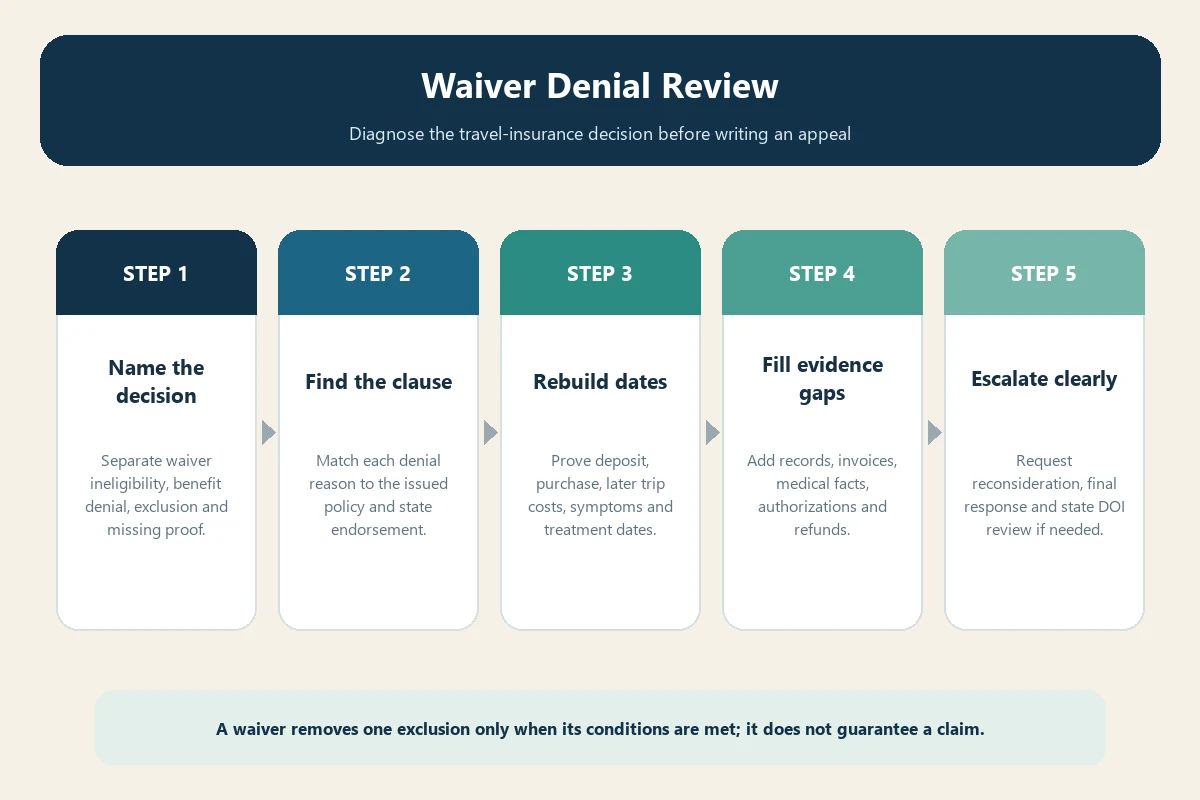
If a pre existing condition waiver is denied, first confirm that the notice concerns a travel-insurance exclusion waiver—not enrollment in U.S. health insurance. Then identify the exact decision: the insurer may say the waiver never became effective, the condition was outside its scope, another exclusion applies, or the claim lacks proof. Each path requires different evidence.
This guide is educational, not medical, insurance, or legal advice. It cannot determine whether a claim is payable. Travel-insurance forms, deadlines, review rights, and complaint procedures vary by plan and state; the issued policy, schedule, declarations, endorsements, and written decision control.
Key takeaways
- Demand the policy clause and factual reason behind the decision.
- Separate waiver eligibility from the underlying benefit claim.
- Rebuild the deposit, purchase, trip-cost, and medical timeline.
- Ask for reconsideration with indexed evidence, not a general complaint letter.
- If the insurer’s final response remains disputed, contact the traveler’s state insurance department.
Reviewed August 16, 2026. Do not send original medical or financial documents; submit copies through the insurer’s secure channel and keep delivery proof.
First identify what was actually denied
A “waiver denied” notice can describe at least four different decisions. The insurer may find that the traveler failed a waiver condition. It may accept the waiver but deny a benefit for another exclusion. It may dispute that the medical event caused the loss. Or it may pause or close the claim because records are missing.
Ask for a written explanation that lists the policy form, page, provision, facts, and missing documents. The broader travel-insurance claim-denial guide covers other benefit failures; this page stays focused on the pre-existing-condition waiver.
This is not the ACA health-insurance rule
Google results for this phrase frequently discuss Affordable Care Act health plans. Those rules address enrollment and health coverage, not a temporary travel policy’s contractual waiver of a pre-existing-condition exclusion. Treating the two as interchangeable can produce a useless appeal.
In the letter, identify the product as travel insurance, name the underwriting insurer, and attach the certificate issued for the traveler’s state. Avoid arguments about unrelated health-plan protections unless qualified counsel or the regulator says they apply.
Reason 1: The policy was purchased too late
Many waivers are time-sensitive. The insurer may count from the first trip payment or deposit, not final payment or departure. The dispute often turns on one definition and two receipts.
Make a dated list of the first quote, first supplier payment, insurance purchase, and policy delivery. Include a receipt showing whether the initial amount was paid, credited, refunded, or transferred. The waiver purchase-deadline guide explains how to locate day zero without assuming that “nonrefundable” appears in the definition.
Reason 2: Not all required trip costs were insured
A policy may require coverage equal to all prepaid nonrefundable trip payments or all cancellation penalties. A later airline ticket, cabin upgrade, excursion, hotel, or final payment can create an update duty. Missing the update period can end waiver eligibility in some forms.
A current, state-specific Travel Guard policy example requires coverage of all cancellation penalties and timely updates for subsequent arrangements. It is an example only. Compare its logic with the actual form, then use the full-trip-cost guide to build a supplier ledger.
Reason 3: The traveler was not medically able to travel
Some waivers require the insured traveler—or every insured traveler—to be medically able to travel on the purchase date. A pending procedure, recent hospitalization, physician restriction, or known need for treatment may become relevant, depending on the definition and facts.
Do not ask a clinician to interpret insurance language. Request dated records describing symptoms, diagnosis, restrictions, planned care, and clinical status. The medically-able-to-travel guide shows how to separate medical evidence from the insurer’s contract decision.
Reason 4: The event falls outside the waiver’s scope
A waiver usually removes a named pre-existing-medical-condition exclusion from applicable coverages. It does not erase every general exclusion, create a new covered reason, or guarantee a benefit. Planned treatment, travel for medical care, travel against physician advice, an uncovered activity, intoxication, or another excluded cause may still be disputed.
Travel Guard’s waiver guidance describes the feature as removal of the exclusion from applicable coverages when conditions are met. Allianz likewise explains in its existing-condition guidance that the plan’s requirements must be satisfied. Marketing examples do not replace the policy.
Reason 5: The wrong person or condition is being analyzed
The medical event may involve the insured traveler, a traveling companion, a non-traveling relative, a business partner, or another defined person. The waiver can apply differently depending on the benefit and the person whose condition caused the loss.
Copy the definitions of insured, traveling companion, family member, and covered reason. Connect the affected person to the cancellation, interruption, medical expense, or evacuation claim with records and relationship proof. Do not submit an entire family’s medical history when only a limited file is relevant.
Reason 6: The medical timeline supports the exclusion
If the waiver was not effective, the insurer may analyze symptoms, examinations, treatment, recommendations, or medication changes during the look-back period. A formal diagnosis after purchase does not necessarily end the analysis if symptoms existed earlier.
Use the look-back examples to create a neutral chronology. List dates and source records without editing the clinical story to improve coverage. Accuracy is more persuasive than selective disclosure.
Reason 7: The claim file is incomplete
A waiver dispute can be a document problem rather than a final coverage conclusion. The administrator may need the policy purchase receipt, initial deposit proof, complete trip-cost ledger, attending-physician statement, prior records, itemized bills, supplier refunds, or proof of loss.
The pre-existing-condition claim-document guide groups evidence by question. Ask which items remain outstanding, the accepted format, secure delivery method, response deadline, and whether the file is open while documents are collected.
Build a clause-to-evidence matrix
| Decision point | Policy text to copy | Evidence to attach |
|---|---|---|
| Purchase timing | Time-sensitive period and initial-payment definition | Supplier receipt and policy purchase confirmation |
| Trip cost | Required insured amount and update deadline | Cost ledger, invoices, refunds, update confirmations |
| Medical ability | Who must be able to travel and on what date | Dated clinical facts and travel restrictions |
| Look-back | Period and symptom/treatment/medication triggers | Relevant records in chronological order |
| Benefit scope | Covered reason, waiver reach, and remaining exclusions | Loss, causation, expense, and authorization proof |
Use one row for every stated denial reason. If the decision letter does not name a clause, request it. A reviewer should be able to follow the file without guessing which document proves which condition.
Write a focused reconsideration request
- Identify the insured, policy, claim, trip, and date of decision.
- Quote each stated reason accurately and briefly.
- Quote the relevant policy language with page numbers.
- State the timeline in dated, verifiable facts.
- Index each supporting document to a waiver condition.
- Explain the requested correction without overstating coverage.
- Ask for a written decision and every remaining reason.
Do not lead with anger, a long travel narrative, or an unsupported statement that a representative “guaranteed” coverage. If a sales call matters, request the recording or notes and provide the date, time, phone number, and name used.
Preserve communications and deadlines
Keep a log of calls, portal messages, emails, uploads, certified mail, and responses. Save the full web confirmation and policy version, not only screenshots of a summary. Record appeal or reconsideration deadlines exactly as written.
If more time is needed to obtain medical records, request an extension in writing before the deadline. Do not assume an open phone discussion stops a contractual or statutory clock.
When to contact the state insurance department
Try to resolve the issue with the insurer first unless urgency or state instructions say otherwise. If the final response remains disputed, the traveler’s state department of insurance can explain its complaint process and review whether the company followed the policy and applicable rules.
The NAIC’s official complaint guidance recommends gathering the policy number, bills, records, communications, a factual timeline, policy language, and the desired outcome. It links consumers to the correct state department. A regulator does not act as the traveler’s private attorney or guarantee payment.
Why clear disclosure matters
The NAIC’s 2025 travel-insurance market-conduct standard instructs reviewers to determine whether consumers receive information about pre-existing-condition exclusions, waiver availability, waiver circumstances, and policy definitions. Cite an actual disclosure gap precisely if one occurred; do not assume the standard itself decides the claim.
If the denial letter gives inconsistent reasons
List each version by date and ask the insurer to identify its complete final basis. Answer every preserved reason, but do not guess at a new one. A clear final explanation matters for reconsideration, deadlines, and any later regulator review.
Bottom line
When a pre existing condition waiver is denied in travel insurance, diagnose the decision before challenging it. Identify the clause, rebuild purchase and medical dates, prove every trip-cost update, separate the waiver from the underlying benefit, and submit a clause-to-evidence matrix. If a focused reconsideration fails, preserve the final response and take the same clean record to the appropriate state insurance department.