
Travel insurance flight diversion coverage depends on what the diversion becomes. An aircraft may land at an alternate airport, refuel, and continue. It may remain on the ground, deplane passengers, use buses, cause an overnight delay, break a connection, or end in cancellation. Each outcome can activate a different airline obligation or policy benefit.
This U.S. guide explains how to document the diversion, identify the insured trigger, protect passenger remedies, and calculate the remaining loss. It is educational, not legal or insurance advice.
A diversion is not automatically a covered reason
A diversion describes where the aircraft landed, not why the policy must pay. Travel insurance may respond through trip delay, missed connection, trip interruption, baggage delay, emergency medical, or another benefit, depending on the cause and consequences.
Read the certificate’s definitions of common carrier, covered hazard, delay, interruption, destination, scheduled arrival, missed connection, reasonable expense, and proof of loss. Do not submit “flight diverted” as the entire coverage explanation.
Record the operating facts immediately
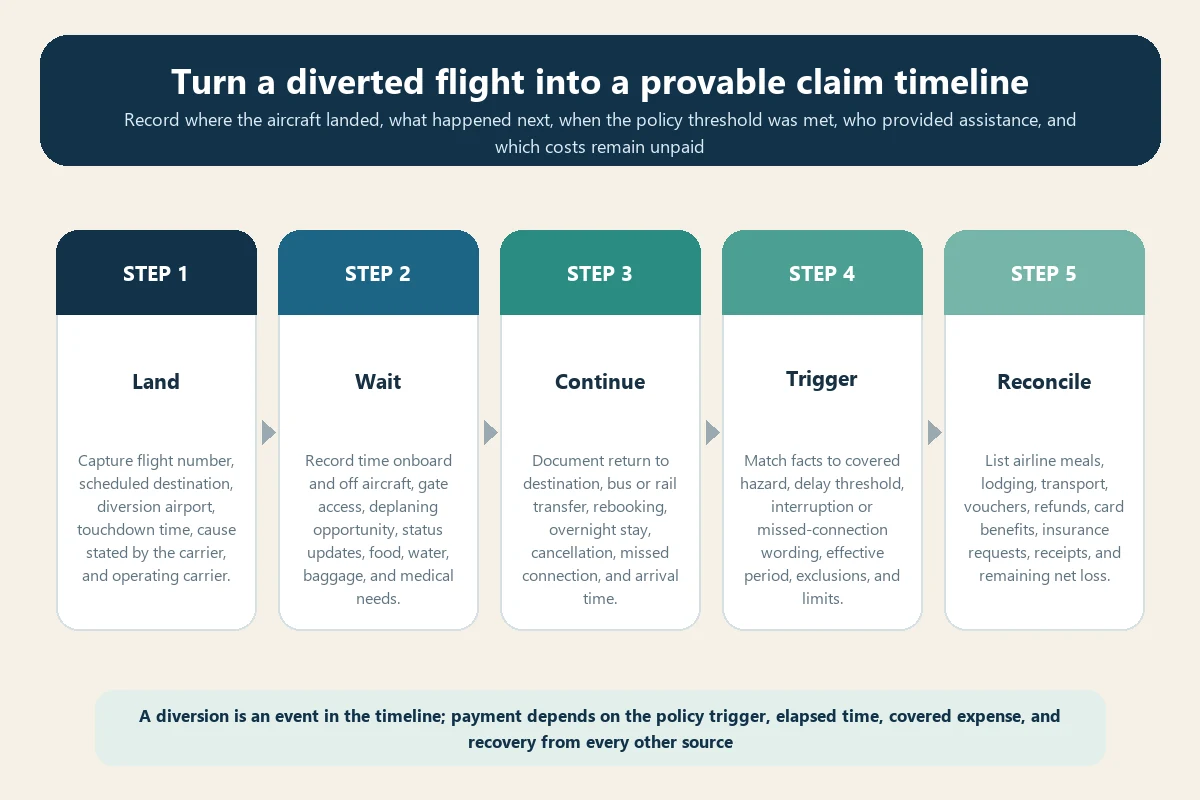
Save the flight number, date, scheduled origin and destination, operating carrier, marketing carrier, aircraft registration if available, alternate airport, touchdown time, gate time, and final arrival. Screenshot the airline app before details change.
Write down the reason announced onboard and later stated in writing. Weather, air-traffic control, medical emergency, security, airport closure, mechanical trouble, crew limits, fuel, and staffing can lead to different carrier support and policy analysis.
Build one continuous timeline
Begin with scheduled departure and arrival. Add actual departure, diversion announcement, alternate-airport landing, gate arrival, first opportunity to deplane, reboarding, substitute ground transport, onward departure, and final arrival.
Use time zones explicitly. A six-hour threshold cannot be proved by mixing local times. Preserve app notifications, emails, boarding passes, photographs of airport boards, location-stamped receipts, and written carrier verification.
Understand why the flight diverted
The FAA’s weather-delay explanation describes how thunderstorms can force aircraft to hold, divert to alternate airports, wait, refuel, and later continue. The operational reason matters because many policies list specific hazards rather than every disruption.
Request a delay or irregular-operations statement from the operating carrier. If it gives only a generic code, ask what the code means and whether the cause changed during the event.
Measure delay from the policy’s chosen points
A policy may measure from scheduled departure, scheduled arrival, common-carrier delay, or the time a covered hazard begins. The clock may stop at the intended destination, the alternate airport, hotel placement, or resumption of travel.
Do not assume time airborne or time on the tarmac counts identically. Compare the exact provision with the timeline. Our flight-delay coverage guide explains waiting periods and per-day limits.
Separate a diversion from a cancellation
If the airline eventually carries the passenger to the ticketed destination, the original flight may remain completed but delayed. If the remaining segment is canceled, the passenger may receive a cancellation notice or be rebooked under a different flight number.
That classification affects refund rights and insurance evidence. Review our cancelled-flight guide, but preserve the diversion timeline even when the carrier later labels the flight canceled.
Know the U.S. tarmac protections at a diversion airport
The DOT defines a tarmac delay as time on the ground when passengers cannot get off. Its tarmac-delay guidance explains that U.S. rules apply at U.S. airports, includes food-and-water timing, status notifications, working toilets, cabin conditions, medical attention, and deplaning rules and exceptions.
Record when the aircraft landed, when the main door opened, and when passengers could actually leave. If an opportunity to deplane is offered, ask whether the flight may depart without passengers who exit and what will happen to checked bags.
Decide carefully before leaving the aircraft
At an unfamiliar diversion airport, deplaning can change the traveler’s position. The carrier may not promise reboarding, checked baggage may remain onboard, immigration or customs procedures may apply, and onward ground transport may be limited. A traveler with medication, disability equipment, a child, or a medical need should tell the crew before making the decision.
Ask whether leaving is optional or required, whether the aircraft will continue, how passengers will receive updates, where baggage will go, and what assistance is available landside. Photograph the gate or disembarkation notice and record the employee’s name. If the traveler leaves for safety or medical reasons, preserve the facts and supporting documentation rather than describing the choice simply as voluntary abandonment.
Ask the airline what it will provide
Airline support and insurance are separate. Ask the carrier to complete transportation to the destination, rebook connections, arrange a bus or hotel, provide meals, retrieve baggage, and confirm the disruption cause.
The DOT Airline Customer Service Dashboard summarizes participating airlines’ commitments for controllable cancellations and delays. Read the carrier’s current customer-service plan because commitments, eligibility, and limits can differ.
Do not assume every diversion creates a refund
The DOT’s refund guidance distinguishes canceled or significantly changed travel from a journey the consumer accepts and completes. A diversion followed by arrival at the intended destination does not automatically produce a full ticket refund.
Before abandoning the itinerary or buying replacement travel, ask the airline about its plan and the effect of declining transportation. Preserve the answer in writing when possible.
Handle a missed connection as a separate benefit
A diversion can break an onward connection even when the first ticket is eventually performed. Document the minimum connection time, original and revised arrival, boarding cutoff, connection departure, through-ticket status, and rebooking offered.
Some policies have a missed-connection benefit limited to specified trips or hazards. Others address the result under trip delay or interruption. Use our missed-connection insurance guide to keep the connection loss distinct.
Treat separate tickets cautiously
When the onward flight is on a separate ticket, the second carrier may treat the traveler as a no-show rather than a connecting passenger. The first airline may have no contractual duty to protect the second booking.
Insurance wording may require a scheduled connection, minimum time, or a common-carrier delay. Preserve both tickets, fare rules, baggage arrangements, and evidence that the planned connection was reasonable.
Classify each expense before spending
Potential expenses include meals, hotel, airport transfer, rail or bus travel, replacement airfare, calls, essential medication, baggage delivery, and unused prepaid arrangements. A policy may limit reasonable expenses, impose a waiting period, or exclude upgrades and convenience purchases.
Contact the assistance line when practical. Ask whether preauthorization is required, which benefit applies, and whether the insurer expects the airline to arrange service first. Keep itemized receipts and proof of payment.
Distinguish delay from trip interruption
Trip delay commonly reimburses necessary expenses while travel is temporarily delayed, subject to a threshold and cap. Trip interruption can address eligible unused arrangements and additional transportation when a covered reason causes the trip to end or materially change.
A traveler who arrives a day late may have delay expenses without an interruption loss. A traveler forced to abandon a tour may need separate calculations for meals, new transport, and unused land arrangements.
Document baggage custody
At the alternate airport, determine whether checked baggage remains onboard, is unloaded, transfers by truck, or must be collected. Record bag-tag numbers and obtain a report if the bag becomes unavailable after passengers deplane.
Do not buy an entire replacement wardrobe without reading the baggage-delay threshold and item limits. Save essential-purchase receipts and the time the bag was returned.
Handle medical diversions separately
If a traveler’s condition caused the diversion, airline operational costs, the patient’s local care, ambulance, hospital bills, onward travel, and interruption expenses are different categories. Notify the assistance company promptly when safe.
Preserve the onboard incident record, clinical documentation, medical necessity, invoices, other-insurance decisions, and fitness-to-fly advice. Do not assume the policy pays the airline’s diversion cost unless the contract expressly provides it.
Reconcile airline, card, and insurance recovery
Create one row per expense with date, vendor, purpose, amount, currency, payer, airline voucher, carrier reimbursement, card benefit, insurance request, and unpaid balance. A meal voucher should reduce the same meal expense, not an unrelated hotel loss.
Follow our supplier-refund and recovery guide. Disclose provisional or pending payments and update the claim when they become final.
Prepare a diversion evidence packet
- Original itinerary, ticket numbers, and operating carrier
- Scheduled destination and alternate airport
- Cause statements and every status notification
- Landing, gate, deplaning, onward, and arrival times with zones
- Airline rebooking, ground transport, hotel, meals, and vouchers
- Missed-connection and separate-ticket records
- Baggage custody and delivery evidence
- Itemized receipts and proof of payment
- Policy provision, threshold, limits, and assistance contacts
- Line-by-line recovery and net-loss ledger
Submit a provision-specific claim
Use our travel insurance claim guide to index the packet. State the benefit requested, quote the covered hazard, show exactly when the threshold was met, and connect every expense to the diversion’s consequences.
If denied, request the relied-on definition, exclusion, timeline, expense rule, and calculation. Correct factual errors with source documents rather than repeating that the flight was diverted.
Bottom line
Travel insurance flight diversion coverage is a consequence-and-contract question. Prove where and why the aircraft diverted, what happened after landing, when the policy trigger was satisfied, what the airline provided, and which reasonable expenses remain. The strongest claim is a synchronized timeline plus a transparent net-loss ledger.
A government shutdown, an FAA action, an airline cancellation, and an insured covered reason are distinct facts. Use this travel insurance government shutdown flight cancellation guide to preserve refund rights, test policy wording, document expenses, and calculate net loss.
A traveler-requested change, airline schedule change, involuntary downgrade, and insured trip interruption follow different rules. Use this travel insurance flight change coverage guide to compare refund rights, covered reasons, fees, fare differences, and net loss.
A prolonged wait onboard creates its own evidence timeline. Use this travel insurance tarmac delay coverage guide to track the DOT clock, preserve announcements, test the policy waiting period, document missed connections, and calculate net loss.
