
Travel insurance arbitration clickwrap agreement disputes begin with a basic formation question: did the online checkout give reasonably conspicuous notice of the terms and require an action that objectively manifested assent? A live terms page alone does not reconstruct what the traveler saw or did.
This U.S. consumer guide explains how to preserve the transaction, screen design, terms version, assent event, purchaser attribution, and amendment record. It is not legal advice.
Separate formation from the insurance merits
Formation asks whether the parties made an agreement. Scope asks whether the clause covers the dispute. Delegation asks who decides specified gateway issues. The merits ask whether policy benefits are owed.
Keep these questions in separate columns. Proof that a claim was denied does not prove assent, and proof of assent does not prove that an exclusion applies.
Identify every company in the transaction
A checkout can involve a booking platform, travel supplier, insurer, producer, claims administrator, payment processor, and technology vendor. One entity’s terms do not automatically form an agreement with another.
Map the legal name shown near the acceptance action, the policy issuer, the party seeking arbitration, and the entity named in the clause.
Preserve the purchase-time terms
Save the policy, certificate, checkout terms, confirmation, receipt, amendment emails, account history, and incorporated arbitration rules. Record effective dates and file hashes where possible.
Current KAYAK terms, for example, explain that KAYAK is a travel search platform and that third-party providers control travel products, including travel insurance. The operative purchase-time allocation still must be established for the actual transaction.
Understand the spectrum of online terms
Labels such as clickwrap, scrollwrap, sign-in-wrap, and browsewrap describe different presentation and assent patterns. Courts generally examine the actual interface and circumstances, not the label selected by a party.
A checkbox expressly tied to hyperlinked terms may provide clearer evidence than a footer link that requires no affirmative action.
Reconstruct the exact checkout screen
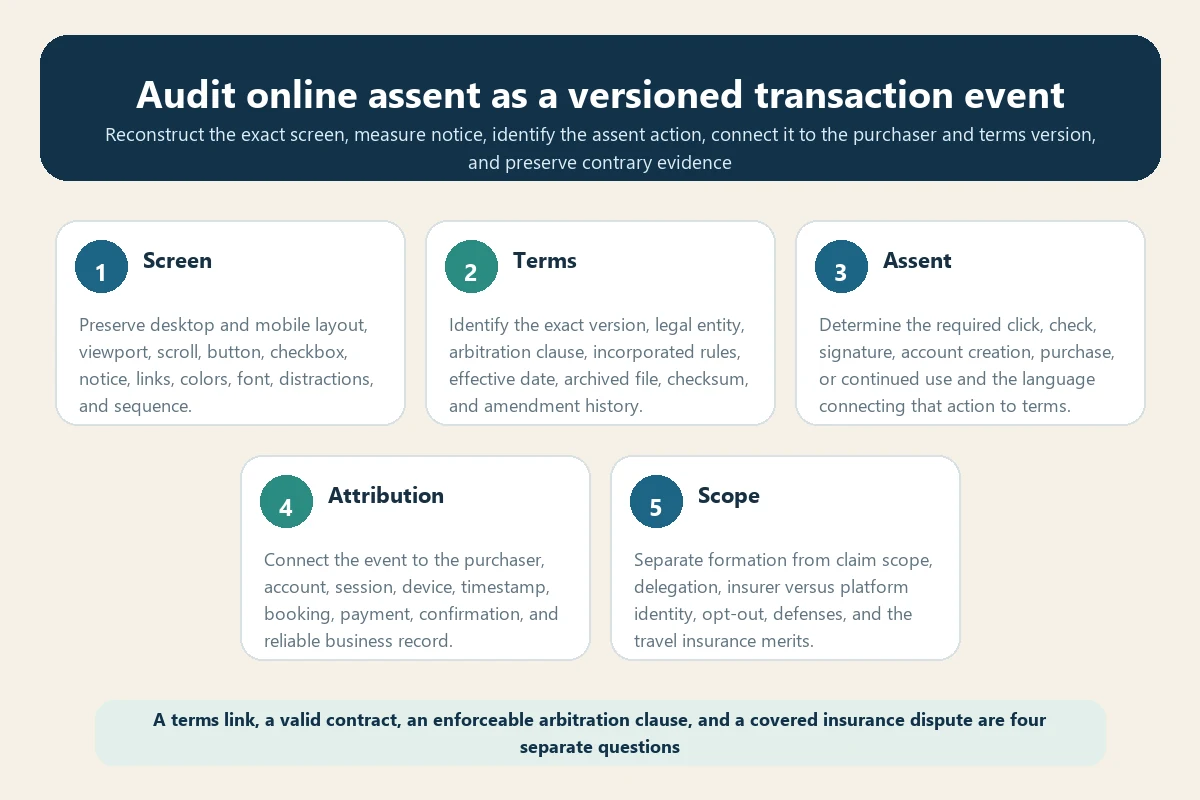
Preserve desktop and mobile versions, viewport dimensions, zoom, scroll position, button text, checkbox state, hyperlink placement, notice wording, font size, color contrast, surrounding offers, and the order of steps.
A modern screenshot may not match an older checkout. Seek dated design files, release records, archived captures, test records, and transaction-specific logs.
Measure whether notice was conspicuous
Ask whether a reasonable user would see language explaining that a defined action creates agreement. Evaluate proximity to the action button, visual contrast, hyperlink styling, clutter, required scrolling, and mobile responsiveness.
The Ninth Circuit’s published Oberstein decision describes the two-part online-assent inquiry as reasonably conspicuous notice plus an unambiguous manifestation of assent, assessed from the full circumstances.
Identify the exact assent action
Record whether the traveler checked a box, clicked “Accept,” created an account, pressed “Pay,” completed a booking, opened a policy, or continued using a service after an amendment.
The notice should connect that specific action to the terms. Generic text saying “I understand” can present a different question from “By clicking Pay, you agree to the Terms.”
Do not infer a click from a completed purchase
A database may show that a transaction completed without establishing which interface version appeared or which required controls were activated. Link the event record to the applicable code path and screen.
Preserve raw logs, schema definitions, timestamps, audit trails, and retention policies rather than relying only on a summary declaration.
Connect the event to the correct purchaser
Identify who operated the device, whose account was used, who paid, who received the confirmation, who was insured, and whether an agent, employer, family member, or travel advisor completed the purchase.
Authority and agency may require separate evidence. An insured traveler is not always the person who encountered the checkout terms.
Preserve transaction-specific evidence
Collect account identifier, session identifier, device type, IP-region evidence where lawfully retained, timestamp, booking number, payment event, policy selection, checkbox state, terms-version identifier, confirmation, and post-purchase delivery.
Minimize sensitive data and protect account and payment identifiers. Evidence quality does not require publishing private information.
Authenticate screenshots and business records
Document who created the record, how the system stores it, whether it can be edited, what the field values mean, and how it connects to the transaction. Preserve native files and metadata.
A generic demonstration screenshot can explain a process but may not prove what appeared on a specific date or device.
Review the Ninth Circuit’s browsewrap warning
In its published Nguyen decision, the Ninth Circuit declined to infer assent merely from conspicuous terms links where the user was not prompted to take affirmative action showing agreement.
The decision is useful evidence of why proximity alone and affirmative assent should be analyzed separately under the governing state law.
Study a current travel-checkout example
A 2026 federal order involving International Travel Network and a Travel Care Services Premium Plan described a checkout requiring payment information, a checked acknowledgment of general terms, and a purchase button. The court analyzed those transaction facts when finding an agreement.
Use the official Puntillo court order as an example of evidence categories, not as a prediction for another interface or jurisdiction.
Match the assent event to the terms version
The record should connect the user’s action to a stable version identifier. Preserve the page or PDF delivered through the hyperlink, not just the URL, because content at that address can change.
Compare title, effective date, entity, arbitration text, forum, opt-out, class waiver, and incorporated rules across versions.
Audit post-purchase delivery
Determine whether the policy and terms were delivered by email, account portal, download, or mail. Record bounce status, access logs, attachment names, and free-look or cancellation instructions.
Post-purchase delivery may support notice of some terms but does not automatically establish pre-purchase assent to every clause.
Distinguish assent from an electronic signature
A checkbox, typed name, platform signature, and payment-button click can serve different functions. One may accept general terms, another may certify claim facts, and another may authorize payment. Identify the legal effect claimed for each event rather than calling every click a signature.
The travel insurance electronic signature guide helps match a document, signer, authority, signature method, timestamp, final file, and receipt. Formation still requires the applicable state contract analysis and reliable transaction proof.
Do not substitute fairness for formation evidence
A process can provide conspicuous notice yet face a separate challenge to fees, location, remedies, or neutrality. It can also appear procedurally fair while lacking proof that this purchaser accepted it. Analyze existence before enforcing the clause, then address the remaining issues under their own standards.
Use the consumer arbitration due process guide to audit notice, neutral selection, cost, location, information exchange, hearing access, remedies, and award form without confusing those safeguards with assent.
Analyze later amendments separately
Identify the original modification clause, new terms, notice method, effective date, required action, opt-out opportunity, continued-use language, and the user’s activity after notice.
Do not merge initial formation with amendment assent. A valid original agreement does not answer whether a materially changed arbitration clause became effective.
Check the arbitration opt-out
If the terms offer an opt-out, preserve the deadline, required content, recipient, method, delivery, receipt, and scope. An opt-out from arbitration is distinct from canceling travel protection.
Use the arbitration opt-out guide to build a controlled record.
Separate formation from arbitrability
A court commonly addresses whether an agreement was formed before enforcing delegation, while allocation of other issues can vary. Read the clause, governing law, and current precedent carefully.
The arbitrability guide separates formation, delegation, claim scope, procedural conditions, and merits.
Preserve state-law defenses precisely
Fraud, duress, incapacity, mistake, unconscionability, lack of authority, and other generally applicable contract defenses have distinct elements. Formation evidence should not be reduced to a broad statement that online terms are unfair.
The unconscionability guide helps audit procedural and substantive issues without confusing them with the existence of assent.
Prepare a formation evidence matrix
Create rows for legal entity, interface version, notice wording, hyperlink destination, button or checkbox, terms version, transaction log, purchaser identity, authority, delivery, amendment, opt-out, and contrary evidence.
For each row, identify the factual proposition, supporting record, custodian, authenticity issue, gap, and follow-up request.
Avoid common clickwrap audit mistakes
- Using today’s terms or interface for an older purchase.
- Assuming a completed booking proves a specific click.
- Ignoring mobile layout, scrolling, clutter, or contrast.
- Failing to connect the action to agreement language.
- Using a generic screenshot as transaction proof.
- Confusing the purchaser, insured, payer, and account holder.
- Failing to identify the company seeking arbitration.
- Ignoring terms versions, amendments, and opt-out records.
- Collapsing formation, delegation, scope, defenses, and merits.
Final online-assent checklist
- Identify every entity and the party invoking arbitration.
- Preserve the purchase-time policy and terms version.
- Reconstruct desktop and mobile checkout screens.
- Evaluate notice wording, position, contrast, and clutter.
- Identify the exact action claimed as assent.
- Connect the action to the traveler or authorized purchaser.
- Authenticate logs, screenshots, confirmations, and delivery.
- Audit amendments and opt-out separately.
- Map contrary evidence and unresolved gaps.
- Separate formation from scope, delegation, defenses, and merits.
A professional clickwrap audit reconstructs a versioned transaction event. It shows the exact screen, notice, action, terms, person, entity, and records—and it states clearly what those facts do and do not prove.