
A travel insurance claim wrong benefit classification can change the applicable limit, deductible, waiting period, covered expenses, and required evidence. The correction is not simply asking for the most generous benefit. Each disputed dollar must connect to the event, policy trigger, timing, service, and wording that actually apply.
This U.S.-focused guide explains how to audit a classification, distinguish related benefits, request a line-level explanation, and submit a focused correction or appeal without rewriting the facts.
Separate five layers before arguing classification
| Layer | Question | Record |
|---|---|---|
| Event | What happened, where, and when? | Carrier, medical, police, or supplier record |
| Trigger | Which defined covered reason may apply? | Exact policy clause and evidence |
| Consequence | Delay, cancellation, interruption, treatment, loss, or transport? | Chronology and itinerary |
| Expense | What service or loss is this line? | Itemized invoice and payment proof |
| Benefit | Which section describes that expense and consequence? | Issued policy, schedule, and endorsement |
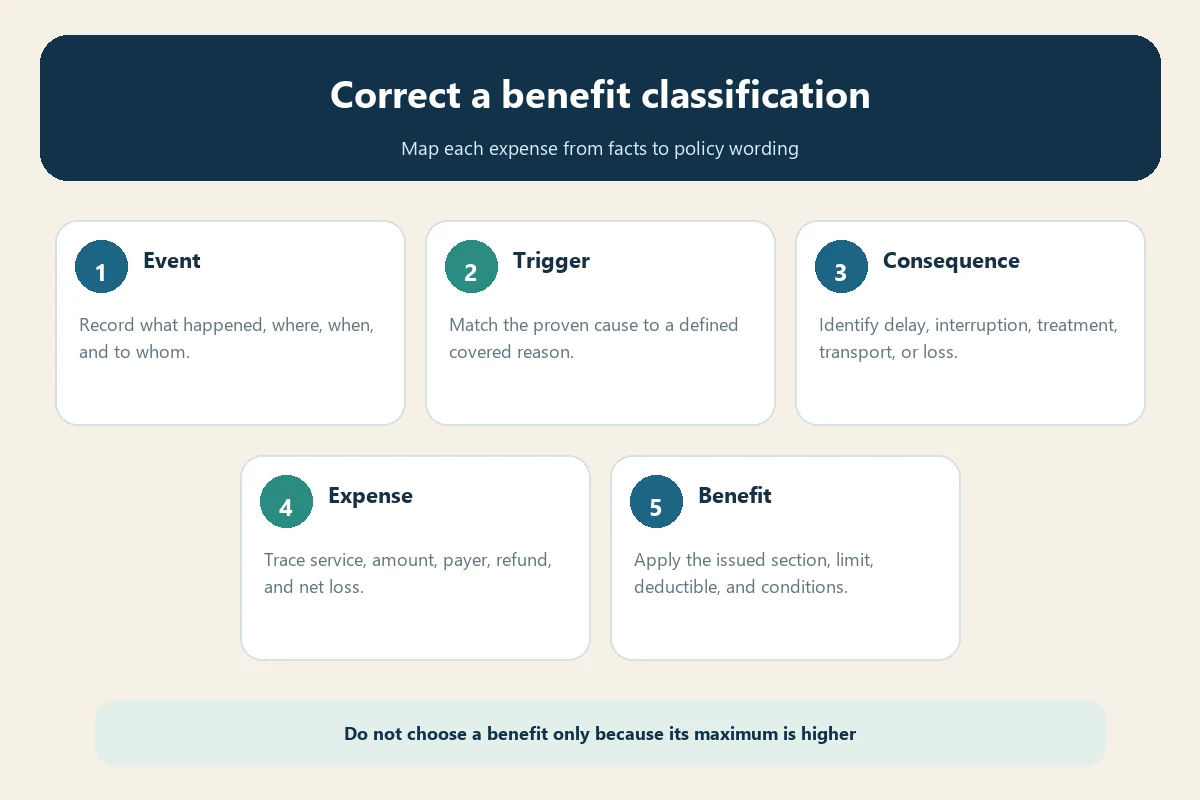
One event may touch several benefits. That does not mean the traveler can place every cost under any of them or recover the same cost twice.
Use the issued policy, not a generic coverage label
Open the certificate or policy issued for the purchaser’s state, the schedule of benefits, definitions, exclusions, claims provisions, and endorsements. Search the exact terms used in the decision. A marketing phrase such as “trip protection” does not establish which section governs an expense.
The travel policy reading guide explains how definitions, insuring clauses, exclusions, conditions, and endorsements interact. Record the form number and revision date so an appeal does not quote a different product version.
Compare delay, missed connection, and interruption
These benefits often overlap in everyday language but can require different consequences. Delay may address reasonable expenses after a qualifying wait. Missed connection may focus on a defined connection and minimum delay. Interruption may address a covered event after departure that causes the traveler to end, alter, or rejoin the trip under stated terms.
Progressive’s travel coverage explainer distinguishes a trip unexpectedly cut short from plans that are delayed. Travel Guard’s interruption page notes that documentation depends on both the reason and the expenses. These are general or plan-provider examples; the issued contract controls.
Build a time line showing scheduled departure and arrival, actual movement, minimum waiting period, decision to continue or return, unused bookings, replacement transport, meals, lodging, and carrier remedies. Then classify each expense separately.
Distinguish medical expense, evacuation, and interruption
A hospital bill, ground ambulance, medically necessary transfer, commercial flight home, companion hotel, unused tour, and changed ticket can arise from one illness. They do not necessarily belong under one medical maximum.
Identify who ordered or authorized each service, the clinical purpose, route, provider, and payment. A medical record proves illness; it does not by itself prove that return airfare is an eligible medical expense. Assistance authorization may support a transport benefit but may not decide unused trip cost.
Use the benefit schedule and definitions for medical treatment, local ambulance, evacuation, repatriation, interruption, and companion expenses. Preserve any written assistance authorization and its conditions.
Separate baggage delay from baggage loss or damage
Essential replacement purchases during a qualifying baggage delay differ from the value of property that is permanently lost or damaged. The carrier’s delivery time, final tracing result, property report, purchase receipts, ownership proof, depreciation rule, and carrier settlement can determine the correct classification.
Do not place the original value of a missing item under a delay allowance or list temporary toiletries again in a later loss claim without disclosure. Link the incident, but maintain distinct expense lines.
Audit the administrator’s calculation line by line
Request a written breakdown showing claimed amount, assigned benefit, allowed amount, excluded amount, deductible, sublimit, refund, other insurance, and payment. The partial payment calculation guide provides a reconciliation table.
For every disputed line, add:
- expense ID and claim number;
- traveler, service date, supplier, and amount;
- event and causal link;
- administrator’s current benefit and reason;
- requested benefit and exact policy language;
- evidence proving trigger, timing, and expense;
- effect on limit, deductible, and cumulative payment.
Do not combine several disputed expenses into one unsupported total. A reviewer should be able to reproduce the requested correction.
Calculate the effect of reclassification
A corrected label does not automatically mean the full submitted amount becomes payable. Recalculate the result under both classifications. Include the benefit maximum, per-day or per-item sublimit, waiting period, deductible, coinsurance, insured trip-cost ceiling, prior payments, supplier refunds, and any shared aggregate.
For example, a traveler submits a $320 hotel, $90 in meals, and a $700 replacement ticket after a disruption. The administrator assigns all $1,110 to a delay benefit with a $500 maximum. The traveler believes the ticket belongs under interruption. The comparison should leave the hotel and meals under delay if the wording supports them, test the ticket separately under interruption, subtract any airline credit, and apply the relevant limit and deductible. It should not simply move the entire $1,110 to interruption.
Show the original decision, proposed allocation, and revised total side by side. If the requested section still excludes the expense or the event is not a covered reason, say what evidence or interpretation resolves that issue. The travel claim denial reasons guide helps distinguish an exclusion, unmet condition, missing proof, and calculation dispute.
Ask whether the issue is classification or eligibility
A claim can be assigned to the right benefit but fail a covered-reason requirement, waiting period, authorization rule, exclusion, or evidence requirement. Moving it to another section does not cure that gap.
Ask the administrator to identify whether its decision means:
- the expense belongs under a different benefit;
- the benefit applies but the expense type is ineligible;
- the event does not satisfy a covered trigger;
- a condition or deadline was not met;
- the line was reduced by a limit, deductible, refund, or other payment;
- the evidence is insufficient to decide.
Each answer requires a different response. Treating every reduction as “wrong classification” weakens the correction request.
Work through a delay-to-interruption example
A mechanical flight cancellation leaves a traveler overnight at an intermediate city. The traveler buys dinner and a hotel, then takes a replacement flight the next morning. A prepaid tour at the destination is missed.
The hotel and meal may be evaluated under a delay benefit if the cause and waiting period qualify. The unused tour may require a different section and evidence that the covered event caused the loss. Replacement transportation might have its own rule. The airline’s refund, voucher, or duty to reroute affects the net expense.
If the administrator places every line under a small delay maximum, the traveler should not merely request “interruption.” The correction matrix should show each line, consequence, policy clause, supplier refund, and supporting record. Some lines may remain delay expenses while another may be evaluated under interruption or remain uncovered.
Preserve the original facts and documents
Do not edit the incident description to fit a benefit label. Correct factual errors transparently and preserve the earlier version. A claim’s classification should follow the evidence, not vocabulary chosen after reading limits.
If multiple benefits or claim numbers are involved, use the multiple claims from one trip guide to link them without duplicating expenses.
Request an informal correction before a formal appeal
If the decision contains an apparent coding or arithmetic error, ask the examiner to review the line and issue a corrected calculation. Include a short matrix and the exact policy citation. Ask whether the request preserves or changes any appeal deadline; do not assume informal review pauses it.
Re: Claim [number], expense [ID]. The decision dated [date] assigned this [service/expense] to [benefit]. I request review under [requested section and clause] because the record shows [trigger], [timing], and [consequence]. Attachments [files/pages] support those facts. Please provide the line-level basis for the present classification, the effect of any limit or deductible, and whether a formal appeal is required by [deadline]. This request does not seek duplicate reimbursement.
Escalate with a focused appeal
If the administrator maintains the classification, follow the decision letter and policy appeal instructions. The travel insurance claim appeal guide explains how to assemble the decision, governing language, facts, evidence, requested remedy, and deadline.
The NAIC travel insurance topic page describes cancellation, interruption, and delay among travel coverages, while its state insurance department directory provides regulator contacts. Coverage and complaint rules vary by state and contract. Seek qualified advice when a significant dispute turns on legal interpretation or limitation periods.
Benefit-classification checklist
- Verify the issued policy form, schedule, and endorsements.
- Separate event, trigger, consequence, expense, and benefit.
- Create a line for every disputed cost.
- Record the administrator’s assigned benefit and reason.
- Cite the requested section and evidence precisely.
- Reconcile limits, deductibles, refunds, and other payments.
- Preserve the original facts and all prior versions.
- Ask whether the issue is classification, eligibility, or evidence.
- Protect the formal appeal deadline during informal review.
A persuasive classification correction is a reproducible policy analysis, not a request for a larger bucket. It shows exactly what happened, what each expense represents, which clause applies, and how the corrected decision should be calculated without duplicate payment.
