
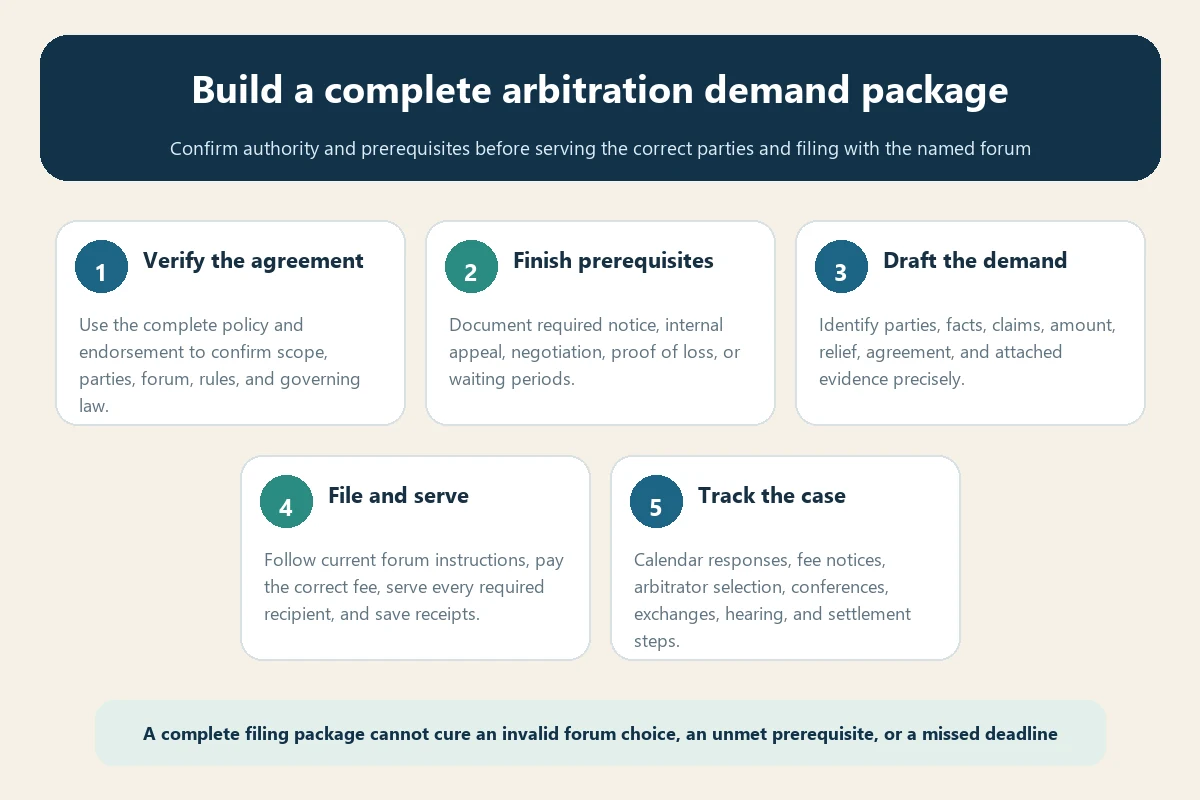
To file a travel insurance arbitration demand, first confirm that the complete policy or a post-dispute agreement actually sends the dispute to arbitration. Then follow the named forum’s current rules, satisfy every prerequisite, identify the correct parties, state each claim and requested remedy, attach the required agreement, pay the applicable fee, and document service.
Do not treat this as a universal form-filling exercise. State insurance law, contract formation, the policy wording, and the selected forum can affect whether arbitration is available or required. Filing a demand also may affect important rights. This guide is general information, not legal advice.
Start with the complete contract
Obtain the policy, certificate, declarations, endorsements, application, purchase record, and any incorporated dispute-resolution rules. A benefits summary or booking confirmation may omit the controlling clause. Compare the documents by effective date and note any amendment delivered after purchase.
Search for “arbitration,” “dispute resolution,” “legal action,” “suit against us,” “governing law,” “venue,” “notice,” and “limitations.” Save the full document as it appeared when coverage was purchased, not only a copied paragraph.
Confirm that the clause covers this dispute
Read the clause’s definition of “claim” or “dispute.” Determine whether it covers benefit denials, claim handling, misrepresentation, statutory claims, tort claims, or only a narrow valuation question. Identify exclusions for small claims, administrative complaints, emergency relief, or particular benefits.
Also note who decides whether the clause applies. Some agreements address whether a court or arbitrator decides scope or enforceability. Do not resolve that question from a generic internet description.
Identify every relevant legal entity
Travel protection can involve an underwriter, insurer, plan administrator, claims administrator, assistance provider, booking platform, tour operator, airline, and seller. The logo on the denial is not proof that the same entity issued the policy or signed the arbitration agreement.
Create a party table with each legal name, role, address, state of formation if known, policy reference, conduct alleged, and source document. Use the contract and official business or insurance-license records. A demand against the wrong entity can create service, jurisdiction, and delay problems.
Verify state-specific enforceability before paying
An arbitration clause’s presence does not prove that it is enforceable for every consumer insurance policy. The District of Columbia provides a concrete example: D.C. Code § 16-4403 states that a consumer insurance policy provision requiring binding arbitration is void and unenforceable, while allowing the parties to elect arbitration after a dispute arises under specified conditions.
That rule should not be generalized beyond its jurisdiction. Instead, it demonstrates why the insured’s residence, policy issuance, governing-law clause, and applicable federal and state law need analysis. If validity is uncertain, qualified state-specific advice may prevent filing in the wrong forum.
Separate arbitration from a regulator complaint
A state insurance complaint asks a regulator to review conduct within its authority. Arbitration asks a neutral to adjudicate a dispute under an agreement and applicable law. One does not automatically replace, toll, waive, or preserve the other.
Use the complaint vs arbitration guide to compare authority, evidence, costs, confidentiality, and outcomes before starting parallel tracks.
Complete contractual prerequisites
The policy may require claim notice, proof of loss, supporting documents, an insurer appeal, a written dispute notice, negotiation, or a waiting period before arbitration. List each condition, the exact clause, completion date, method, recipient, and proof of delivery.
If the denial can still be corrected through internal review, the travel insurance claim appeal guide explains how to address the stated reason with policy-specific evidence. Do not let an optional appeal distract from a separate arbitration or suit deadline.
Find the correct arbitration forum and rules
Use the forum named in the agreement. Confirm its current legal name, website, case type, rules, form, filing channel, fee schedule, and service instructions. A clause might name the American Arbitration Association, JAMS, another provider, an industry process, or a selection method rather than a fixed administrator.
The official AAA consumer arbitration page says that a party filing a consumer case submits a Demand for Arbitration, a copy of the arbitration provision naming AAA or its rules, and the appropriate filing fee. AAA also identifies hospitality, travel, and insurance among consumer dispute areas it administers. That does not establish that AAA is the forum for a particular policy; the actual agreement controls the starting inquiry.
Use the current demand form
Download the form directly from the selected forum on the filing date. Do not reuse an undated form from a blog, prior case, or search-result attachment. Rules, addresses, fee schedules, and online portals can change.
AAA’s official Consumer Demand for Arbitration form requests consumer and business contact information, the filing party, amount claimed, other relief, and a brief explanation of the dispute and each claim. Other forums may request different information.
Draft a precise statement of the dispute
Begin with a short chronology: purchase, coverage dates, covered event, notice, claim, documents, insurer decision, appeal, and final position. Cite exhibit numbers. Separate facts from conclusions and avoid unnecessary commentary.
For each claim, identify the policy term or legal duty, the respondent’s alleged act or omission, resulting loss, and requested remedy. Explain the amount rather than listing an unexplained total. Distinguish policy benefits, consequential loss, interest, fees, costs, and any nonmonetary relief.
Build a damages schedule
Use a table with category, description, source document, currency, original amount, exchange-rate date and source, prior payment, disputed balance, and requested amount. Prevent duplicate recovery where one expense appears on multiple receipts or under multiple benefits.
If the insurer paid only part of the claim, follow the partial travel insurance payment guide to reconcile allowed, reduced, excluded, and unpaid amounts before stating the demand.
Prepare a controlled exhibit index
A practical initial index may include:
- The complete policy and arbitration provision.
- Purchase confirmation and proof of premium.
- Claim form and proof of timely submission.
- Covered-event records and supplier documents.
- Receipts, invoices, refunds, credits, and payment records.
- Denial, explanation of benefits, and appeal decision.
- Material communications and delivery receipts.
- Damages schedule and supporting calculations.
The original claim should remain the anchor for this record. Compare it with the travel insurance claim filing guide to identify any notice, proof, or delivery gap before describing the insurer’s response in arbitration.
Follow the forum’s instructions on initial attachments. Do not upload an uncontrolled archive merely because more pages seem stronger. Redact unnecessary account numbers, identity data, medical details, and third-party information where rules allow.
Check the fee schedule and hardship options
Use the current schedule for the exact case type. Confirm the consumer filing fee, what the business must pay, arbitrator compensation, hearing or postponement charges, and consequences of nonpayment. Compare the agreement because it may allocate fees differently, subject to applicable rules and law.
AAA’s consumer page explains that consumer costs are capped under its consumer framework and that qualifying fee waivers may be available. Verify the current amount and waiver form directly rather than copying an old dollar figure into the demand.
File through the authorized channel
Follow the forum’s online, email, mail, or other instructions exactly. Record the upload confirmation, transaction number, time zone, payment receipt, file names, checksums if useful, and every document submitted. If a portal fails, preserve screenshots and contact the forum using its official support channel.
AAA’s official case filing page directs users to its filing workflow and case-access tools. A portal submission to an administrator is not necessarily service on every respondent.
Serve the demand on the correct recipients
Read the arbitration clause, forum rules, policy notice provision, and applicable law for who must receive the demand, where, by what method, and when. Recipients may include a registered agent, contractual notice address, counsel, or designated claims contact.
Save proof of delivery showing the document, recipient, address, method, tracking number, sent date, delivery date, and any rejection or forwarding. Do not rely solely on a sent-email screenshot if a different service method is required.
Calendar the case after filing
A case number is the beginning, not the end. Track defect notices, administrator review, respondent answer, business fees, arbitrator lists, disclosures, strikes and rankings, preliminary conference, scheduling order, document exchange, motions, witness lists, hearing, post-hearing submissions, and award.
Keep complaint and arbitration records separate but cross-reference shared exhibits. If a state department requests an update, provide accurate procedural status without characterizing an interim step as a final award.
Consider settlement without losing deadline control
Settlement discussions may occur before or during arbitration, but they do not automatically suspend filing or case deadlines. Confirm any stay in a written order or administrator notice. Evaluate release scope, payment timing, confidentiality, withdrawal, dismissal, fees, and enforcement before signing.
The travel insurance settlement guide offers a useful release-and-payment checklist even when the parallel matter is arbitration rather than a regulator complaint.
Common filing mistakes
- Using a summary instead of the complete arbitration agreement.
- Naming a brand while omitting the contracting legal entity.
- Filing with a familiar administrator not named by the agreement.
- Skipping an express notice or appeal prerequisite.
- Stating one lump-sum demand without a calculation.
- Assuming a regulator complaint stopped the deadline.
- Paying an outdated fee or using an obsolete form.
- Filing with the forum but failing to complete required service.
- Uploading sensitive, duplicative, or unlabeled documents.
- Ignoring state insurance restrictions on arbitration clauses.
Final filing checklist
- Complete policy and clause obtained.
- Scope, parties, forum, rules, and law reviewed.
- State-specific validity concerns checked.
- Prerequisites and deadlines documented.
- Current form and fee schedule downloaded.
- Claims, facts, damages, and relief stated precisely.
- Agreement and required exhibits attached.
- Filing confirmation and payment receipt saved.
- Every required party served with proof.
- Post-filing calendar created.
Bottom line
A strong travel insurance arbitration demand begins before the form: verify the agreement, jurisdiction, parties, forum, prerequisites, and deadline. Then present a concise claim, reconciled damages, controlled exhibits, correct fee, and documented service.
Do not assume that a clause is enforceable, that AAA or another administrator is automatically proper, or that a pending complaint protects the filing period. When those questions could determine access to a remedy, obtain qualified advice under the applicable state and federal law.
