
Travel insurance government shutdown flight cancellation claims require more than proof that federal funding lapsed. A shutdown can affect agencies and workers differently, while a flight may operate, be delayed, be reduced under an official order, or be canceled by the airline. The policy then asks whether the actual event matches a covered reason.
This U.S. guide separates shutdown status, aviation operations, airline remedies, insurance benefits, and voluntary cancellation. It is educational, not legal or insurance advice. Verify current conditions before acting.
A government shutdown is not one universal travel event
The U.S. Office of Personnel Management explains that a shutdown furlough follows a lapse in appropriations, but some functions have alternative funding or continue under legal exceptions. That means “the government is shut down” does not establish that a specific airport, security checkpoint, air-traffic facility, passport office, or flight has stopped.
Insurance responds to contract facts, not the political label. Identify the affected agency, operational action, flight consequence, date, and expense before choosing a benefit.
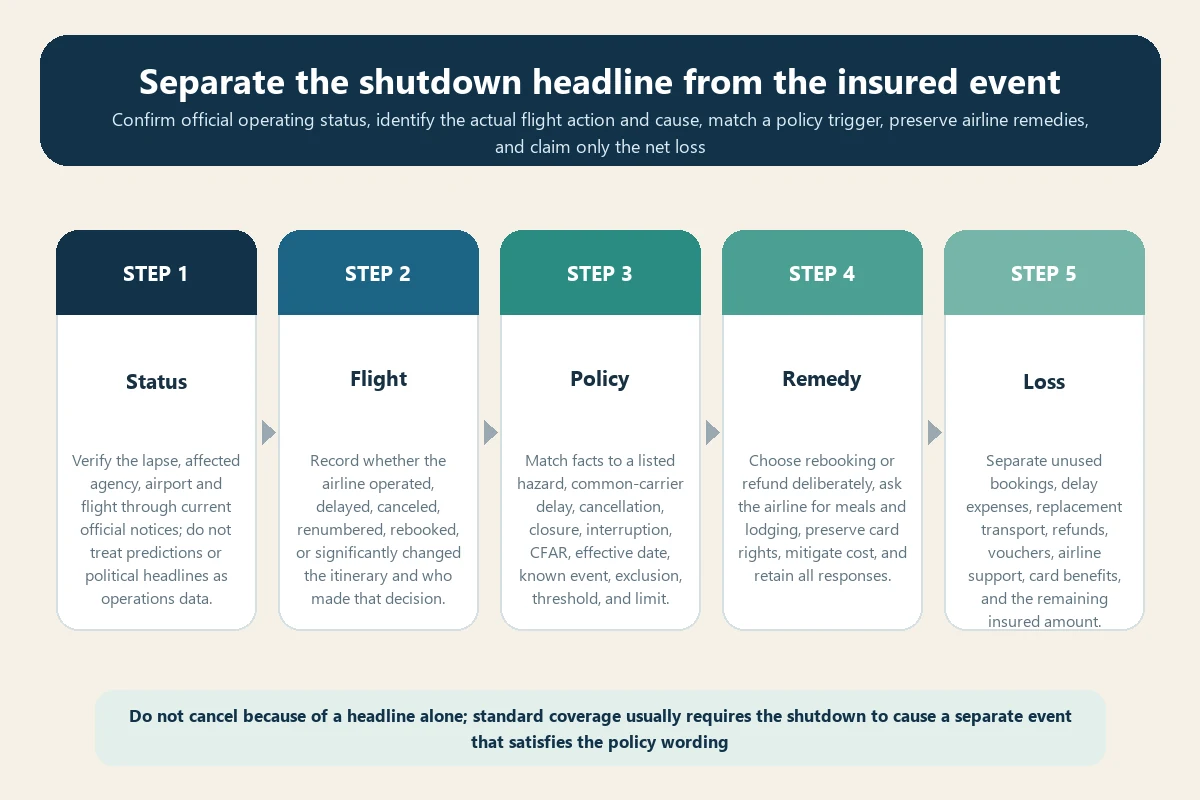
Do not cancel because of a headline alone
A predicted shutdown, funding deadline, staffing warning, or news report may not cancel transportation. If the traveler cancels while the airline remains scheduled to operate, the carrier’s ordinary fare rules may apply and standard trip-cancellation coverage may not.
Before acting, check the operating carrier, departure airport, connection airports, destination services, and current government notices. Screenshot time-stamped status pages and retain airline messages.
Identify the actual cause of the flight action
An airline notice may cite FAA restrictions, air-traffic staffing, airport congestion, security processing, crew displacement, weather, equipment, or operational decisions. Several causes can exist in sequence.
Request written delay or cancellation verification from the operating carrier. Record whether a government agency ordered a reduction, the airline selected the flight, or another cause controlled. Do not rewrite a vague notice into a stronger insurance trigger.
Separate five possible policy paths
Review trip cancellation, trip delay, missed connection, trip interruption, and Cancel For Any Reason separately. Search for common carrier, cessation, delay, cancellation, airport closure, government regulation, travel advisory, strike, weather, mechanical breakdown, and other listed hazards.
The words “government shutdown” may be absent. That does not automatically prove coverage or exclusion; the consequential event still must satisfy the complete definition, timing, exclusions, and limits.
Test standard trip cancellation wording
Standard trip cancellation usually requires a listed covered reason. Fear of congestion, concern about staffing, or a desire to avoid uncertainty is not necessarily listed. An actual common-carrier cancellation may matter only if the policy includes that event and its conditions.
Use our cancelled-flight coverage guide to separate the carrier’s action from the traveler’s decision and the loss on the rest of the trip.
Test trip delay rather than assuming cancellation
If the flight eventually operates, a trip-delay benefit may reimburse eligible meals, lodging, local transport, or communication after a defined waiting period. The cause must still qualify, and per-day or total limits may apply.
Build a minute-by-minute timeline with scheduled and actual departure and arrival. Our flight-delay insurance guide explains thresholds, necessary expenses, and carrier documentation.
Use CFAR only when its conditions are satisfied
Cancel For Any Reason can address a voluntary decision that standard coverage does not, but it is optional and time-sensitive. It commonly requires purchase soon after the first trip payment, insurance of eligible trip cost, cancellation before a specified cutoff, and forfeiture of only the nonrefundable balance.
It generally reimburses a stated percentage rather than the entire loss. Review the CFAR guide before canceling, and confirm the deadline in the actual certificate.
Check the known-event boundary
Buying insurance after a shutdown, official reduction order, or public cancellation announcement may not protect the known disruption. The relevant boundary depends on policy purchase, effective date, initial deposit, public knowledge, and the particular hazard.
Preserve the insurance transaction timestamp and what had officially occurred by then. Do not use a later timeline to imply that later facts were known earlier.
Airline refund rights do not depend on insurance coverage
The DOT’s refund guidance states that a consumer is entitled to a refund when the airline cancels a flight and the consumer declines alternatives. The cause of cancellation does not erase that basic refund route.
Decide deliberately between rebooking and refund. Accepting and using substitute transportation can change the refund analysis. Save every offer, selection, voucher term, and refund confirmation.
Identify the merchant of record
For tickets bought through an agency, package seller, or online portal, the merchant shown on the payment statement can matter. Ask which entity must process the airfare refund and which entity holds hotel or tour payments.
Do not submit the gross package price as one canceled-flight loss. Allocate air, lodging, transfers, tours, fees, used services, refundable amounts, and retained amounts.
Distinguish controllable from external disruption
Airline meal, hotel, and ground-transport commitments often depend on whether the cause was within the carrier’s control. A government staffing event or FAA restriction may be treated differently from a carrier crew or mechanical problem.
Check the current carrier plan and the DOT Airline Customer Service Dashboard. Ask for support, but do not promise that every shutdown-related cancellation qualifies for amenities.
Preserve official operational evidence
Save the FAA or DOT order if one exists, agency statements, airport alerts, flight-status history, carrier cancellation message, new itinerary, ticket number, boarding pass, and actual arrival. Use the official document’s scope and dates.
For historical context, FAA records can show that a shutdown-related order started or ended; for example, the FAA documented the termination of a 2025 flight-reduction emergency order. A past order is evidence for affected dates, not proof of current disruption.
Do not confuse an agency closure with an airport closure
A policy may define airport closure, destination inaccessibility, or government regulation precisely. A federal office reducing activity is not automatically a physical airport closure, and a long security line is not automatically a common-carrier cancellation.
Quote the provision and identify the facility, start and end times, authority, and causal link to the trip. If the airport remained open, do not characterize it as closed.
Plan for checkpoint and airport-service disruption
Long security lines, reduced government staffing, and limited airport services can create practical risk without canceling the ticket. Arrive according to current airport and carrier advice, monitor checkpoint information, keep essential medication and documents accessible, and allow more connection time when feasible.
If a missed flight follows a checkpoint delay, document airport arrival, bag-check time, checkpoint entry, queue conditions, staffing notices, screening completion, gate distance, boarding cutoff, and requests for help. A photograph or anecdotal estimate alone may not establish the cause or duration. Ask the carrier and insurer which proof they require, and distinguish an official closure from congestion at an operating checkpoint.
Handle missed connections and onward bookings
A shutdown-related delay can break a connection without canceling the original flight. Preserve the original itinerary, connection time, boarding cutoff, actual arrival, protected-ticket status, and rebooking.
Separate tickets are especially risky because the second airline may apply no-show rules. Ask the first carrier to protect onward travel before independently buying a replacement.
Mitigate without destroying the claim
Contact the airline and insurance assistance service before large purchases when practical. Ask about same-airline rebooking, another carrier, nearby airports, rail, ground transport, hotel, meal, and refund options.
Choose reasonable alternatives that match the traveler’s needs. Preserve screenshots showing availability and price when urgent replacement travel is necessary.
Separate federal-employee leave from travel insurance
A federal employee’s furlough, canceled leave, or work recall is not automatically the same as an insured travel event. Policy definitions for employment termination, leave revocation, employer requirement, or government service can be narrow.
Obtain the official personnel or supervisor notice, dates, employment status, and required reporting time. Do not assume general OPM furlough guidance proves the individual policy trigger.
Build a net-loss ledger
Create one row per airfare, hotel, tour, meal, transfer, replacement ticket, and fee. Record original cost, refundable amount, airline payment, voucher, card benefit, supplier refund, insurance request, and unresolved balance.
Use our supplier-refund and recovery guide. A pending refund remains pending; it is not zero and not a final payment.
Submit the claim by benefit
Trip cancellation may involve unused prepaid arrangements. Trip delay may involve meals and lodging. Interruption may involve unused arrangements and additional return transport. A missed connection may have its own limit. CFAR uses a different calculation.
Follow our travel insurance claim filing guide. Quote the provision, show the causal chain, attach indexed evidence, and state which recovery sources remain open.
Government shutdown flight claim checklist
- Policy, declarations, endorsements, and purchase timestamp
- First trip payment and full trip-cost history
- Official shutdown, agency, FAA, DOT, or airport notice
- Operating carrier’s cause and cancellation verification
- Original and replacement itinerary
- Refund, rebooking, voucher, and airline-support choices
- Delay and missed-connection timeline with time zones
- Itemized expenses and proof of payment
- CFAR cutoff and cancellation timestamp, if applicable
- Supplier, card, airline, and insurance recovery ledger
Bottom line
Travel insurance government shutdown flight cancellation analysis begins with the actual operational event, not the headline. Verify the agency and flight facts, preserve airline refund rights, match a separate covered hazard or valid CFAR option, mitigate reasonably, and claim only the documented net loss.
A traveler-requested change, airline schedule change, involuntary downgrade, and insured trip interruption follow different rules. Use this travel insurance flight change coverage guide to compare refund rights, covered reasons, fees, fare differences, and net loss.
Missing the first departure is different from missing an onward connection. Use this travel insurance missed departure coverage guide to test the covered cause, prove airport timing, preserve the ticket, choose reasonable replacement travel, and calculate net loss.
An ATC restriction needs a cause-and-timing record beyond the airline’s short delay code. Use this travel insurance air traffic control delay coverage guide to identify the traffic-management event, test policy wording, preserve FAA evidence, and calculate net loss.
A conflict-related flight cancellation requires a supplier-first recovery and clause-by-clause coverage review. Use this travel insurance flight cancellation due to war guide to preserve airline refunds, test exclusions and known-event timing, compare safe reroutes, and calculate net loss.
