

Travel insurance flight change coverage depends first on who changed the itinerary and why. A traveler moving departure for convenience, an airline changing the schedule, a physician advising delayed travel, and a carrier involuntarily downgrading a cabin are not the same claim.
This U.S. guide separates fare rules, passenger refund rights, insurance benefits, change fees, fare differences, and ancillary-service refunds. It is educational, not legal or insurance advice.
Classify the change before requesting payment
Label the event as traveler-requested, airline-initiated, ticket-agent error, tour-operator change, employer requirement, medical necessity, or government action. Then record whether travel is before departure, underway, or already completed.
The classification determines which contract to read first: airline fare rules, ticket-agent terms, package agreement, card benefit, or travel policy.
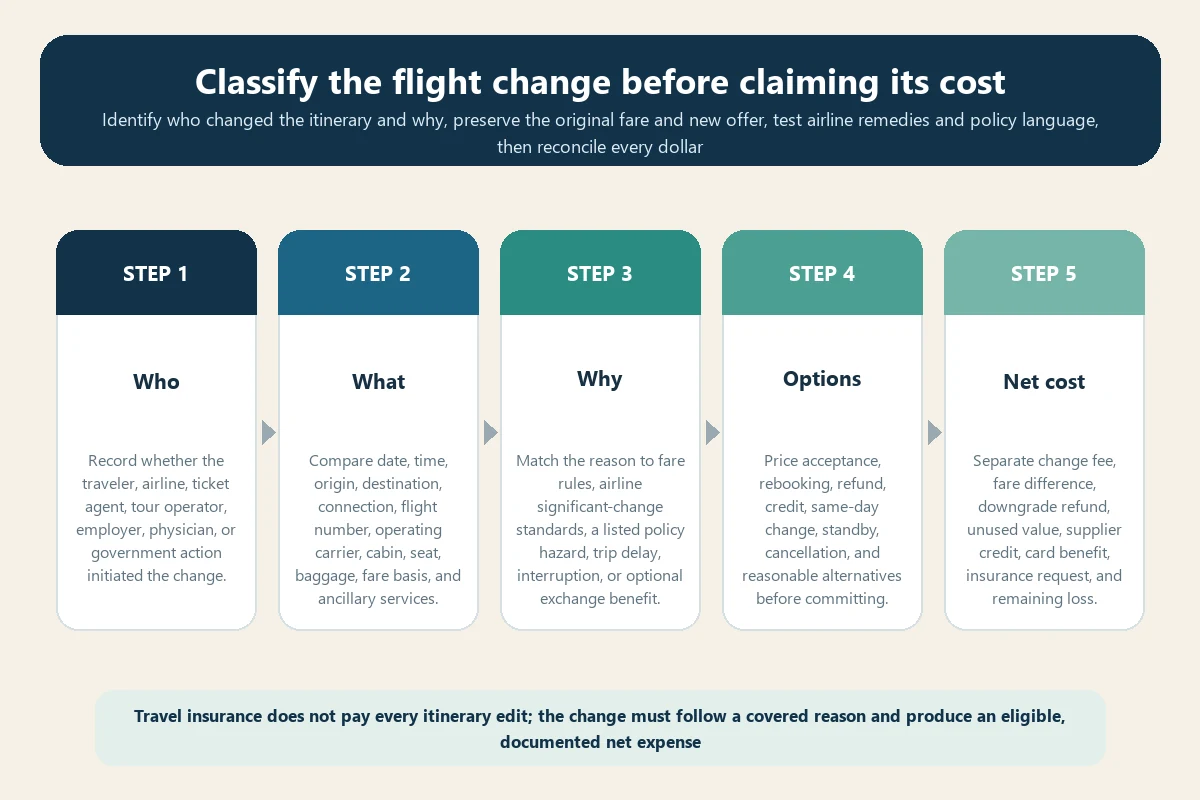
Travel insurance does not cover every voluntary change
Changing dates for preference, a better fare, convenience, extra vacation time, or a new meeting is usually not enough for standard reimbursement. The traveler still may use a flexible fare, airline waiver, loyalty benefit, or optional product.
Do not describe a voluntary change as cancellation or interruption. Quote the actual reason and confirm whether the policy lists it.
Read the airline fare rules first
The DOT’s ticket-buying guidance explains that fare classes have different restrictions and that airlines are not generally required to change a ticket free of charge. Basic economy, refundable, award, corporate, and premium tickets can have different flexibility.
Save the fare basis, conditions of carriage, original receipt, ticket number, booking channel, and rules displayed at purchase. A “no change fee” promise may still leave a fare difference.
Separate the change fee from the fare difference
A change fee is a charge for modifying the ticket. A fare difference is the price gap between the old and replacement itinerary. Taxes, agency service fees, seat fees, baggage fees, and exchange penalties are additional components.
Require an itemized exchange receipt. A single “new ticket $800” line cannot prove how much was retained from the old ticket or which expense might be eligible.
Verify fees disclosed for the original fare
Do not assume a fee is valid merely because it appears at exchange. Compare the charge with the policy shown before purchase, the e-ticket receipt, fare family, loyalty status, card benefit, and any airline waiver. The DOT’s ancillary-fee information explains federal disclosure requirements concerning change and cancellation policies.
Ask the airline or agent to identify the contractual source for every fee. Preserve screenshots and the full exchange calculation. A disclosed fee may still be outside insurance coverage, while a waived fee creates no reimbursable loss.
Check whether the reason is insured
A medical event, injury, death, weather event, common-carrier disruption, home damage, jury duty, or other event may qualify only if it matches the certificate’s definition and conditions. The change must also be necessary because of that event.
Preserve contemporaneous clinical, employer, court, carrier, or government evidence. A covered reason does not automatically make every chosen itinerary or upgrade reasonable.
Use cancellation, interruption, and delay correctly
Before departure, an insured reason may support trip cancellation rather than a generic change-fee claim. After departure, trip interruption may address unused arrangements and additional transportation. A temporary disruption may fall under trip delay.
Our delay, interruption, and cancellation comparison helps assign each expense to the correct lane.
Airline-initiated schedule changes create a different choice
If the airline changes departure, arrival, airport, connection, carrier, or class, compare the offered itinerary with the original before accepting. Ask for alternative transportation and the right to decline it.
The DOT’s refund guidance identifies significant changes that can entitle a consumer to a refund when the alternative is rejected. Insurance should not replace a refund the airline owes.
If the change becomes a cancellation, use our cancelled-flight insurance guide. If it begins with an alternate-airport landing and later rebooking, preserve the sequence described in our flight-diversion guide.
Do not accept a new itinerary blindly
Compare arrival time, airport, number and length of connections, minimum connection time, overnight stops, accessibility, visa or transit requirements, baggage transfer, and the traveler’s medical needs. Ask whether declining the offer produces a refund and whether another acceptable route is available.
Acceptance can affect the airline remedy, but it does not erase proof that optional services or a cabin were not delivered. Save the offer before selecting it and obtain a new ticket receipt afterward.
Understand what may count as a significant change
DOT guidance includes defined changes involving substantial early departure or late arrival, different origin or destination airports, additional connections, and involuntary cabin downgrade. Special rules also address certain connection or aircraft changes affecting passengers with disabilities.
A smaller schedule change can still matter under the airline’s contract or the travel policy, but do not assume it creates the same federal refund right.
Handle an involuntary cabin downgrade
If moved from first or business class to premium economy or economy, preserve the original cabin, fare, seat, new boarding pass, operating carrier, and reason. Do not accept a generic voucher without understanding the cash-refund option.
DOT states that a traveler who continues in the lower class is not entitled to the full airfare refund but must receive the difference between the original and downgraded fare. Ask the airline to show its fare-difference calculation.
Separate a seat change from a cabin downgrade
Moving from an aisle to a middle seat within the same cabin is not necessarily a lower class of service. An aircraft swap can remove extra-legroom, lie-flat, bassinets, power, or accessibility features without changing the printed cabin.
Document the purchased service and actual service. Request refund of an optional fee for a service not provided, then evaluate any separate consequential loss.
Use the 24-hour rule accurately
For qualifying airline tickets purchased at least seven days before departure, carriers must provide either a 24-hour hold or a 24-hour cancellation-and-refund option. They need not offer both.
This does not require a free date change or name correction. Canceling and rebooking can also expose the traveler to a higher fare or lost inventory, so confirm the process before releasing the original seat.
Changing a misspelled name is not trip insurance
A spelling correction, legal name change, passenger substitution, and transfer to another person follow different carrier and security rules. Standard travel insurance is not a general ticket-editing service.
Contact the carrier or ticket agent promptly. Preserve the identity document, original entry, requested correction, response, fee, and whether the ticket had to be reissued.
Handle award tickets and points
Separate miles from cash taxes, carrier surcharges, redeposit fees, change fees, and added points. Record who owns the loyalty account and whether miles were restored.
A policy may not value points as insured trip cost. Claim only the recognized cash expense or fee under the applicable benefit and wording.
Check card and employer benefits
A premium card, corporate travel program, status tier, or employer agency may waive fees or arrange exchanges. Determine who paid the original ticket and replacement cost.
Preserve benefit decisions and reimbursement records. Do not claim the same fare difference from an employer, card issuer, and insurer.
Ask before independently buying a replacement
When the airline causes the change, ask it to rebook on an acceptable flight. When an insured event causes the change, contact the assistance company if practical and confirm the benefit and authorization requirements.
Document alternatives and prices. A last-minute premium cabin purchase may exceed reasonable additional transportation even if some change cost is covered.
Handle connected bookings
Changing one flight can affect a hotel, cruise, rail ticket, rental car, tour, positioning flight, or separate onward ticket. Notify every supplier promptly and ask about shifting dates, credit, refund, or name changes.
Do not treat all downstream cost as airfare. Identify the causal chain and the benefit that could address each unused or additional arrangement.
Document the original and changed itinerary
Create a side-by-side table with date, time, airport, flight number, operating carrier, cabin, seat, connections, baggage, fare basis, ticket value, and optional services. Highlight every changed field.
Save the original itinerary before accepting the new one. Airline apps often overwrite prior details, leaving the claim without a baseline.
Build a cost and recovery ledger
Use separate rows for change fee, fare difference, agency fee, new taxes, refunded taxes, unused seat fee, baggage fee, replacement transport, supplier credit, airline refund, card benefit, and insurance request.
Follow our supplier-refund and recovery guide. Record credits by issuer, value, restrictions, and expiration rather than calling every credit cash.
Prepare the claim packet
Include the policy, original ticket, fare rules, changed itinerary, exchange receipt, covered-event evidence, airline communications, assistance records, proof of payment, supplier outcomes, and net-loss ledger.
Use our travel insurance claim filing guide to index the evidence. State why the change was necessary and why the chosen replacement was reasonable.
Flight change coverage checklist
- Who initiated the change and when
- Exact reason and supporting evidence
- Original ticket, fare basis, and restrictions
- Original and changed itinerary comparison
- Airline refund and alternative-transportation offer
- Change fee and fare difference itemized separately
- Cabin, seat, baggage, and ancillary-service changes
- Insurance benefit, threshold, limit, and authorization
- Supplier, employer, card, and airline recoveries
- Final net-loss ledger
Bottom line
Travel insurance flight change coverage is not a universal benefit for editing a ticket. Identify who changed the itinerary, prove the reason, compare fare rules and DOT remedies, separate fees from fare differences, obtain airline refunds first, and submit only the eligible net cost under the correct policy provision.
Missing the first departure is different from missing an onward connection. Use this travel insurance missed departure coverage guide to test the covered cause, prove airport timing, preserve the ticket, choose reasonable replacement travel, and calculate net loss.
Being present at the gate but refused a seat requires a different analysis. Use this travel insurance denied boarding coverage guide to identify the airline’s stated reason, preserve passenger rights, test policy benefits, and calculate the remaining net loss.
A missing or timed-out crew is an airline staffing event, not an ATC restriction. Use this travel insurance flight crew shortage coverage guide to identify the crew problem, preserve controllable-delay remedies, test policy wording, and calculate net loss.
An airline technology failure needs a carrier-system record, not an airport-power assumption. Use this airline computer outage travel insurance guide to identify the failed function, preserve airline remedies, test policy wording, and document net loss.
