
A travel insurance arbitration preliminary hearing is usually a case-management conference, not the final evidentiary hearing. Its purpose is to identify the issues, set procedures, control information exchange, address threshold questions, choose a hearing format, and establish deadlines in a scheduling order.
Prepare to make specific, proportionate requests rather than arguing the entire claim. The arbitration agreement, governing rules, administrator notices, and arbitrator’s orders control. This guide provides general information, not legal advice.
Confirm the conference identity and authority
Save the appointment notice, conference notice, participant link or dial-in, case number, date and time zone, governing rule set, agenda, arbitrator disclosures, and administrator contact. Determine whether the event is called a preliminary hearing, preliminary management hearing, initial conference, scheduling conference, or another term.
Do not assume a similarly named court conference or state insurance hearing follows the same procedure. Confirm whether the arbitrator, administrator, or a state program is conducting it.
Read the current consumer rules
If AAA administers the case under its consumer rules, use the current AAA Consumer Arbitration Rules and Mediation Procedures. The rule set addresses arbitrator authority, information exchange, hearing format, motions, confidentiality, subpoenas, and other procedural matters.
AAA’s 2025 rule-update announcement notes stronger management of preliminary issues, reworked information-exchange provisions, and default virtual hearings while preserving the ability to request another format. Verify the exact rule language and any later amendment rather than relying on a summary.
Use external checklists only as prompts
AAA publishes a detailed Preliminary Hearing Reference Tool covering parties, history, arbitrability, preconditions, proceedings, relief, exchange, witnesses, hearing logistics, and other topics. The document expressly identifies itself for commercial or construction cases and not certain expedited procedures.
Use it to spot questions, not as authority for a consumer travel insurance case. The accepted agreement, consumer rules, and arbitrator’s directions take priority.
Build a one-page case snapshot
Prepare a page containing:
- Policy, claim, and case identifiers.
- Legal names and roles of all parties.
- Amount claimed and components.
- Core coverage issue and denial reason.
- Accepted counterclaim and amount, if any.
- Threshold objections or pending court matter.
- Expected witnesses and key records.
- Preferred hearing format and estimated duration.
- Known deadline, privacy, accessibility, or language issues.
This is a management tool, not a substitute for the demand or evidence.
Turn pleadings into an issue list
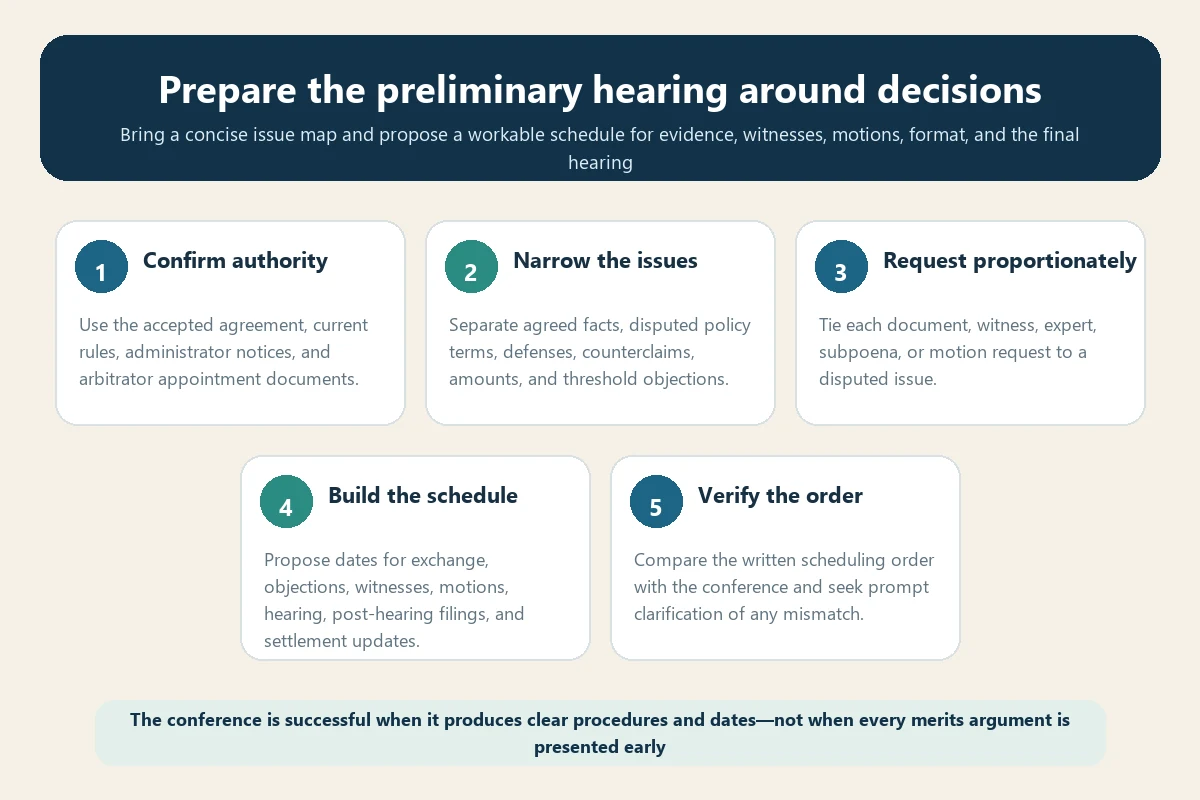
Compare the demand with the answer and identify admitted facts, disputed facts, policy-interpretation questions, exclusions, conditions, causation, amount, offsets, timing, jurisdiction objections, and remedies. Number each issue so later requests can cite it.
The travel insurance arbitration answer guide explains how to build an allegation-response and defense matrix before the conference.
Separate agreed facts from disputed facts
Propose stipulations only where the answer and evidence support them: policy issuance, premium payment, coverage dates, claim receipt, denial date, receipt of named documents, or partial payment. Agreement on receipt does not establish coverage or truth.
A short agreed-facts list can reduce witnesses and document exchange. Do not trade away a disputed element merely to simplify the conference.
Identify threshold issues
List disputes about arbitration agreement formation, scope, proper party, forum, prerequisites, timeliness, governing law, small-claims option, pending court action, or prior release. Ask who decides each issue and in what sequence.
If the administrator previously returned the demand, bring the accepted filing date and cure history. The rejected arbitration demand guide distinguishes intake status from an arbitrator’s jurisdictional or merits ruling.
Design proportional information exchange
For each requested record, identify the issue it proves, likely custodian, date range, and narrowest useful form. Possible categories include the issued policy version, purchase record, claim log, communications, calculation worksheet, refund verification, medical review, vendor correspondence, license record, or documents supporting a defense.
Avoid asking for “the entire claim file” without explaining relevance or addressing privilege and confidentiality. Prioritize documents necessary to present the claim fairly.
Prepare a document-request table
Use columns for request number, disputed issue, record description, custodian, date range, format, basis, objection, production date, and follow-up. Mark which records you already possess so the order does not require unnecessary duplication.
Ask how electronically stored information, metadata, native spreadsheets, redactions, privilege logs, and inaccessible files will be handled only when relevant and proportionate.
Plan your own production
Inventory policy documents, purchase evidence, claim submission, denial and appeal, medical or supplier records, receipts, refunds, communications, damages schedule, and service proof. Assign stable exhibit numbers and retain original files.
Use the travel insurance arbitration demand guide to reconcile the initial filing package with the records that remain to be exchanged.
Identify witnesses by proposition
For each witness, state the disputed fact the person can establish, personal knowledge, expected duration, availability, location, language, and whether live testimony is necessary. Separate fact witnesses from expert witnesses.
A treating clinician, travel supplier employee, claims representative, companion, or records custodian may have different roles. Do not list a person merely because the name appears in a file.
Decide whether expert evidence is necessary
Ask what specialized issue requires expertise: medical causation, reasonableness of charges, aviation operations, valuation, or another technical question. Compare the likely value with cost and disputed amount.
If an expert is proposed, request clear dates for disclosure, report, supporting materials, qualifications, rebuttal, and testimony. Do not assume court expert rules automatically apply.
Address subpoenas and third-party evidence
Identify records or testimony unavailable voluntarily and ask what authority, procedure, service, geographic, fee, and enforcement rules apply. Do not issue or promise a subpoena based on a generic template.
AAA’s official discussion of the 2024–2025 rule changes notes expanded arbitrator authority regarding subpoenas and depositions. The governing agreement, rules, applicable law, and arbitrator direction still determine the procedure in a particular case.
Choose the hearing format deliberately
Compare documents-only, telephone, virtual, in-person, and hybrid formats. Consider disputed credibility, witness location, medical or technical exhibits, accessibility, translation, internet reliability, privacy, cost, and claim value.
AAA states that virtual hearings became the default under its revised consumer rules, while parties may agree on another format or the arbitrator may resolve disagreement. State your preference with case-specific reasons rather than treating one format as always superior.
Prepare virtual-hearing logistics
Confirm platform, device requirements, test session, participant email, private room, backup telephone, exhibit display, witness waiting process, interpreter access, recording restrictions, and response to disconnection.
Do not email sensitive records to an unverified address. Use the authorized portal or secure method and follow the order on access and redaction.
Raise confidentiality and privacy issues precisely
Identify medical information, account details, identity documents, minor records, trade secrets, or third-party data that may require redaction, restricted access, secure transfer, or a protective order. Distinguish case confidentiality from public-record or regulator rules.
AAA’s official arbitration overview discusses confidentiality under its rules and the ability of parties to disclose details absent a separate confidentiality agreement, subject to applicable requirements. Verify the current rule and case order before promising secrecy.
Identify motions before proposing a schedule
Ask whether either party anticipates a jurisdiction motion, dispositive motion, amendment, protective order, evidence motion, or other application. For each, identify the issue, proposed page limit, supporting record, response, reply, hearing need, and relationship to the merits schedule.
Do not brief a motion during the scheduling conference unless requested. Seek a clear authorized sequence.
Prepare a realistic deadline proposal
Draft dates for:
- Amended claims, defenses, or counterclaims.
- Initial document exchange.
- Targeted follow-up requests and objections.
- Privilege or redaction logs.
- Fact and expert witness identification.
- Expert reports and rebuttal.
- Motions, responses, and replies.
- Joint exhibit list and exhibit objections.
- Witness statements or hearing briefs.
- Technology test and final hearing.
- Post-hearing submissions if authorized.
Check travel, medical availability, work schedules, holidays, time zones, and record-request lead time before proposing dates.
Discuss hearing length from an issue estimate
Estimate direct examination, cross-examination, openings, closings, exhibit disputes, interpreter time, breaks, and technology delays. A one-day request should reflect actual witness and issue counts.
If the case can be narrowed after document exchange, propose a status conference or conditional reservation rather than overstating certainty.
Protect unrelated deadlines
A preliminary hearing does not automatically toll contractual, statutory, court, regulator, appeal, claim, or settlement deadlines. Maintain a separate deadline table and disclose a parallel proceeding if the rules or arbitrator require it.
If negotiations begin, use the travel insurance settlement checklist to examine release scope, payment, withdrawal, confidentiality, and default terms. Ask for any arbitration stay or schedule change in a written order.
The complaint vs arbitration guide explains why related regulatory and adjudicative tracks can have different authority and timing.
Use a conference script
Prepare a short opening: identify yourself, confirm contact information, state the claim and disputed amount, name threshold issues, summarize agreed and disputed facts, identify essential exchange and witnesses, state hearing-format preference, and present proposed dates.
Keep the demand, answer, agreement, rules, issue list, request table, witness table, damages summary, availability calendar, and proposed schedule open and searchable.
Take a decision log during the conference
Record each ruling, agreement, reserved issue, responsible party, document, due date, time zone, submission channel, and next event. Mark points that require the written order before action.
Do not rely on memory or a private recording. Follow recording rules and wait for the official order where required.
Audit the scheduling order immediately
When the written order arrives, compare it with your decision log. Verify parties, issues, production scope, confidentiality, motion permission, witness and exhibit requirements, format, dates, time zones, service method, hearing length, and consequences of noncompliance.
If wording is ambiguous or inconsistent with the conference, request clarification promptly through the authorized channel. Do not silently apply your preferred interpretation.
Common mistakes
- Arguing the whole merits case instead of managing procedure.
- Using commercial or court checklists as controlling consumer rules.
- Requesting broad files without tying them to disputed issues.
- Listing witnesses without stating their propositions.
- Ignoring counterclaims or threshold objections.
- Choosing a hearing format without considering credibility and access.
- Promising confidentiality beyond the rules and order.
- Proposing dates without checking availability and time zones.
- Acting on memory before reviewing the written order.
- Assuming the conference tolls another deadline.
Final preparation checklist
- Authority, rules, notice, and conference logistics confirmed.
- One-page case snapshot completed.
- Agreed and disputed issues numbered.
- Threshold questions and counterclaims identified.
- Targeted exchange requests tied to issues.
- Own exhibits, witnesses, and experts inventoried.
- Format, privacy, access, and technology needs prepared.
- Motion and subpoena questions listed.
- Realistic proposed schedule and availability ready.
- Decision log template ready for the conference.
Bottom line
A travel insurance arbitration preliminary hearing is most productive when the claimant arrives with a concise issue map, proportional evidence requests, witness propositions, format reasons, privacy needs, availability, and a workable proposed schedule.
The goal is a clear written order that allows both sides to present the case fairly and efficiently. Use the governing consumer rules and arbitrator direction, not a generic litigation calendar, and seek qualified advice when jurisdiction, enforceability, court action, or limitations questions affect the plan.
