

A travel medical insurance deductible is the amount an insured traveler must absorb under the policy before the plan begins paying eligible medical expenses, but its scope can change the result as much as its dollar value. The key questions are what expense base it uses and how often it resets.
Key takeaways
- Identify whether the deductible applies per person, incident, trip or policy period.
- Calculate it from eligible or allowed expenses, not automatically from the provider’s full bill.
- Check coinsurance, sublimits and exclusions after the deductible.
- Ask whether emergency transport, evacuation or other benefits use separate cost sharing.
- Compare total exposure and payment operations, not premium alone.
Planning information reviewed August 16, 2026. Deductible structures and policy terminology vary. All calculations below are illustrations; the issued certificate controls.
Use the policy’s definition first
HealthCare.gov defines a deductible as the amount paid for covered healthcare services before a health plan starts to pay. That is a useful general concept, but short-term travel medical certificates may apply the amount by occurrence, person or coverage period.
Find “deductible” in the definitions, schedule of benefits and each medical section. Record the amount, unit, services subject to it and reset rule. Do not rely on a quote screen that displays only one number.
Separate billed, eligible and allowed amounts
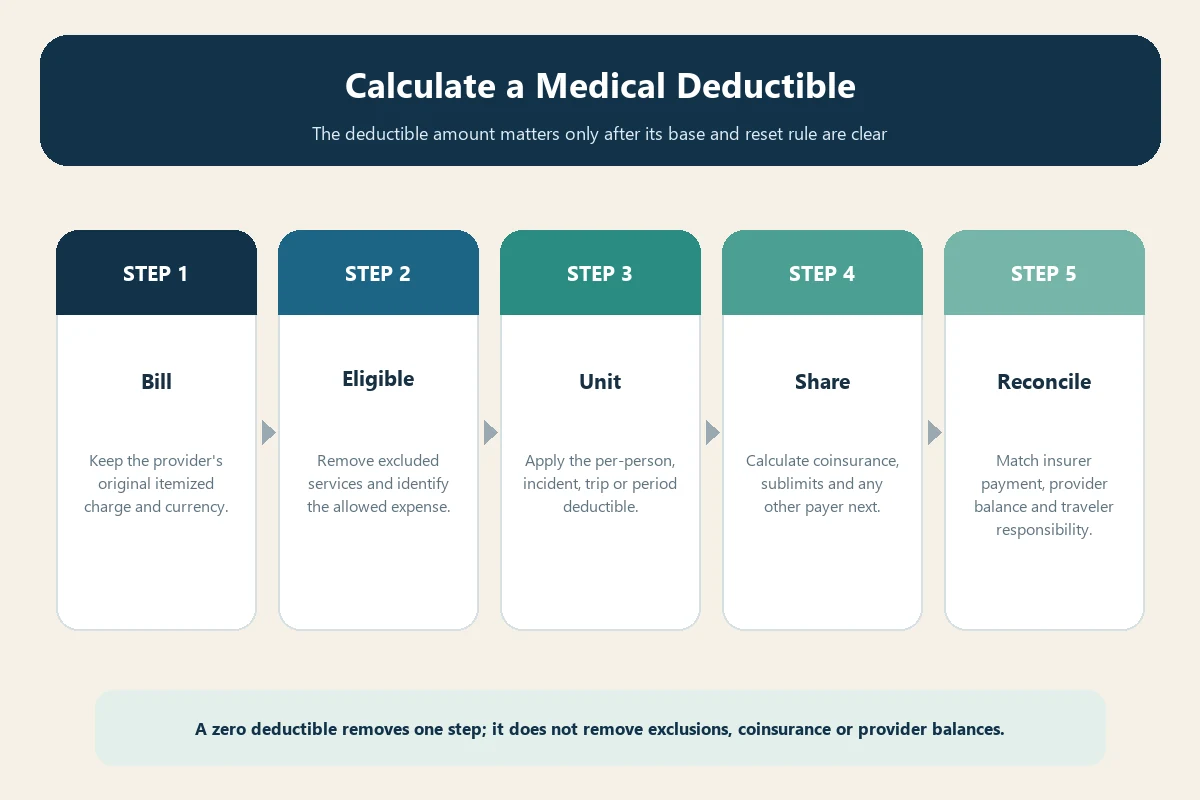
A provider’s invoice is the billed charge. The insurer may determine that only some services are covered and may recognize a lower eligible or allowed amount. The deductible is then applied according to the policy, often after ineligible charges are removed.
Ask who bears a charge above the recognized amount and whether a network agreement changes it. The traveler can owe the deductible, coinsurance, excluded services and any nonrecognized balance at the same time.
Calculate a simple eligible claim
Consider a purely illustrative case: an overseas clinic bills $900, the policy recognizes $800 as eligible, and a $100 deductible applies. If no other cost sharing exists, the payable base after the deductible is $700. The $100 in excluded or unrecognized charges remains separate.
This is not a benefit promise. Change the policy’s eligible amount, deductible unit or coinsurance and the result changes. Use the actual explanation of benefits to show every adjustment in order.
Per-person deductible
A per-person deductible applies separately to each insured traveler under the stated period. A family of four can therefore have more than one deductible even when all travelers share one certificate. Ask whether a family aggregate also exists.
Test two travelers who become ill in the same incident. Determine whether each person’s eligible bills meet a separate deductible. Preserve patient-specific invoices and claim numbers so expenses are not mistakenly combined.
Per-incident or per-occurrence deductible
This structure can reset when a new unrelated sickness or injury occurs. The definition of incident or occurrence matters: follow-up visits for the same diagnosis may stay together, while a later unrelated event may start again.
Ask how the insurer groups symptoms, referrals, prescriptions and follow-up care. Obtain a written response for a multi-visit scenario. The medical record should link the treating episodes accurately rather than being rearranged for a claim.
Per-trip deductible
A per-trip deductible may apply once across eligible medical events during one defined trip. The policy must explain when the trip begins and ends. Returning home, starting a new journey or exceeding a maximum duration can reset eligibility.
Annual policies can still apply one deductible to each trip. Do not assume “annual” means one deductible for the entire year. Compare the policy period, maximum trip duration and trip definition together.
Policy-period deductible
A period-based deductible can accumulate across eligible claims until the period ends. Check the effective dates, renewal date and whether an extension creates a new period. Long-stay travelers should confirm how a mid-treatment renewal is handled.
Keep each explanation of benefits showing how much deductible has already been satisfied. A traveler should not have to reconstruct the accumulator from card statements alone.
Deductible before coinsurance
HealthCare.gov describes coinsurance as a percentage of a covered service cost paid after the deductible in common health-plan structures. A travel medical plan may use similar sequencing, but the actual certificate must confirm it.
Illustration: if $1,000 is eligible, a $100 deductible applies and the traveler then pays 20% coinsurance, the percentage is applied to the remaining $900 under that assumed sequence. The traveler pays $100 plus $180; the policy share is $720, before any other limit.
Do not assume an out-of-pocket cap
Marketplace plans have regulated cost-sharing structures, and HealthCare.gov explains their out-of-pocket maximum. A travel medical certificate is not automatically a Marketplace plan and may not promise an equivalent cap.
Search for explicit out-of-pocket wording. If none exists, calculate every deductible, coinsurance share, excluded expense and charge above the allowed amount separately. The medical maximum limits insurer payment; it is not necessarily a limit on the traveler’s liability.
Check separate service deductibles
Some policies may apply different cost sharing to an emergency room, hospital admission, prescription, dental service or provider network. A medical evacuation benefit can have no deductible, a separate one or different authorization rules.
Build a row for each benefit rather than carrying one deductible across the certificate. The evacuation limits guide helps separate medical treatment from transport.
Compare zero-deductible plans correctly
A zero deductible means one cost-sharing step is absent. It does not make an excluded condition, activity or service payable. Coinsurance, sublimits, provider balances and other-insurance rules can remain.
The zero-deductible guide shows how to compare the full claim path. Ask whether “zero” applies to every traveler, destination and medical benefit shown in the quote.
Compare premium with expected exposure
A higher deductible may reduce the purchase price, but the traveler needs enough liquidity to pay it plus noncovered charges. Compare quotes with identical travelers, dates, destination, limits and benefits so the deductible is the controlled variable.
Run a low-cost clinic scenario, a hospital scenario and a second unrelated incident. This reveals whether the deductible difference matters only on small claims or repeats across the trip.
Check primary and secondary processing
A secondary policy may require a domestic insurer’s decision before calculating its eligible share. The deductible can apply after other insurance according to the coordination clause. A primary label can shorten the payer sequence without guaranteeing direct provider payment.
The primary versus secondary guide maps the documents. Save every explanation of benefits, denial, provider adjustment and prior payment.
Verify the domestic health-plan gap
The U.S. Department of State’s insurance checklist recommends asking a U.S. provider whether emergency and routine care abroad is covered. The answer affects which plan processes first and which deductible might apply.
The CDC’s travel insurance guidance says travelers may need to pay foreign medical bills out of pocket and should examine existing coverage. Use the health insurance abroad guide to record the domestic plan’s geographic, network and claim rules.
Ask about provider payment
Direct payment and the deductible are separate questions. Assistance may arrange a guarantee for the eligible insurer share while the hospital asks the traveler to pay the deductible and noncovered amounts. Another provider may require the entire bill upfront.
Before admission when practical, ask assistance what it can confirm and request a case number. The assistance versus claims guide explains why coordination is not final reimbursement approval.
Check activities and pre-existing conditions
A deductible calculation begins only after the event is eligible. Scuba, climbing, racing or motorcycling exclusions can remove the expense. A pre-existing-condition definition or stability rule can do the same for treatment related to prior health history.
Use the activity exclusions guide and pre-existing condition guide. Do not choose a deductible before confirming the risk itself is covered.
Build a deductible audit table
Create columns for service date, diagnosis or incident, billed charge, excluded charge, recognized amount, other insurance, deductible applied, accumulator remaining, coinsurance, sublimit, policy payment and traveler share.
Use one row per provider or service. This prevents a percentage from being applied to the wrong base and shows whether a second deductible was justified. Ask the insurer to explain any unexpected reset.
Document the claim in order
Collect clinical notes, itemized invoices, prescriptions, payment proof, assistance contacts and other-payer decisions. Label each with the traveler, currency and incident. Keep the original charge and actual card conversion.
The claim documentation guide helps reconcile the final amount. An insurer calculation can be appealed more effectively when every adjustment and deductible unit is visible.
Check refunds and corrected invoices
A hospital may initially collect a deposit and later issue a final statement or refund. Apply the deductible to the claim under the policy’s rules, not to a temporary authorization. Keep both documents and show how the provider reconciled them.
If a provider corrects an invoice after the insurer has processed it, notify the claims team and preserve both versions. A changed eligible amount can alter the deductible accumulator, coinsurance and later claims. Ask for a revised explanation of benefits rather than calculating the adjustment informally.
Bottom line
The smallest deductible is not automatically the best policy, and the largest deductible is not automatically the best value. Identify the eligible expense base, reset unit, coinsurance sequence, service-specific rules and payer order. Then compare the purchase price with the traveler’s realistic ability to fund care abroad.