

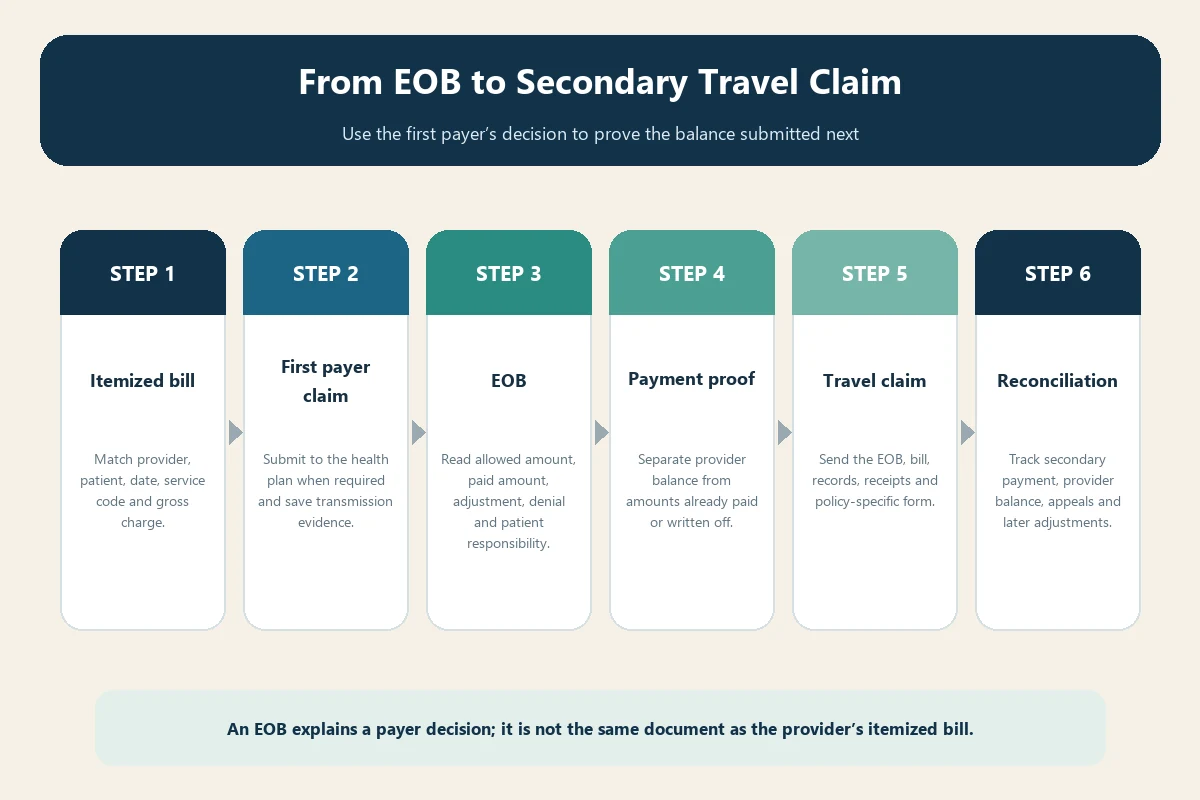
A travel insurance claim Explanation of Benefits request often appears after a traveler has already sent a bill and receipt. That request is not necessarily duplication. An Explanation of Benefits, commonly called an EOB, shows how a health plan processed an expense: the billed charge, allowed amount, plan payment, adjustments, denial or remark codes, and the amount assigned to the patient. A secondary or excess travel medical insurer uses that decision to calculate the remaining eligible loss.
An EOB is not a bill, a medical record, or proof that the traveler paid. A complete claim may need all four. This guide explains how U.S. travelers can read the first payer’s decision, respond when no EOB exists, and keep multiple claim deadlines under control.
Key takeaways
- An EOB documents a payer decision; it does not request payment from the patient.
- Secondary travel medical coverage commonly needs the first insurer’s EOB or formal denial.
- A zero payment can mean denial, deductible, missing information, coordination, or a processing error.
- Submit the itemized bill, EOB, proof of payment, clinical support, and travel policy form as distinct records.
- Waiting for an EOB does not automatically extend a travel policy’s notice or proof-of-loss deadline.
What an Explanation of Benefits actually shows
Health insurers issue an EOB after processing a claim. Medicare beneficiaries receive a Medicare Summary Notice for Original Medicare claims, while Medicare Advantage, employer, retiree, or individual plans issue their own statements. Although layouts differ, the document normally identifies the patient, provider, dates of service, procedure or service lines, billed amount, allowed amount, payer payment, adjustments, and member responsibility.
The EOB’s reason and remark codes matter. They can show that the expense was excluded, applied to a deductible, reduced to a contracted rate, sent to another payer, denied for missing information, or rejected because the provider needs to correct the claim. A travel insurer cannot reliably calculate a secondary benefit from the bottom-line balance alone.
EOB versus itemized bill
An itemized bill comes from the hospital, physician, ambulance company, laboratory, or pharmacy. It describes what was charged. The EOB comes from an insurer or health plan and describes what that payer did with the charge. A receipt or card statement shows money changed hands. Clinical records explain why the care was medically necessary. These documents answer different questions.
For a clean claim packet, keep the provider’s original itemized invoice, the first payer’s full EOB, proof of any amount the traveler paid, and any corrected or final account ledger. Do not edit an invoice so it displays only the unpaid balance. Adjusters need an auditable trail from original charge to net loss.
Why secondary travel medical insurance requests an EOB
A policy described as secondary or excess generally pays after other collectible insurance for the same eligible expense. Its primary-versus-secondary travel medical rules may require the traveler to submit the expense to a domestic health plan first. The EOB establishes whether the first plan paid, denied, applied a deductible, or requested more information.
The secondary carrier then applies its own contract. It can have a different deductible, benefit maximum, definition of medically necessary treatment, pre-existing-condition rules, exclusions, and reasonable-and-customary limits. The patient responsibility on the first EOB is therefore not an automatic promise of payment by the travel insurer.
Original Medicare and the Medicare Summary Notice
Original Medicare’s Medicare Summary Notice is the practical equivalent of an EOB. It summarizes Part A or Part B claims and explains whether Medicare approved each service. It is not a bill. Travelers can review notices through their Medicare account and follow the appeal instructions when a decision appears wrong.
For covered care in the United States, a secondary travel insurer may request the notice before evaluating the balance. For most care outside the United States, Original Medicare generally does not pay, subject to narrow statutory exceptions. Ask the travel insurer what documentation it accepts for noncoverage. Depending on the claim, it may request a formal Medicare decision, a written plan statement, or another specific record.
Medicare Advantage and private health plans
Do not assume a Medicare Advantage plan follows Original Medicare’s foreign-coverage result. Some plans include worldwide emergency or urgent-care benefits with plan-specific notice, reimbursement, and filing rules. Submit the expense according to the member materials and obtain the plan’s EOB. The travel insurer may need that decision even when an Original Medicare publication says routine foreign care is generally outside Medicare.
The same principle applies to employer, retiree, marketplace, student, TRICARE, or other coverage. Identify the actual plan responsible for the traveler and obtain its decision. A generic benefits summary is not a substitute for an expense-specific EOB unless the travel adjuster confirms otherwise in writing.
How to read a zero-payment EOB
A zero in the “plan paid” field does not reveal why nothing was paid. Check whether the amount was:
- applied to a deductible or coinsurance;
- excluded as a noncovered service;
- denied because coverage was not active;
- redirected to another insurer as primary;
- rejected because records, coding, or an authorization were missing;
- reduced by a provider contract or duplicate-claim edit; or
- pending while the plan requests more information.
Send every page, including code explanations. If the reason text is unclear, call the first payer and record the representative, date, reference number, and explanation. Ask for a corrected or final EOB when the initial statement is only provisional.
Foreign provider cannot bill the U.S. plan
Foreign hospitals often require the patient to pay and may not submit claims to U.S. insurers. The traveler may need to file a member claim using the health plan’s form. Request an itemized bill showing patient name, diagnosis or reason for treatment, service dates, each service and charge, currency, provider identity, and payment status. Obtain an English translation when the payer requires one, but retain the original-language document too.
Original Medicare beneficiaries who believe a foreign service fits a Medicare exception may need the Patient’s Request for Medical Payment form and supporting records. Follow the current Medicare instructions; do not file merely to create a denial unless the travel insurer or Medicare directs that workflow.
Denial letter versus EOB
A formal denial letter can supplement or replace an EOB when a plan cannot process the expense through its ordinary claims system. The strongest record identifies the patient, provider, date and amount, the plan, the precise coverage reason, and appeal rights. A customer-service email saying “international care is not covered” may be too general for a secondary carrier.
Ask the travel adjuster exactly what it will accept. Save that answer. If a formal first-payer claim would jeopardize another deadline, submit the travel claim on time with the available records and explain that the EOB or denial is pending.
Five-part submission packet
- Provider record: itemized bill and relevant clinical documentation.
- First-payer decision: every page of the EOB, Medicare Summary Notice, or formal denial.
- Payment record: receipt, card statement, bank record, or provider ledger showing who paid.
- Travel-policy record: claim form, itinerary, proof of travel dates, and policy or certificate number.
- Reconciliation: a one-page table matching each invoice line to payer decisions, refunds, and the remaining amount requested.
This structure is more useful than one large unsorted PDF. Name files with the date, provider, and document type, and preserve unredacted originals. Use secure portals when available rather than ordinary email for sensitive health information.
Build the reconciliation table
Create one row for each provider and date of service. Record the original currency and charge, conversion method if required by the policy, first payer allowed amount, first payer payment, contractual adjustment, patient responsibility, amount actually paid, refund received, and amount submitted to travel insurance. Add the EOB page and claim-line reference.
If the figures do not reconcile, resolve the difference before declaring the packet final. A provider may have posted the insurer payment after issuing the bill, or a refund may be pending. Report later reimbursements promptly so total recovery does not exceed the eligible loss.
Keep four deadline clocks
Travel policies can contain separate deadlines for emergency notification or preauthorization, notice of claim, proof of loss, and appeal. The domestic health plan has its own claim and appeal periods. Waiting for an EOB usually does not pause the travel insurer’s clock. File notice promptly, provide what is available, identify the missing EOB, and ask in writing how to supplement the claim.
Use the workflow in our travel insurance claim documentation guide, and review common claim-denial reasons before submitting. If a medical event also ends the trip, track the separate evidence needed for trip interruption. Medicare coordination is covered step by step in our Medicare coordination guide.
Questions to ask the travel insurer
- Is this medical benefit primary, secondary, or excess for this expense?
- Which health plan must receive the claim first?
- Will you accept a coverage letter instead of an expense-specific EOB?
- What must a foreign itemized bill contain?
- Can I submit notice now and add the EOB later?
- How should exchange rates, provider refunds, and later reprocessing be reported?
- Which portal or address should receive sensitive records?
FAQ
Is an EOB proof that I paid?
No. It describes the payer’s processing. Provide a receipt, account ledger, or financial statement separately when the claim requires proof of payment.
Is the patient-responsibility amount automatically covered?
No. The travel insurer applies its own deductible, exclusions, limits, and eligible-expense definition.
What if my EOB is wrong?
Contact the first payer about a correction or appeal and tell the travel insurer that the decision is disputed. Protect every policy deadline while the issue is pending.
Can I submit a screenshot?
A complete downloadable statement is safer because it includes patient, claim, page, and code details. Follow the adjuster’s file requirements.
Bottom line
An EOB turns a medical charge into a documented payer decision. For secondary travel medical claims, submit the full EOB or formal denial together with the itemized bill, payment evidence, clinical support, and a clear reconciliation. Read reason codes carefully, separate pending claims from true denials, and never let the wait for another payer erase a travel-policy deadline.
Sources
- Medicare — Medicare Summary Notice
- Medicare — Claims
- CMS — Coordination of Benefits
- CMS — Patient’s Request for Medical Payment
- Medicare — Coverage Outside the United States
- NAIC — What to Know About Travel Insurance
Reviewed August 16, 2026. This educational guide does not replace your policy certificate, health-plan documents, medical advice, or a claim decision from an insurer.
