
A travel insurance claim W-9 request before payment should be verified, not ignored or answered through an unprotected email. Form W-9 collects a U.S. payee’s taxpayer identification number and certifications for a requester. It does not, by itself, prove that the travel claim payment is taxable or that a Form 1099 will be correct.
This U.S.-focused guide explains how to confirm the requester, intended payee, purpose, form version, secure channel, payment hold, withholding statement, and later tax document. It is general information, not tax, legal, accounting, identity-theft, or insurance advice. Ask the payer and a qualified tax professional about the specific payment.
Identify who is being asked for a tax form
The request may concern the insured traveler, claimant, person who paid an expense, medical provider, repair vendor, estate, attorney, business, or another approved payee. Do not provide one person’s Social Security number for a payment intended for another entity.
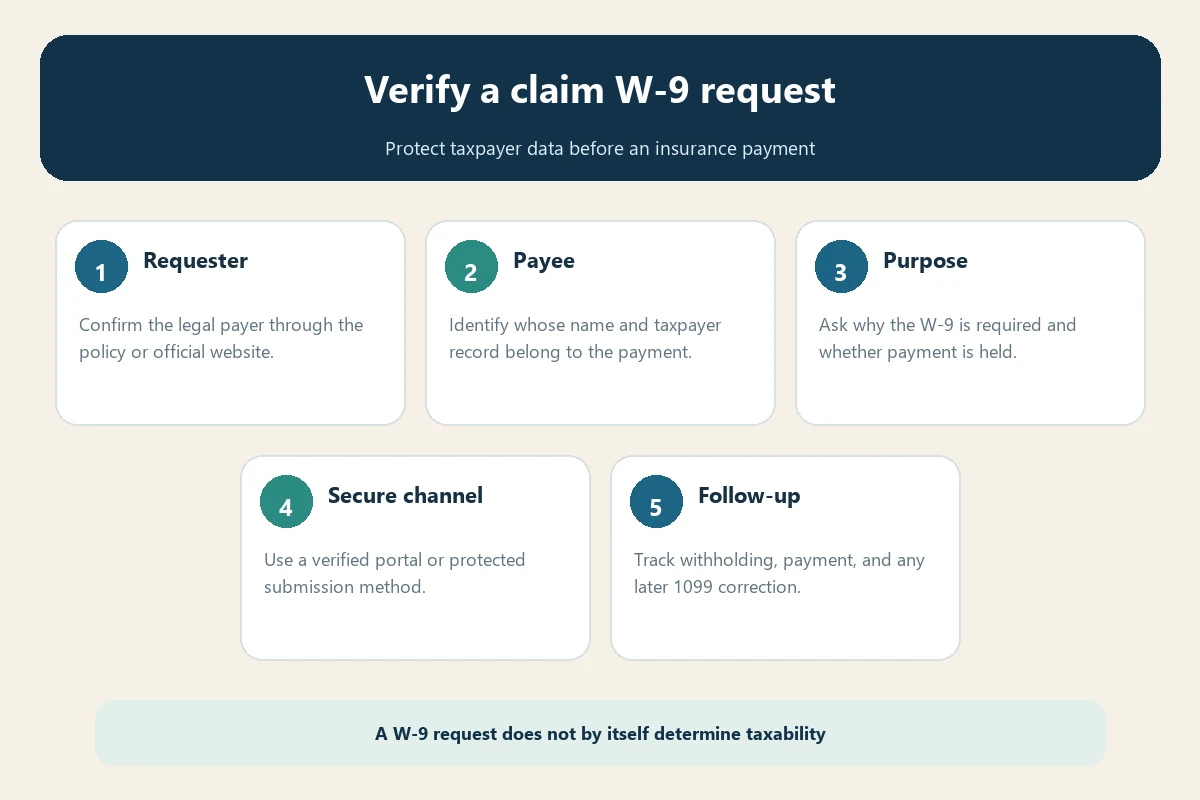
| Question | Why it matters | Record to obtain |
|---|---|---|
| Who is the requester? | Confirms the insurer, administrator, payment vendor, or other payer | Legal name, official contact, claim role |
| Who is the payee? | Determines whose name and taxpayer record are relevant | Written payment approval |
| What payment? | Separates reimbursement, benefit, vendor fee, or settlement | Decision and line-item calculation |
| Why this form? | Identifies reporting, withholding, or vendor setup purpose | Written explanation |
| Which channel? | Protects TIN and certification data | Verified secure submission instructions |
Understand what Form W-9 does
The IRS Instructions for the Requester of Form W-9 explain that the form requests the taxpayer identification number of a U.S. person and certain certifications or exemption claims. The requester, not the IRS, normally asks the payee to complete it.
A W-9 is an information and certification form. It is not a tax bill, claim release, settlement agreement, assignment of benefits, or proof that the insurer’s calculation is correct. Review every separate document on its own terms.
Do not infer taxability from the request alone
Tax treatment can depend on what the payment replaces, who receives it, how the underlying expense was treated, business or personal context, multiple insurance reimbursements, settlement terms, and federal and state rules. A travel policy can pay medical expenses, unused trip costs, baggage value, delay allowances, accidental death benefits, provider charges, or other items that do not share one tax answer.
The fact that a payer requests a W-9 or issues a 1099 does not resolve the recipient’s correct tax reporting by itself. Do not rely on a claims representative for individualized tax advice. Ask for the payer’s stated reporting position and consult a qualified tax professional with the policy, decision, expense records, and form.
Verify the request independently
Use a telephone number or secure portal obtained from the issued policy or official website—not the contact details inside an unexpected message. Confirm:
- claim number and exact approved payment;
- legal requester and its relationship to the insurer;
- intended payee and payee type;
- why taxpayer information is requested;
- whether payment is held and on what basis;
- accepted form version and signing method;
- secure upload, portal, fax, or postal destination;
- contact for later correction or tax statements.
The travel claim payment scam guide explains how to validate domains, payment vendors, urgent requests, changed bank details, and recovery demands.
Use the current official form and instructions
Obtain Form W-9 and instructions from the official IRS Form W-9 page or the payer’s verified secure workflow. Compare the revision and fields before entering data. Do not trust a search-ad download or an attachment with extra bank-password fields.
Complete only the form appropriate to the payee’s actual status and the requester’s valid instructions. A non-U.S. person, estate, entity, disregarded entity, exempt payee, or joint payee can present different questions. Do not guess the entity classification or substitute a form based on an online comment; obtain tax guidance.
Protect the TIN and signature
A W-9 can contain a Social Security number or employer identification number, legal name, address, entity classification, and signature under penalties of perjury. Treat it as a high-sensitivity identity document.
Avoid ordinary unencrypted email unless a qualified adviser and verified requester confirm an appropriate secure method. Prefer an authenticated portal or another protected channel offered by the payer. Save the submission receipt, not an exposed copy in a shared downloads folder.
The claim document redaction guide explains why the secured master can differ from a redacted reference copy. Do not redact the TIN on the actual W-9 if the valid requester requires it; instead, use a secure route.
Separate W-9 data from banking data
Form W-9 does not request online banking credentials, a card PIN, portal password, or one-time authentication code. A payer may separately request payment instructions through a secure process, but the two records serve different purposes.
Do not place full bank details in the W-9 email body. Use the claim payment method guide to verify ACH, check, digital payment, payee, trace, and reissue instructions.
Ask whether the request is for the claimant or provider
A foreign clinic, U.S. provider, translator, contractor, attorney, or other vendor may be a proposed direct payee. The administrator may need vendor information that the traveler does not possess and cannot certify.
Do not complete a provider’s W-9 or invent its TIN. Send the request to the verified provider contact or ask the administrator whether reimbursement can be issued to the person who actually paid, subject to the policy. Preserve the invoice, payment proof, approved payee, and provider response.
The assignment of benefits guide distinguishes direct provider payment, claimant reimbursement, assignment, guarantee, and authorization.
Request a written payment-and-tax explanation
Re: Claim [number]. I received a request for Form W-9 before payment. Please confirm the legal requester, intended payee, payment type and amount, purpose of the W-9, secure submission channel, payment hold status, anticipated information-return form if known, and contact for correcting any later tax statement. This request seeks process clarification and does not make a tax classification.
Keep the response with the claim decision. If the administrator has not supplied a detailed outcome, use the written claim decision guide to request the line-item basis and appeal instructions.
Track backup withholding separately
The IRS W-9 requester instructions discuss circumstances involving backup withholding and certifications. Do not assume a reduced insurance deposit is a deductible, claim denial, fee, or tax withholding without documentation.
Ask the payer to identify any amount withheld, rate, legal or tax basis it relies on, deposit amount, and tax form that will report the withholding. Keep this separate from insurance-policy deductible, coinsurance, sublimit, refund, or other-insurance reduction.
Review any later Form 1099
The IRS General Instructions for Certain Information Returns explain the information-return framework. When a tax statement arrives, compare payer name and TIN, recipient name and TIN, form type, tax year, amount, boxes, withholding, and claim payment records.
A mismatch can arise from wrong payee data, duplicate reporting, a corrected payment, or a payer’s classification. Contact the payer through its official correction process and preserve the original and corrected forms. Consult a tax professional about how to report while a correction is pending.
Store tax records separately and securely
Keep the signed W-9, submission receipt, payer explanation, withholding record, payment advice, and tax statement in a restricted tax folder. The general claim folder can contain a note that verification was completed without exposing the full TIN to every helper or representative who reviews receipts.
Record who can access the sensitive folder, when the form was transmitted, and which requester received it. Follow qualified tax and legal guidance for retention and secure destruction. Do not delete the only copy while payment, a corrected 1099, identity concern, tax return, audit period, appeal, or estate administration remains unresolved.
Work through a W-9 request example
A travel administrator approves $3,200 for a claimant’s unused tour and sends an email attachment requesting a W-9. The email domain differs slightly from the administrator’s website and asks the claimant to return the form with bank login details.
The claimant should not reply. Using the number on the policy, the claimant should confirm whether the administrator uses a payment vendor, whether a W-9 is genuinely required, and where the official secure form is located. Bank login credentials should never be supplied.
If the verified administrator confirms the request, the claimant should ask who the approved payee is and why the form is needed, submit through the secure channel, and retain the receipt. The claimant should not infer taxable income or nontaxable reimbursement from the form alone and should obtain tax advice with the final decision and any 1099.
W-9 request checklist
- Identify the requester independently.
- Confirm claim number, payment, and intended payee.
- Ask the stated purpose and payment-hold status.
- Use the official current form and instructions.
- Do not certify another person’s or provider’s TIN.
- Use a verified secure channel for taxpayer data.
- Keep banking credentials outside the W-9 process.
- Document any withholding separately from claim reductions.
- Compare and correct any later tax statement.
- Obtain qualified tax advice for the actual payment.
A legitimate W-9 request can be part of payment administration, but it deserves the same verification as a bank change. Confirm who asks, whose taxpayer information belongs on the form, why it is needed, and how it will be protected—then keep the tax record connected to the actual claim decision.