
A travel insurance claim overpayment repayment demand should be verified before money is returned. Ask the sender to identify the claim, original payment, alleged error, policy or legal basis, line-item calculation, deadline, dispute process, and secure repayment route.
Do not ignore a genuine demand, spend a known duplicate payment, or repay an unexpected caller through an improvised method. Overpayment rights vary by policy, state law, plan type, contract, facts, and timing. This U.S.-focused guide is general information, not legal, tax, debt, banking, accounting, or insurance advice.
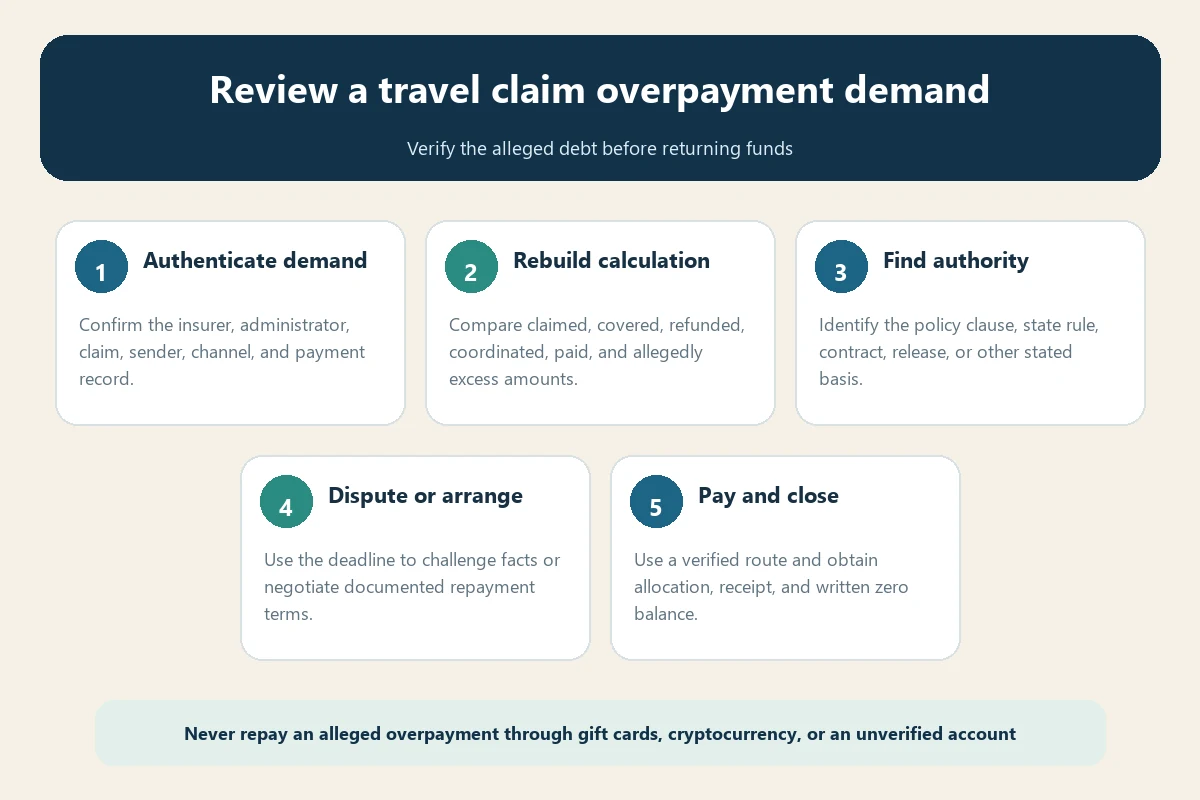
Authenticate the demand independently
Contact the insurer or administrator through the issued policy, official website, or authenticated claim portal—not the telephone number or payment link in an unexpected message. Confirm the sender’s name, department, mailing address, claim number, demand reference, and relationship to the legal insurer.
Ask whether the demand appears in the claim file and whether a third-party recovery vendor is authorized. The claim payment scam guide explains how to validate domains, urgent repayment claims, fake overpayments, changed accounts, and recovery fees.
| Demand element | Evidence to request | Risk if missing |
|---|---|---|
| Original payment | Decision, date, amount, method, trace | Wrong claim or recipient |
| Reason | Duplicate, refund, offset, error, coordination | Vague unsupported debt |
| Calculation | Line-item before-and-after ledger | Incorrect or double recovery |
| Authority | Policy clause, agreement, or applicable rule | No stated basis |
| Challenge process | Deadline, address, records, review level | Lost dispute rights |
| Repayment route | Verified legal payee and reference | Fraud or misapplied payment |
Identify the alleged overpayment type
Common explanations include a duplicate check or ACH, supplier refund received after insurance payment, benefit paid under the wrong coverage, deductible or limit error, currency correction, primary-secondary coordination, payment to the wrong person, returned expense, subrogation recovery, or revised eligibility decision.
These categories do not have identical consequences. A duplicate disbursement can be simpler to reconcile than a retroactive coverage reversal or disputed interpretation. Require the sender to select and document the actual theory.
Rebuild the claim calculation from source records
Create a ledger with every claimed expense, supplier refund, credit, chargeback, payment from another policy, insurer approval, deductible, limit, offset, exchange rate, and disbursement. Match each entry to a dated document and bank record.
Start with the original explanation of benefits and any revised decision. The travel claim EOB guide explains how to reconcile claimed, allowed, excluded, adjusted, and paid amounts.
Do not accept a demand that merely subtracts two totals without showing the affected line items. Check whether the company is seeking the gross payment even though only one component changed.
Check for a supplier refund or credit
A travel supplier may refund cash, reverse a card charge, issue a voucher, restore points, or pay compensation after the insurer reimburses the same loss. Determine whether the credit is refundable, transferable, restricted, expired, used, or actually received.
The supplier refund and subrogation guide explains how to prevent duplicate recovery while preserving differences in covered amount, nonrefundable cost, and usable value. Do not repay cash based only on a voucher’s face amount when its treatment is disputed.
Multiple insurance payments require allocation
If another insurer, credit-card benefit, employer plan, carrier, or health plan paid, compare the coordination clauses and the exact expense each payment covered. Receiving two payments connected to one trip does not prove that the same loss was paid twice.
Use the multiple travel claims guide to build one shared loss ledger. Ask which payer is primary, secondary, excess, or seeking contribution and why.
Confirm the contractual or legal basis
Ask the company to cite the issued policy provision, reimbursement agreement, assignment, release, coordination clause, subrogation clause, state rule, or other authority it relies on. Marketing pages and generic plan summaries are not substitutes for the contract issued to the claimant.
Do not assume that every administrative mistake can be retained, or that every demand is enforceable exactly as written. State limitation periods, notice requirements, defenses, equity, reliance, plan status, and contract language can matter. Obtain qualified legal advice for a material or old demand.
Government program examples are not private-policy rules
Public benefit programs often issue structured overpayment notices. For example, the Social Security Administration says its notice explains the reason and provides appeal or waiver routes in that program. See the official SSA overpayment page.
TRICARE likewise states that its contractor sends a written repayment request when it finds an overpayment to a beneficiary or provider. See TRICARE’s recoupment guidance. These federal program procedures do not create identical rights or deadlines under private travel insurance; they illustrate why a written reason, calculation, review path, and payment record matter.
Protect the dispute deadline
Record the notice date, presumed receipt date, response deadline, appeal or reconsideration deadline, collection date, and any interest or fee date. Ask in writing whether a timely dispute pauses collection, offset, referral, or interest.
If more time is needed to obtain records or advice, request an extension before the deadline. State that the request does not admit the alleged debt. Preserve proof of delivery for every challenge.
Send a focused written dispute
A useful response identifies the demand and separates agreed from disputed facts. It can request:
- the original and revised claim decisions;
- complete transaction and payment ledger;
- specific overpaid line items and arithmetic;
- policy or legal authority;
- supplier, carrier, or other-insurer evidence;
- explanation of any interest, fee, or offset;
- review procedure and collection hold;
- corrected balance after reconsideration.
Attach only relevant records and retain originals. Do not send full bank histories when a redacted transaction proves receipt or nonreceipt.
Do not confuse a partial claim with an overpayment
A claimant may still be owed money on other expenses even if one line was overpaid. Require the administrator to maintain a claim-wide ledger and identify whether it proposes netting amounts.
The partial travel claim payment guide helps reconcile approved and unpaid items. Do not sign a broad release of unrelated benefits merely to correct one payment error.
Verify any proposed offset
The payer may propose deducting the alleged debt from another claim or future benefit. Ask for the contract or legal basis, exact claims affected, timing, calculation, notice, and challenge rights. Do not assume that an internal accounting entry proves a lawful offset.
If another traveler, provider, policy, or benefit is involved, confirm the debtor and creditor are legally the same parties. A household relationship alone does not necessarily permit cross-account collection.
Arrange repayment only after the amount is verified
If the debt is accepted, ask whether payment in full, installments, corrected offset, return of an uncashed duplicate check, or reversal of an unused instrument is appropriate. Obtain the terms in writing, including amount, schedule, interest, fees, default, allocation, and final release or zero-balance confirmation.
Do not borrow, liquidate assets, or agree to an unaffordable schedule without understanding alternatives and obtaining financial or legal advice. A good-faith request for terms should preserve the exact disputed and agreed amounts.
Use a verified repayment channel
Confirm the legal payee, bank account, portal, mailing address, memo reference, and responsible department independently. Never repay through gift cards, cryptocurrency, cash courier, personal payment handle, or an account changed only by email.
For a duplicate uncashed check, ask whether to mark it void and return it with tracking rather than deposit and send separate funds. Keep a copy and the payer’s instruction. For ACH or card repayment, preserve the confirmation without exposing full credentials.
Tax reporting may need correction
If the payer requested a W-9, issued a Form 1099, withheld tax, or the payment crossed tax years, repayment may require a corrected information return or individualized reporting analysis. Ask the payer what it will report and when.
The claim W-9 request guide explains why a tax form does not itself decide taxability. Consult a qualified tax professional with the demand, repayment proof, and any original or corrected forms.
Obtain final allocation and closure
After repayment, request a receipt showing date, amount, method, demand reference, principal, interest or fees, affected claim, and remaining balance. Ask for a revised claim ledger and written confirmation that the verified overpayment is satisfied.
Check that no automatic collection, future offset, duplicate demand, or recovery-vendor account remains open. Retain the notice, dispute, agreement, payment proof, and closure for the applicable record period.
Escalate an unsupported or fraudulent demand
If the insurer will not explain the debt or correct a documented error, identify the relevant state insurance department through the NAIC regulator directory. A debt collector, bank, or identity-theft issue may require a different complaint route.
Provide the policy, original and revised decisions, demand, ledger, supplier or other-insurance records, dispute, responses, and deadline timeline. Do not ask one regulator to decide conduct outside its jurisdiction.
Bottom line
A travel insurance claim overpayment demand should be authenticated and reconstructed before repayment. Identify the exact error, affected expense, policy basis, amount, deadline, and challenge route. If repayment is verified, use a secure method, preserve its allocation, and obtain written zero-balance closure so the same alleged debt is not collected twice.
