
A travel insurance arbitration exhibit list should identify every document or demonstrative a party may offer, connect it to the issue it proves, and track its status through exchange, objection, offer, admission, limitation, or exclusion. Uploading a file to a portal does not automatically make it evidence.
The arbitration agreement, governing rules, preliminary order, pre-hearing order, and hearing directions control exhibit deadlines, formats, numbering, delivery, objections, and use. This U.S. consumer guide provides general information, not legal advice.
Separate discovery files from hearing exhibits
Information exchange may contain thousands of pages, duplicates, drafts, and irrelevant records. The hearing set should be a focused collection tied to disputed coverage, causation, notice, compliance, loss amount, or credibility.
Use the arbitration document exchange checklist to preserve production history. Build the exhibit list as a later, decision-focused layer rather than renaming the entire discovery folder.
Read the case order before assigning numbers
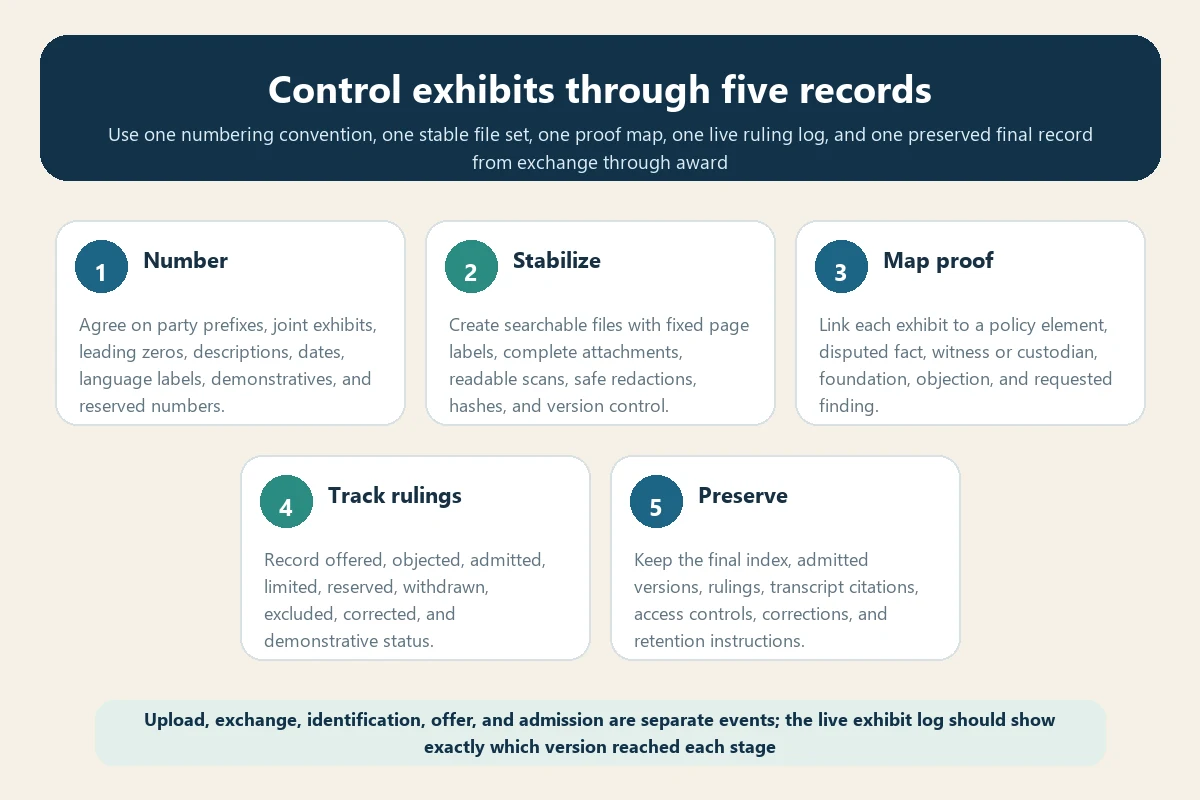
Confirm whether exhibits use claimant and respondent prefixes, joint numbers, sequential numbers, letters, leading zeros, language codes, or a provider convention. Ask how demonstratives, impeachment material, rebuttal exhibits, physical objects, audio, and video will be labeled.
Do not create a private numbering system after the arbitrator has ordered another. A late renumber can break witness outlines, objections, transcript citations, and other parties’ copies.
Build one master exhibit index
| Field | Purpose | Example control |
|---|---|---|
| Exhibit number | Stable identity | C-001 |
| Short description | Fast retrieval | Issued policy form |
| Date and source | Chronology and foundation | Insurer, purchase date |
| Page range | Precise citation | C-001.001–.024 |
| Proof issue | Relevance | Covered reason definition |
| Witness or custodian | Context and authenticity | Traveler or records custodian |
| Status | Hearing record | Admitted with limitation |
Add confidentiality, redaction, translation, objection, ruling, and transcript fields when needed. Keep the working columns separate from the clean index exchanged with others if the order does not require strategy notes.
Use short neutral descriptions
Describe what the file is, not what it proves: “Airline cancellation notice dated June 4” is neutral; “Proof the insurer wrongly denied the claim” is argument. A neutral index helps everyone find the document without embedding disputed conclusions.
Use consistent names for policy, itinerary, claim form, denial letter, appeal, medical record, supplier notice, receipt, refund ledger, photograph, and correspondence.
Stabilize every file before exchange
Create a complete readable file with fixed pagination, correct orientation, searchable text when practical, all attachments, and no broken links. Preserve original native files and metadata separately when authenticity or electronic context matters.
Do not edit substantive content. Redact only under the governing rule or order and keep an unredacted controlled copy when required.
Use exhibit-level page labels
Apply unique page labels that remain stable when exhibits are combined or downloaded. A citation such as C-014.006 is less ambiguous than “page 6,” especially when PDF viewer numbers differ from printed labels.
Check that labels do not cover text, signatures, dates, account fields, or image details. Validate the first and last page after processing.
Detect duplicates and near-duplicates
Compare hashes, filenames, dates, page counts, and visible content. One email may appear alone, inside a thread, and as an attachment to a claim form. Choose the version that preserves necessary context.
Document why two similar versions both remain, such as different annotations, metadata, attachments, or recipients. Avoid burdening the hearing with cumulative copies.
Connect each exhibit to a proof issue
For every proposed exhibit, identify the policy element, disputed fact, witness, foundation, likely objection, and requested finding. If no material issue is served, remove it from the hearing set.
The opening statement guide helps preview only anchor exhibits that support the decision roadmap.
Map witnesses and custodians
Identify who created, sent, received, maintained, photographed, downloaded, or relied on each record. A witness may explain source and context even when formal courtroom evidence rules do not apply unchanged.
Use the witness testimony guide to distinguish firsthand knowledge from assumptions and to avoid calling multiple witnesses for the same uncontested point.
Track authenticity and completeness
Record whether the document is an original, native export, certified record, complete statement, screenshot, scan, partial thread, or copy received from another party. Preserve transmission details and any certification.
For a screenshot, keep the URL, date, full screen context, underlying file when available, and explanation of who captured it. Do not crop away information that changes meaning.
Handle medical records carefully
Limit the set to material dates, diagnoses, treatment, restrictions, or causation evidence while following privacy and protective requirements. Confirm completeness of the relevant encounter and legibility of handwritten or scanned pages.
Do not alter a medical record to simplify it. Use an authorized excerpt or demonstrative only if the source pages remain identifiable and available.
Reconcile the damages exhibits
Link receipts, card statements, invoices, supplier credits, refunds, chargebacks, vouchers, other insurance, deductibles, and limits to one final ledger. Mark unsupported and duplicate items.
The ledger should show the calculation, while underlying exhibits prove each line. The final total must match the relief requested in the closing argument.
Exchange according to the actual order
Calendar the list deadline, file deadline, objections, responses, meet-and-confer, joint index, hard copies, portal upload, supplemental exhibits, and hearing. Record method, recipients, time, and proof of delivery.
FINRA Rule 12514, for example, requires prehearing exchange of intended hearing materials in that forum and restricts late materials absent good cause. FINRA’s official rule does not govern an AAA case, but illustrates why the assigned deadline and late-exhibit standard matter.
Use the AAA Hearing Exhibits space correctly
AAA’s official Hearing Exhibits Space FAQ explains that parties and arbitrators may agree on its use, numbering and descriptions support sorting, and parties generally upload, index, and manage their own materials.
The case manager generally does not curate the exhibits. Confirm activation, access, naming, upload cutoff, file size, replacement procedure, download behavior, and retention.
Do not confuse upload with admission
Maintain separate timestamps and status for produced, exchanged, uploaded, identified, offered, objected, admitted, limited, excluded, and withdrawn. A portal proves availability, not necessarily evidentiary status.
Ask the arbitrator to state rulings clearly. Update the live log without overwriting the original exchange record.
Prepare an objection matrix
For each contested exhibit, record objection, response, proposed limitation, supporting rule or order, witness, and ruling. Common issues include relevance, duplication, completeness, source, privacy, privilege, unfair surprise, readability, and missing translation.
Keep objections concise and tied to the practical problem. Current AAA Consumer Arbitration Rules give the arbitrator broad authority over relevance, materiality, weight, privilege, and cumulative evidence.
Separate demonstratives from evidence
A timeline, chart, calculation, or slide may help explain admitted material but may not itself be evidence. Label demonstratives separately and cite every source exhibit.
Confirm advance exchange, objections, display permission, record status, and whether a copy becomes part of the file. Do not place new facts into a closing slide.
Prepare audio, video, and physical items
Identify format, duration, player, codec, excerpt, transcript, source, custodian, privacy, and backup for audio or video. Test on the actual hearing system.
For physical evidence, photographs, or large items, confirm inspection, transport, storage, marking, substitution, and return. A filename alone cannot describe a physical chain of custody.
Control translated exhibits
Keep the source-language document, translation, translator certification if required, language code, matching pagination, objection, and controlling version together. Do not replace the original with translation alone.
Use the arbitration interpreter guide to separate written translation from oral interpretation at the hearing.
Run a pre-hearing exhibit audit
- Every index row has a unique number and neutral description.
- Every file opens, is complete, readable, searchable, and correctly paginated.
- Every exhibit maps to a material issue and available foundation.
- Every redaction, translation, confidentiality label, and version is correct.
- Every objection and response deadline is calendared.
- Every participant has the authorized identical set.
Maintain a live hearing log
Assign one person to record offer time, witness, objection, ruling, limitation, admitted version, correction, and transcript reference. In a self-represented case, update the log during breaks rather than losing focus during testimony.
For a virtual arbitration hearing, confirm the displayed file and admitted file are identical. Stop sharing excluded material promptly.
Reconcile the record after each session
Compare the live log with the arbitrator’s rulings, reporter notes, portal, and parties’ indexes. Resolve number errors, replacement pages, and reserved rulings through the authorized channel.
Never silently substitute a corrected file. Preserve the original and document what changed, why, when, who received it, and which version controls.
Preserve the final exhibit record
Keep the final index, admitted versions, excluded-item log, rulings, transcript citations, corrections, source files, hashes, proof of exchange, confidentiality order, and retention instructions.
Restrict access to medical and financial material. Do not retain portal downloads indefinitely on unsecured personal devices.
Common exhibit-list mistakes
- Turning the entire discovery production into the hearing set.
- Renumbering after witness outlines and objections are complete.
- Using unstable viewer page numbers instead of exhibit page labels.
- Uploading incomplete threads, missing attachments, or unreadable scans.
- Assuming portal upload equals admission into evidence.
- Failing to distinguish source documents, translations, and demonstratives.
- Losing track of limited, excluded, corrected, or replacement versions.
- Citing an exhibit in closing that was never admitted.
Final exhibit-list checklist
- Follow the ordered numbering, format, exchange, objection, and upload procedure.
- Use one master index with stable files, pages, descriptions, and proof mapping.
- Track foundation, authenticity, privacy, translation, objections, and rulings.
- Distinguish exchange, upload, identification, offer, and admission.
- Reconcile the live hearing log and preserve the exact final record.
Coordinate the exhibit list with the arbitration hearing preparation checklist and hearing transcript guide. A reliable exhibit system lets the arbitrator find the right admitted page, understand what it proves, and cite the same version every participant used.
