
If an insurer sends a travel insurance claim W-8BEN request, verify the requester and payment before providing sensitive information. Confirm the legal payer or withholding agent, individual beneficial owner, foreign status, correct W-8 form, payment category, secure delivery channel, treaty claim, identifiers, signature, and expected tax-document follow-up.
Do not complete Form W-8BEN simply because a traveler lives abroad, has foreign citizenship, or uses an overseas bank. U.S. tax status, beneficial ownership, payment source, entity type, and effectively connected income can change the documentation route. This guide is general information, not tax, legal, immigration, accounting, or insurance advice.
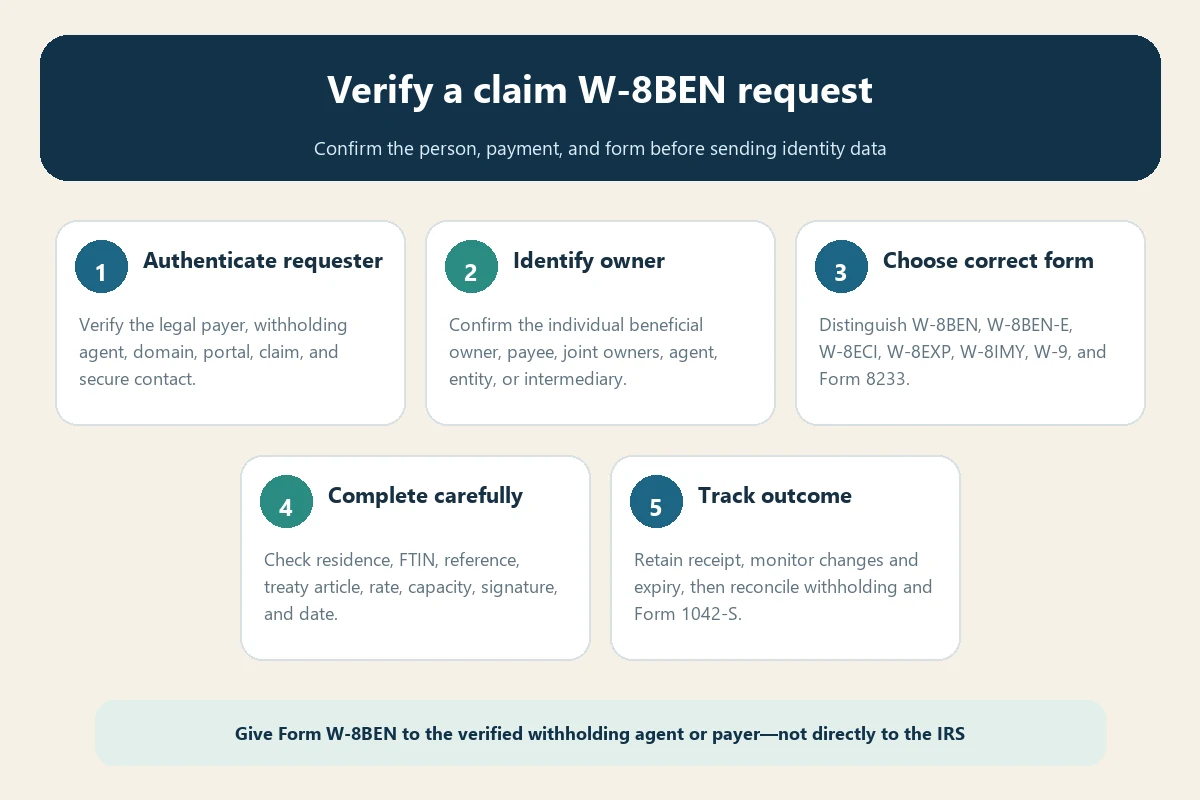
Authenticate the requester first
Independently verify the insurer, third-party administrator, settlement payer, withholding agent, or payment vendor. Use contact details from the policy, official website, prior authenticated portal, or known claims correspondence—not only the new email.
| Verification item | Evidence to request | Risk controlled |
|---|---|---|
| Legal requester | Entity name and role | Impersonation or wrong recipient |
| Claim link | Policy, claim, and payment reference | Unrelated data collection |
| Payment purpose | Benefit or settlement component | Wrong tax form |
| Secure route | Authenticated portal or encryption | Identity theft |
| Withholding outcome | Rate, exemption, and reporting plan | Unexplained net payment |
| Retention | Privacy and record policy | Excessive document exposure |
Understand what Form W-8BEN does
The IRS Instructions for Form W-8BEN explain that a foreign individual beneficial owner may use it to establish foreign status and, when applicable, claim a reduced rate or exemption under an income tax treaty.
The form does not decide whether the travel claim payment is taxable or U.S.-source. It supplies documentation to a withholding agent. The payer still needs to classify the payment and determine whether withholding and reporting rules apply.
Send the form to the payer, not the IRS
Form W-8BEN is generally given to the withholding agent or payer that requests it. The IRS instructions explicitly say not to send it directly to the IRS. Ask the insurer which legal entity will retain and rely on the certificate.
A message directing the claimant to mail a W-8BEN to an unexplained personal address or upload it to an unrelated domain should be treated as suspicious until independently verified.
Determine whether the claimant is a foreign individual
Form W-8BEN is designed for individuals in specified foreign-person circumstances. A U.S. citizen or other U.S. person generally uses Form W-9, even when living abroad. Tax residency can require analysis beyond mailing address, passport, or bank country.
The claim W-9 request guide covers the U.S.-person route. If status is uncertain, obtain cross-border tax advice before certifying either form.
Identify the beneficial owner
The claimant, traveler, policyholder, beneficiary, provider, attorney, estate, agent, bank-account holder, and beneficial owner may be different parties. Ask who owns the payment under the policy and settlement records.
The IRS page on beneficial owners notes that different W-8 forms serve different certifications. An agent, nominee, custodian, partnership, trust, or entity should not sign an individual W-8BEN as though it owns the payment.
Joint owners require a complete owner review
A claim payment can belong to two travelers or be issued to joint payees. The W-8BEN instructions describe documentation implications for jointly owned income or accounts, including forms for owners.
Do not submit one traveler’s certificate and assume it covers everyone. Ask the payer how it allocated the payment and which owner documentation it requires. Preserve the endorsement and distribution records separately.
Choose among the W-8 series carefully
Form W-8BEN is generally an individual beneficial-owner certificate. Form W-8BEN-E serves certain entities; W-8ECI addresses specified effectively connected income; W-8EXP and W-8IMY serve other statuses and intermediaries. Personal-services situations can involve Form 8233 or another route.
The IRS Instructions for Requesters of Forms W-8 outline the payer’s documentation framework. Do not substitute one form because it is shorter or already available.
Classify the claim payment before treaty analysis
A travel claim may include policy reimbursement, fixed benefits, provider payments, interest, settlement amounts, attorney-related proceeds, or compensation for services. Different components can require separate analyses or certificates.
The claim interest guide separates interest from policy principal. Ask the payer to identify each amount for which it wants the W-8BEN and the source rule it applies.
Do not assume a U.S. insurer makes all income U.S.-source
Payer location, trip destination, insured loss, recipient residence, and income source are different facts. Ask the withholding agent for its written source analysis and payment category.
A claimant should not certify treaty language or withholding conclusions merely because the insurer’s headquarters are in the United States. Cross-border advice should address the actual component.
Complete identity fields exactly
Use the beneficial owner’s legal name, country of citizenship, permanent residence address, mailing address if different, U.S. TIN when required, foreign TIN when required, date of birth, and payer reference number consistently with official records.
Do not use a mail-forwarder or bank address as permanent residence without advice. Ask the payer to explain any rejected field and correct its own claim record rather than changing valid identity data to fit a portal.
Protect foreign and U.S. taxpayer identifiers
A foreign TIN, U.S. SSN or ITIN, birth date, passport data, and address can enable identity theft. Send only required fields through the verified secure channel. Avoid ordinary email attachments and public file-sharing links.
Request a submission receipt that identifies the form, signer, date, claim reference, and receiving entity without reproducing the full taxpayer numbers.
Treat treaty claims as substantive certifications
A reduced rate or exemption can depend on treaty residence, beneficial ownership, the income article, limitation-on-benefits provisions, and required TINs or explanations. A treaty’s existence does not mean every claim payment qualifies.
The IRS page on claiming treaty benefits provides general guidance. Have a qualified adviser confirm the article, rate, conditions, and wording before signing Part II.
Check signature and capacity
The beneficial owner generally signs and dates Form W-8BEN. An authorized agent may require valid authority and must identify capacity. The IRS instructions also describe standards for acceptable electronic signatures.
Typing a name into an unverified email template is not a safe substitute for the verified payer’s process. Preserve the signed version and submission evidence.
Record the form’s validity period
The W-8BEN instructions describe a general validity period through the last day of the third succeeding calendar year, subject to exceptions and changes in circumstances. Record the signature date and expected expiry.
A change in address, citizenship, residency, beneficial ownership, entity status, or income connection can make information incorrect earlier. Notify the withholding agent promptly and obtain advice on replacement documentation.
Understand the consequence of missing documentation
The payer may state that it must apply a presumption or withholding rate when valid documentation is missing. Require it to identify the payment subject to withholding, legal basis, gross base, rate, and expected form.
Do not assume an unexplained 30% reduction is correct. Use the claim tax withholding guide to reconcile the gross payment, rate, tax, form, and net funds.
Separate tax withholding from foreign bank fees
An intermediary bank, receiving bank, payment vendor, or currency conversion can reduce the amount independently of U.S. withholding. Ask for each deduction by type and currency.
The foreign bank claim payment guide covers SWIFT, intermediary fees, beneficiary matching, returns, and exchange rates. Maintain separate banking and tax ledgers.
Track the Form 1042-S follow-up
Ask whether the payer expects to issue Form 1042-S, which income code and gross amount it will report, which withholding rate and tax will appear, and when the recipient statement will be available.
The claim Form 1042-S guide explains how to match the certificate, payer, codes, exemption, country, gross income, withholding, and net payment.
Send a controlled written response
Before submitting, ask the requester to confirm:
- legal payer and withholding agent;
- claim and payment component;
- beneficial owner and payee;
- why Form W-8BEN is the correct certificate;
- source and withholding analysis;
- treaty article and rate if requested;
- secure delivery and retention method;
- expected withholding and Form 1042-S; and
- correction contact and case number.
Watch for fake W-8BEN requests
The IRS warns about fake Form W-8BEN scams. A legitimate form exists, but criminals may use altered versions or false tax stories to collect identity, passport, bank, and family information.
Review the official IRS warning on fake W-8BEN requests. Never pay a tax-release fee by gift card, cryptocurrency, wire to an individual, or remote-access session.
Keep a secure tax-document file
Retain the policy, decision, payment classification, requester verification, status advice, final W-8BEN, authority to sign, submission receipt, expiry calendar, withholding calculation, Form 1042-S, corrections, and tax workpapers.
The final file should show why the form applied, who signed it, which payment it covered, what treaty claim was made, how the payer used it, and how withholding reconciled.
Bottom line
For a W-8BEN request before a travel insurance claim payment, authenticate the payer, identify the individual beneficial owner, choose the correct certificate, verify residence and treaty claims, protect taxpayer data, track validity, and reconcile the resulting withholding and Form 1042-S with qualified cross-border advice.
