
A travel insurance complaint authorized representative can help prepare, file, and discuss a state insurance complaint when the consumer gives valid written permission or the representative provides accepted legal authority. The appointment should identify the people, case, permitted actions, information access, duration, signatures, and secure filing route.
A family relationship, beneficiary status, or possession of claim documents does not automatically authorize access to a private regulator file. State forms and procedures differ. This guide provides general information, not legal advice.
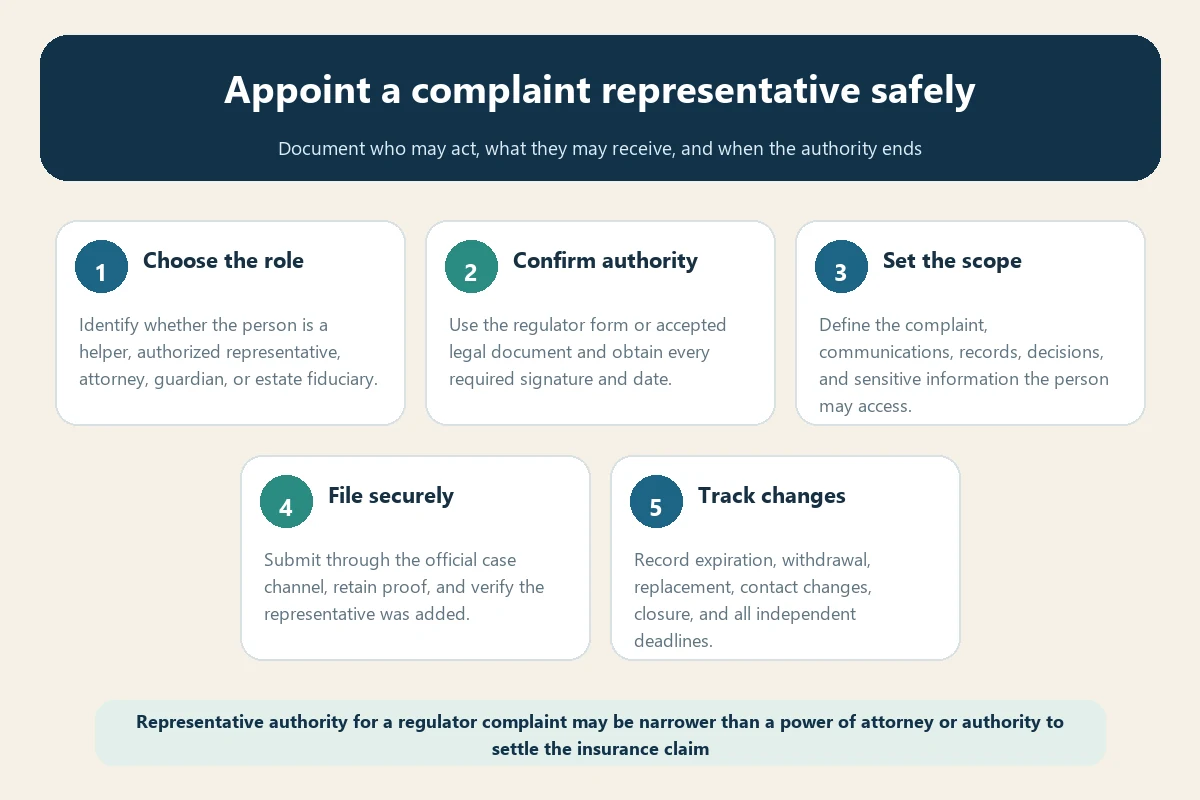
Decide whether a representative is needed
A representative can assist when the policyholder is ill, traveling, disabled, overwhelmed by records, uncomfortable with the process, unable to use the portal, deceased, or working with counsel. A helper who organizes documents behind the scenes may not need access to the regulator’s confidential communications.
Choose the least authority needed. The consumer can often remain the filer while another person helps prepare the chronology and exhibits.
Identify the representative’s exact role
Possible roles include friend, spouse, adult child, caregiver, interpreter, consumer advocate, public adjuster, contractor, attorney, agent under power of attorney, guardian, executor, administrator, trustee, or organizational caseworker.
Record the relationship and purpose. Do not call someone an attorney, guardian, executor, or power-of-attorney agent unless valid documentation supports that title.
The representative’s residence does not by itself choose the regulator. If the consumer, policy, insurer, and representative connect to different states, use the wrong-state complaint jurisdiction guide to identify the proper department from the policy and transaction record.
Use the regulator’s official form when available
Find the appointment or designation form on the department’s government website or authenticated portal. Verify the title, revision date, instructions, address, and complaint number field.
The Illinois Department of Insurance representative form asks for the representative’s relationship and contact details and authorizes complaint filing and access to financial and personal health information related to the review. That form governs the Illinois process, not every state.
Do not substitute an informal email without approval
A consumer’s casual email saying “talk to my daughter” may not satisfy the department, insurer, or privacy requirements. Ask whether the agency accepts its own form, a signed letter, electronic signature, power of attorney, court order, or another document.
Keep the request and response. If the department accepts a letter, include the consumer, representative, case, scope, duration, contact details, signatures, and date.
Distinguish appointment from power of attorney
A complaint-specific appointment may authorize communication and document access only. It may not permit policy changes, settlement, release of claims, banking transactions, litigation decisions, or broader healthcare choices.
The Kentucky consumer complaint form expressly explains that its third-party authorization does not constitute a power of attorney. Read the actual authority instead of inferring powers from the title “authorized representative.”
Provide legal-capacity documents when required
An attorney, power-of-attorney agent, guardian, executor, estate administrator, or other legal representative may need to provide a signed letter of representation, court order, power of attorney, letters testamentary, or similar proof.
The Michigan DIFS representative designation form tells attorneys, agents under power of attorney, executors, and other legal representatives to provide relevant signed documentation. Use Michigan’s requirement only for Michigan matters.
Handle minors and incapacitated adults carefully
A parent or legal guardian may have a different filing route from an ordinary representative. An adult who cannot sign may require evidence of guardianship or another valid legal authority.
Do not sign the consumer’s name or invent consent. Ask the regulator what proof it requires and whether a healthcare or financial power of attorney covers the complaint at issue.
Handle deceased-insured complaints separately
A beneficiary is not always the estate representative, and an executor is not always the claimant. Identify the policyholder, insured, claimant, beneficiary, estate, and person authorized to obtain private records.
Ask whether the department needs a death certificate, letters testamentary, small-estate affidavit, beneficiary proof, or another document. Share only the pages necessary to establish authority when permitted.
Define what the representative may do
Possible actions include filing the complaint, uploading documents, receiving notices, discussing status, viewing the insurer response, submitting a rebuttal, correcting contact information, or requesting closure. Settlement or release authority should never be assumed.
Create a written scope table and ask the department to confirm any unclear action. The complaint authorization form guide explains how to review recipients, records, duration, and revocation.
Define which information may be disclosed
The file may contain policy terms, claim evidence, medical history, financial records, addresses, dates of birth, insurer communications, and regulator findings. Decide whether the representative needs all of it or only case status and ordinary correspondence.
Do not include passwords, one-time codes, complete card numbers, or banking credentials. A representative can use their own regulator account when instructed; they should not impersonate the consumer.
Understand confidentiality consequences
The Kentucky Department of Insurance complaint form warns that an authorized third party may obtain confidential information developed in the investigation, including personal, financial, and health information. That disclosure illustrates why the consumer should choose the representative deliberately.
Ask whether communications will go to the consumer, representative, or both. Confirm how protected messages and attachments are delivered.
Collect accurate identity and contact details
Verify legal names, relationship, organization, address, telephone, email, complaint number, policy and claim numbers, and the consumer’s contact details. A typo can send sensitive information to the wrong person.
Use a dedicated, secure email account when appropriate. Tell the department promptly if contact information changes.
Obtain every required signature and date
The consumer may need to sign; some forms also require the representative’s signature. Follow instructions for handwritten, electronic, witnessed, or notarized signatures.
Do not backdate. Keep the executed version and note when the authority becomes effective.
Submit the appointment through the existing case
Use the official portal, case email, fax, or postal address and reference the complaint number. Upload the appointment as a supplement rather than opening a duplicate complaint.
If no acknowledgment appears, use the no state response guide to verify receipt and representative status through the official channel.
Confirm the appointment was accepted
Ask whether the representative was added, what information they may receive, which account they should use, and whether any additional proof is required. Save the confirmation.
Do not assume a successful upload equals approval. Until acceptance is confirmed, the department may communicate only with the consumer.
Keep the consumer involved
Unless incapacity or legal authority prevents it, the representative should keep the consumer informed of submissions, insurer responses, regulator questions, deadlines, and closure. Maintain a shared decision log.
The representative should distinguish the consumer’s facts and requested outcome from the representative’s own interpretation.
Prepare the complaint from primary records
Use the issued policy, purchase record, claim submissions, delivery confirmations, decisions, appeal, payment calculation, and correspondence. Identify which statements come from the consumer and which are supported by third-party evidence.
The state complaint filing guide provides a factual structure for jurisdiction, chronology, evidence, disputed conduct, and requested review.
Review the insurer response with the consumer
Compare the response with the policy, chronology, exhibits, calculations, and every original issue. Correct only material errors and obtain consumer approval before presenting a disputed factual account as final.
Use the insurer complaint response guide to prepare a concise, indexed rebuttal when the department permits one.
Recognize limits on attorneys and other professionals
South Carolina’s official consumer guidance says third parties—including attorneys, legal representatives, executors, advocates, vendors, and public adjusters—must provide written authorization or appropriate legal documents. Professional status does not eliminate the department’s documentation requirement.
Fee agreements, professional licensing, legal ethics, public-adjuster rules, and unauthorized-practice restrictions can create separate duties. Obtain qualified advice where applicable.
Revoke or replace the representative correctly
Read how the consumer can withdraw authority, where notice must be sent, when it becomes effective, and whether information already disclosed remains with the former representative. Send written notice through the official case channel.
If appointing a replacement, identify the prior representative and effective date. Change portal, email, and mailing access as instructed; do not merely stop copying the former person.
Preserve independent deadlines
Appointment, correction, or revocation may not pause claim, appeal, arbitration, lawsuit, chargeback, refund, or tax deadlines. The consumer and representative should maintain the same deadline chart.
Seek qualified legal advice promptly when authority is disputed, the consumer lacks capacity, an estate is involved, a limitation period is near, or a substantial settlement decision must be made.
Keep a representative audit file
Retain the blank and executed forms, legal-capacity documents, submission receipt, acceptance, scope notes, communications, changes, revocation, and final closure. Protect identity and health records with access controls.
The file should show who could act, during which period, for what case, with access to which information, and how the authority ended.
Bottom line
To appoint an authorized representative for a travel insurance complaint, choose the correct role, use the regulator’s accepted form or legal document, define actions and information access, obtain valid signatures, submit through the existing case, confirm acceptance, and record any revocation. Complaint authority should be explicit rather than inferred from family, professional, or beneficiary status.
