
A travel insurance complaint authorization form may allow a state insurance department to obtain, review, and share policy, claim, medical, financial, or other private information needed to investigate the complaint. Before signing, confirm the official source, parties, records, purpose, recipients, duration, representative access, and revocation language.
An investigation authorization, medical-record release, and representative consent are not automatically the same document. Requirements vary by state and case. Read the actual form and ask the regulator or qualified counsel about unclear language; this guide is general information, not legal advice.
Verify that the form is official
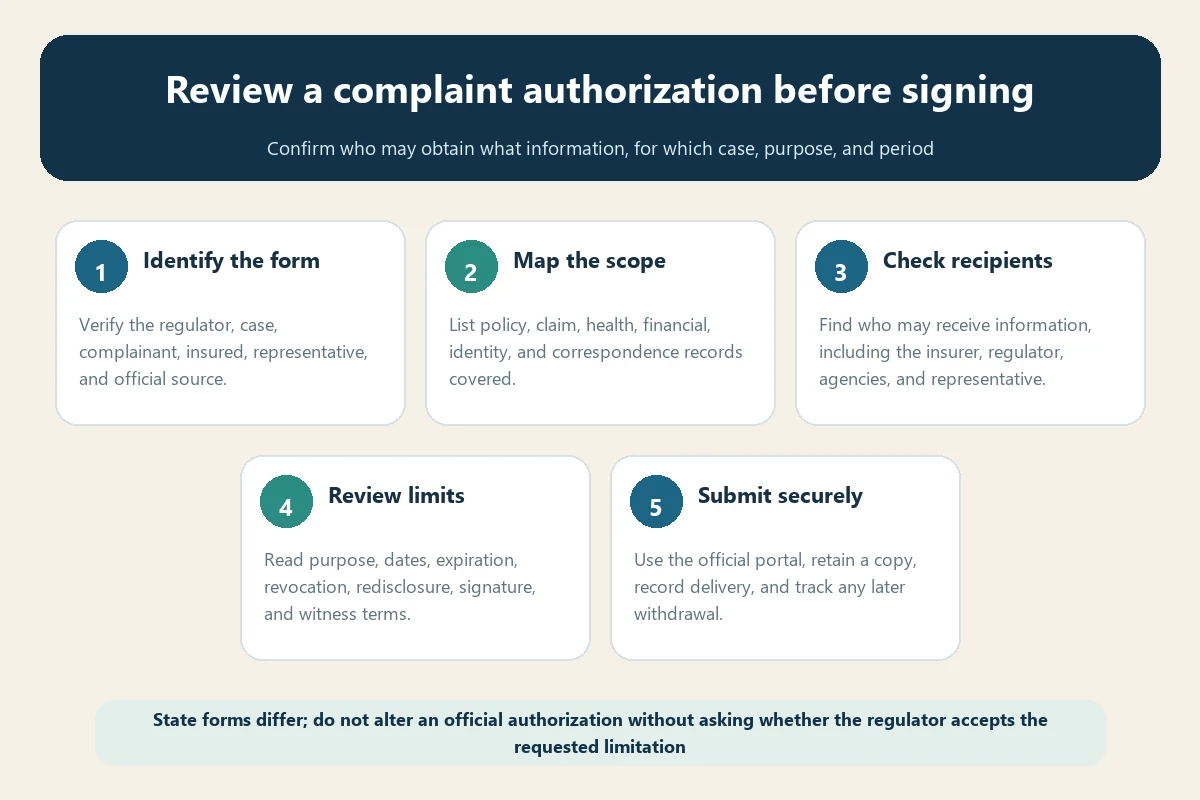
Navigate to the insurance department’s government website or authenticated complaint portal. Confirm the agency name, form title, revision date, contact information, privacy notice, and case number. Do not sign a form delivered only through an unverified link.
Save the blank original, instructions, and transmission message. Compare the request with the state travel insurance complaint guide to confirm the regulator and licensed insurer are correctly identified.
Identify the type of authorization
A complaint form may contain one or more permissions:
- authorization for the department to obtain information from the insurer or other parties;
- permission for the department to share the complaint and exhibits with the insurer;
- medical or financial information release;
- consent for an authorized representative to discuss the case;
- attestation that the complaint information is accurate; or
- consent to electronic communication.
Label each permission separately. Do not assume one signature grants every possible type of access.
Confirm who must sign
The complainant, insured, patient, policyholder, claimant, legal guardian, personal representative, or authorized organization may have different roles. A spouse or adult child does not automatically have authority to release another adult’s records.
If signing under power of attorney, guardianship, estate authority, or another legal capacity, ask which proof the department accepts. Preserve the governing document securely and disclose only what the case requires.
Handle incapacity and deceased-insured cases separately
If the insured cannot sign or has died, do not sign the insured’s name or assume that policy beneficiary status creates authority over private records. Contact the department before filing and ask whether it requires guardianship papers, a durable power of attorney, healthcare representative evidence, letters testamentary, small-estate documentation, a death certificate, or another state-specific record.
Identify whether the signer is acting for the complaint, the insurance contract, the estate, or medical information; those powers may come from different documents. Submit only the pages needed to prove authority when the regulator permits. Ask how the agency protects identity and estate records, whether the insurer will receive them, and whether a separate provider authorization is required.
Record the legal capacity exactly as shown in the supporting document and obtain qualified advice when authority is disputed.
Distinguish representative consent from record release
A representative consent may let another person receive case information or speak with the department. A medical-record release may let providers disclose health information. One does not necessarily include the other.
The Utah Insurance Department consumer complaint form illustrates the distinction: it contains authorization for investigative information exchange and a separate section for consent to share complaint information with a representative. That Utah form is an example, not a nationwide template.
List every person and organization covered
Identify the department, insurer, producer, administrator, assistance company, claims vendor, medical provider, financial institution, other agency, and representative named or described. Note whether broad phrases such as “other parties” or “all involved entities” appear.
Ask how an unnamed recipient must relate to the complaint and whether the department can provide examples. Do not add a private intermediary that does not need access.
Map the categories of information
Create a table of records the form may reach:
| Category | Examples | Review question |
|---|---|---|
| Policy | Application, certificate, endorsements, premium | Is the correct plan and period identified? |
| Claim | Forms, adjuster notes, decisions, appeal | Is access limited to the disputed claim? |
| Medical | Diagnosis, treatment, billing, fitness records | Which providers and dates are relevant? |
| Financial | Payments, refunds, bank or card evidence | Are unrelated accounts excluded? |
| Identity | Address, date of birth, identification | What is necessary to verify the complainant? |
| Communications | Email, letters, calls, portal history | Which parties and subjects are included? |
Connect each category to the complaint
A delay complaint may require submission dates and correspondence. A medical-coverage dispute may require relevant treatment records. A payment-calculation issue may require receipts and refund evidence. The authorization should support the issue under review rather than become an unfocused data request.
Write down why each record category matters. Ask the assigned analyst about any category whose connection is unclear.
Read broad health and financial language carefully
The Texas Department of Insurance approval page explains that complaint information may include health information and other private facts and may be shared with the insurance company and specified organizations. The exact Texas consent and applicable law govern Texas cases.
Do not upload passwords, one-time codes, complete card numbers, or banking credentials. An authorization to investigate a payment dispute is not a request for account access.
Check dates and subject limits
Look for treatment dates, policy period, trip dates, claim number, provider names, subject matter, and geographic scope. An authorization covering every provider and all years may reach far beyond a short travel claim.
Do not alter an official form silently. Ask whether the department accepts a case-specific date or provider limitation and how any change affects its ability to investigate.
Review expiration and event-based termination
Find a fixed expiration date or an event such as complaint closure. Determine whether a copy is treated as valid, whether the form must be renewed, and whether later requests require a new signature.
Record the signing date and expiration in the case log. The claim status follow-up guide can track authorization requests and renewals alongside the complaint timeline.
Understand revocation language
Read how to revoke, where to send the revocation, when it becomes effective, and what happens to information already obtained or disclosed. Revocation may not undo earlier authorized actions and may limit the department’s ability to continue.
Obtain written confirmation that a revocation was received. Do not assume deleting a portal upload withdraws a signed authorization.
Check redisclosure and public-record notices
Determine whether information sent to an insurer, agency, or other recipient remains protected under the same rules. Read the regulator’s public-record and confidentiality notice before including unrelated personal details.
The Washington insurance complaint process warns that a complaint and submitted documents can become public records subject to state law. That warning reflects Washington’s process; other jurisdictions may differ.
Review the medical-record release separately
A medical authorization may specify providers, conditions, dates, recipients, purpose, expiration, revocation, and sensitive categories. The travel insurance medical-record authorization guide provides a detailed checklist for claim-related releases.
If substance-use, psychotherapy, genetic, reproductive, or other specially protected records may be involved, obtain qualified advice about the form and applicable law. Do not assume a general release always covers every category.
Understand why the insurer receives the complaint
A department often sends the complaint and relevant exhibits to the regulated company for explanation. This allows the insurer to respond to the allegations and evidence but also means unnecessary personal details may be disclosed.
Use the complaint response review guide when the company’s answer arrives. Compare it with the exact evidence transmitted.
Ask what happens if you do not sign
The department may be unable to obtain records, communicate with a representative, or investigate a private claim without authorization. It may request a narrower form, proceed on limited information, refer the case, or close it.
Ask for the consequence in writing. Do not sign from fear alone, but do not assume refusal has no procedural effect.
Correct errors before signing
Verify names, policy and claim numbers, insurer, representative, address, birth date where required, complaint number, providers, dates, and contact information. Ask the department how to correct a prefilled error.
Do not use correction fluid, delete required text, or add handwritten limitations unless the agency accepts that method. Keep a copy of the final executed version.
Sign and transmit securely
Follow instructions for electronic, handwritten, witnessed, notarized, or representative signatures. Use the official portal or listed secure channel. Avoid ordinary email for sensitive records unless the department specifically directs it and explains the protection.
Save the delivery confirmation, upload list, filename, version, signature date, and case number. If no acknowledgment arrives, use the no state response guide to verify the existing case without filing a duplicate.
Keep an authorization audit log
Record who requested the form, when, why, which version, what was signed, recipients, scope, expiration, delivery, later disclosures you learn about, renewals, and any revocation. Store the blank and signed versions separately.
This log should let a reviewer determine what permission existed at any point and which documents were supplied under it.
Bottom line
Before signing a travel insurance complaint authorization form, verify the official source, signer, case, records, recipients, purpose, representative access, duration, revocation, and transmission method. Ask about unclear or overly broad language and preserve the final signed version. A careful authorization supports the regulator’s review while reducing unnecessary disclosure of sensitive information.
