
Travel insurance complaint public record privacy depends on the state department, applicable disclosure law, information category, authorization, and complaint process. Before filing, read the regulator’s privacy and public-record notices, identify what will be sent to the insurer, remove unnecessary sensitive data, and preserve the evidence needed for review.
Do not assume every complaint is public or every document is confidential. State rules differ sharply, and protected information can coexist with disclosable contact details in the same file. This guide is general information, not legal advice.
Read the regulator’s privacy notice before uploading
Locate the complaint page, portal terms, authorization, confidentiality statement, public-record notice, and document instructions. Save dated copies because online notices can change.
The state travel insurance complaint guide helps verify that you are using the correct regulator and official portal before any private record leaves your control.
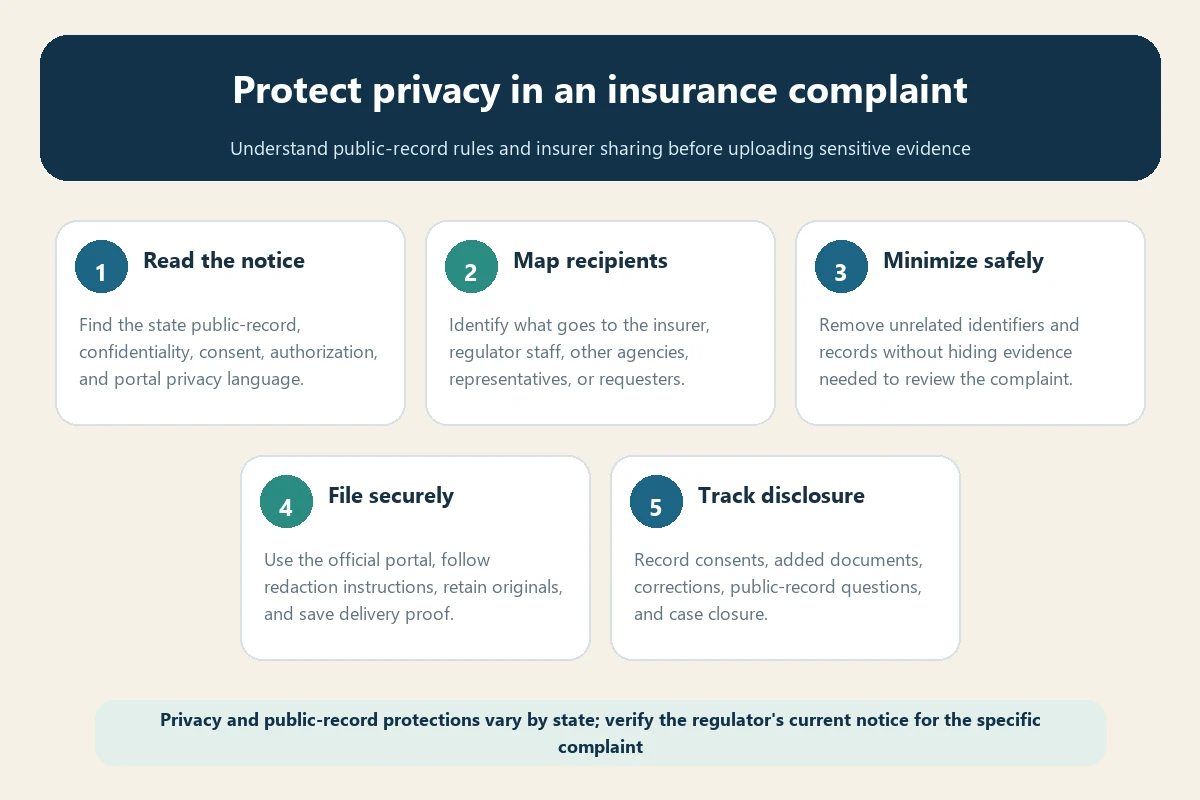
Separate public record from insurer sharing
The department may send the complaint and relevant exhibits to the insurer so the company can respond. That operational disclosure is different from a member of the public requesting agency records.
Ask two questions separately: what will the insurer receive, and what might a public-record requester obtain? The answers may involve different statutes, exemptions, redactions, and consents.
Do not assume one national confidentiality rule
State insurance departments operate under different public-record and insurance statutes. The same category of complaint may receive different treatment depending on jurisdiction and record type.
The Washington Office of the Insurance Commissioner complaint process states that complaints and submitted documents become public records and may be disclosed under state law, while also identifying categories protected from public disclosure.
Understand what Washington says may be unprotected
Washington’s notice lists Social Security numbers, driver license numbers, financial account numbers, and nonpublic personal health information as protected. It also warns that home addresses, telephone numbers, email addresses, and dates of birth are generally not protected in most cases.
That is a Washington-specific statement. It demonstrates why a consumer should not add unnecessary contact or identity information beyond required form fields.
Compare other state approaches
The Arkansas Insurance Department complaint page warns that submitted complaints are subject to disclosure as public records. By contrast, Missouri law describes consumer complaint file materials—including medical records, adjuster notes, policy provisions, and claim records—as confidential and unavailable for public examination, subject to stated exceptions.
These examples are not interchangeable. Read the current law and notice for the regulator handling the actual complaint.
Know that confidentiality can have exceptions
A confidential agency record may still be shared with the regulated company, another regulator, law enforcement, a court, an authorized representative, or another recipient allowed by law. Privilege and confidentiality also have separate meanings.
Do not promise a witness, provider, or family member that no one else will see a document. Explain only what the official notice and qualified advice support.
Map every likely recipient
Create a disclosure map covering:
- assigned complaint analysts and supervisors;
- the insurer, producer, administrator, or claims vendor;
- other state or federal agencies;
- law enforcement or courts where authorized;
- an appointed representative;
- auditors or quality reviewers; and
- public-record requesters where state law permits disclosure.
Ask which recipients receive the whole submission and which receive only relevant extracts.
Review the complaint authorization
A signed form may authorize the department to obtain and disclose private information necessary for the investigation. Read the records, recipients, purpose, dates, expiration, revocation, and redisclosure language.
The complaint authorization form guide provides a detailed review checklist before signing.
Review representative access separately
A family member, attorney, guardian, executor, or advocate may receive complaint communications only when valid authority is documented. Representative access can include health, financial, and identity information.
Use the authorized representative guide to define who may act, which records they may receive, and how authority ends.
Minimize data without weakening the complaint
Provide enough evidence to establish the policy, claim, chronology, disputed conduct, financial effect, and requested review. Remove unrelated account data, full card numbers, passwords, one-time codes, unrelated medical history, and third-party records when permitted.
Data minimization is not evidence destruction. Keep complete originals securely and follow the regulator’s instructions about redacted copies.
Use a document-by-document privacy inventory
| Document | Potential sensitive data | Review action |
|---|---|---|
| Policy or certificate | Address, birth date, policy number | Submit required pages and follow redaction rules |
| Claim form | Health, identity, payment details | Check every field before upload |
| Medical record | Diagnosis, treatment, unrelated history | Limit to relevant provider and dates where accepted |
| Bank or card record | Account number, other transactions | Show payment while masking unrelated data if permitted |
| Email chain | Addresses, signatures, third parties | Extract relevant messages and preserve originals |
| Identity document | Photo, number, birth data | Upload only when officially required |
Handle medical information carefully
Submit the records needed to prove the covered event, medical necessity, treatment, fitness to travel, or claim chronology. Ask whether a clinician summary or selected relevant pages can satisfy the request.
Do not assume HIPAA alone decides what a state agency can disclose. State public-record law, authorization, insurance privacy rules, and other protections can also apply.
Handle financial information carefully
Receipts, refunds, bank statements, card statements, currency records, and payment confirmations may prove the amount. Mask unrelated transactions and full account numbers when allowed while preserving the merchant, date, amount, currency, and ownership evidence.
Never provide online banking credentials or security codes. A regulator can review documents without logging into the consumer’s account.
Protect third-party information
Traveling companions, relatives, physicians, employees, and other claimants may appear in the file. Do not disclose their complete records merely because the complaint concerns the same trip.
Ask whether separate consent or representative authority is required. Identify which facts belong to whom in the exhibit index.
Understand California’s different notice
The California Department of Insurance privacy notice states that information supplied during a complaint investigation is treated as a confidential communication under California Insurance Code section 12919. That California protection should not be exported to another state’s process.
Even in a confidentiality framework, the insurer may need relevant complaint information to respond. Read the consent and investigation notice together.
Understand the Texas distinction
Texas complaint guidance explains that information must be shared with the company or person complained about to help resolve the matter. It also says some submitted information can be provided under the Texas Public Information Act, while medical records, financial information, and email addresses are confidential by law.
This distinction reinforces the need to analyze each information category rather than label the entire file public or private.
Submit through a secure official channel
Prefer the regulator’s authenticated portal or expressly listed secure method. Verify the domain, certificate, file limits, accepted formats, privacy notice, and confirmation process.
Do not send sensitive exhibits through social media, an advertisement, or an unverified complaint service. Save upload confirmations and file hashes when practical.
Check the insurer response for unnecessary disclosure
When the company responds, note whether it included private material unrelated to the disputed issue or sent information concerning another person. Preserve the response and report a material privacy concern through the approved case channel.
The complaint response review guide helps map each statement and exhibit without republishing sensitive content.
Correct an accidental disclosure promptly
If you upload the wrong file, notify the department immediately with the case number, filename, upload time, and requested correction. Ask whether the file can be restricted, replaced, or removed under its procedure.
Do not assume deleting a local copy changes the agency record. Document the department’s response and consider qualified privacy or legal advice when exposure is significant.
Respond to public-record questions through the agency
If you receive a notice concerning a record request, read the deadline and process. Identify the specific statutory protection or factual basis you believe applies, but do not make unsupported claims that the entire file is exempt.
Request qualified legal advice when the record contains highly sensitive, disputed, privileged, or third-party information.
Keep a privacy audit file
Retain the original and redacted documents, disclosure inventory, authorizations, representative forms, upload receipts, insurer response, corrections, privacy correspondence, closure, and a list of known recipients.
The file should show what was submitted, what was withheld or masked, why, who received it, and how any accidental disclosure was handled.
Do not assume closure erases the record
Complaint closure can end the active review without deleting the agency file, insurer response, exhibits, or tracking data. Read the retention and public-record notice and ask how long records remain, which protections continue, and how later correction requests are handled.
If the matter closes with no violation, no jurisdiction, insufficient information, or another result, use the complaint closure review guide to preserve the outcome without republishing private documents. Record any continuing confidentiality instruction and keep your own archive access-limited.
Bottom line
Travel insurance complaint privacy and public-record treatment vary by state and information type. Read the regulator’s current notice, separate insurer sharing from public disclosure, minimize unrelated sensitive data, preserve complete originals, use official secure channels, and document every authorization and correction. Do not assume that an entire complaint file is automatically public or confidential.
