
A travel insurance arbitration subpoena may be needed when a nonparty will not voluntarily provide material testimony or records. It is not the first tool for every evidence gap. A narrow request, authorization, stipulation, party production, certified record, or voluntary appearance may be faster, less expensive, and less likely to create a separate court dispute.
Subpoena authority and procedure depend on the arbitration agreement, incorporated rules, governing federal or state law, hearing location, requested evidence, and court precedent. Start early and obtain case-specific legal advice. This U.S. consumer guide provides general information, not legal advice.
Define the evidence gap before drafting anything
Write the exact disputed fact and the evidence needed to prove it. Examples include a carrier’s cancellation log, a provider’s refund record, a treating facility’s chart, a booking platform’s transaction history, or testimony from the person who created a key record.
Identify who possesses or controls the evidence, whether that person is a party, what has already been exchanged, and why the information is material. “All records concerning the traveler” is not a useful starting point. Connect each requested category to a claim, defense, policy term, date range, and custodian.
Try the least burdensome reliable route first
Ask whether the evidence can be obtained through the normal arbitration document exchange, a claimant authorization, a focused voluntary request, a business-record certification, an agreed stipulation, or a witness who will appear without compulsion.
Keep a dated log of requests, responses, follow-ups, offers to narrow, and remaining gaps. It can show the arbitrator why formal process became necessary and why the proposed scope is proportionate.
Distinguish a party from a nonparty
A party is already bound by the arbitration process and case orders. A nonparty—such as an airline, hotel, hospital, payment processor, or former employee—may require different authority and protections. Confirm the correct legal entity and the person or agent authorized to receive process.
Do not assume a brand name identifies the records custodian. Corporate affiliates, contractors, administrators, and vendors may hold different systems. A command sent to the wrong entity can waste the evidence deadline.
Read the arbitration agreement and current case orders
Record the designated provider, incorporated rule version, applicable law, arbitral seat, hearing location, discovery limits, motion procedure, service rules, and deadlines. The preliminary order may require a party to confer, obtain permission, submit a draft, or give the other side time to object.
Use the arbitration preliminary hearing checklist to raise nonparty evidence before the schedule becomes compressed. Do not communicate privately with the arbitrator unless the rules and case administrator permit it.
Understand the federal statutory starting point
Section 7 of the Federal Arbitration Act says arbitrators, or a majority of them, may summon a person in writing to attend as a witness and, in a proper case, bring material books, records, documents, or papers. It also addresses signature, service, witness fees, and a petition to compel attendance.
The statute’s wording matters: it refers to attendance “before” the arbitrator and places a compliance petition in the federal district where the arbitrators are sitting. Courts have disagreed about aspects of pre-hearing document-only subpoenas and territorial reach. Do not convert a hearing subpoena into an assumed nationwide discovery device.
Check the provider rule that governs the case
Current AAA Consumer Arbitration Rule R-32 permits an arbitrator or another person authorized by law to subpoena witnesses or documents. A party asking the arbitrator to sign must copy the request to the other parties when providing it to the arbitrator.
That rule does not erase statutory, court, service, fee, or geographic requirements. Confirm the rule version incorporated by the agreement or selected in the case and follow the administrator’s filing channel.
Identify who may issue and sign
Do not assume a party or attorney can issue the arbitral subpoena in the same way as a civil-litigation subpoena. Determine whether the arbitrator must issue or sign it, whether state law supplies another authorized issuer, and whether the provider requires a motion or draft.
A request to the arbitrator should explain the material fact, recipient, scope, time and place, prior voluntary efforts, anticipated burden, service plan, fees, objections, and why the evidence cannot reasonably be obtained another way.
Choose testimony, documents, or both
| Need | Possible command | Key planning question |
|---|---|---|
| Firsthand account | Attend and testify | Where and how can attendance lawfully be required? |
| Business records | Attend and bring identified records | Is a custodian or certification also needed? |
| Electronic data | Produce defined ESI at attendance | Which fields, date range, and usable format? |
| Medical evidence | Records and possibly testimony | What authorization, privacy limit, or expert issue applies? |
| Refund or credit | Transaction record and explanation | Which entity owns the ledger and adjustment history? |
Match the command to the actual gap. If authenticated records resolve the issue, compelling a busy clinician or airline employee to testify may add cost without adding material proof.
Draft for specificity and proportionality
Identify the recipient, time, place, appearance method, requested testimony topics, document categories, relevant date range, claim or booking identifier, production format, and protected information. Avoid vague terms, unlimited periods, and requests unrelated to the disputed coverage issue.
Include definitions only when they improve clarity. Separate required fields from optional context. Consider phased production: obtain a narrow core record first, then raise any concrete missing item with the arbitrator.
Protect private and privileged information
Travel claims can contain medical details, passport data, payment information, account numbers, location history, and other travelers’ records. Request only what is material. Use redaction, secure transfer, access limits, a protective order, or an attorneys’/representatives’ eyes-only process when appropriate.
A subpoena does not automatically defeat attorney-client privilege, work-product protection, medical privacy rules, trade secrets, or another valid protection. Define a process for privilege claims and inadvertent production before sensitive data moves.
Confirm service rather than guessing
Identify the permitted server, delivery method, correct recipient, deadline, proof of service, and any requirement to tender attendance and mileage fees. Section 7 refers to service in the same manner as subpoenas to appear and testify before a court.
The current official Federal Rules of Civil Procedure include Rule 45 requirements for federal civil subpoenas, including protections, compliance location, service, attendance fees, objections, and motions. How those provisions interact with an arbitral summons requires jurisdiction-specific analysis.
Calendar witness fees and mileage
Do not serve first and calculate later. Determine which fee statute and mileage rate apply, when tender is required, who pays service and attendance costs, and whether the arbitrator’s order allocates additional expenses.
Keep the payment instrument, calculation, receipt, proof of tender, and service return. An avoidable fee defect can threaten compliance when the hearing is near.
Test geographic reach and compliance location
Map the witness’s residence and workplace, the requested compliance location, the arbitral seat, the arbitrator’s physical or deemed location, and the relevant federal district. Virtual attendance does not automatically eliminate territorial questions.
Courts differ on some Section 7 issues. A request that appears simple may fail if the witness is outside permitted reach or if enforcement must occur in a court without the required connection. Investigate this before the arbitrator signs.
Build enough time for objections and modification
The recipient may object based on burden, scope, relevance, privilege, privacy, trade secret, service, fees, timing, location, or authority. The other arbitration party may also object to the request. Calendar all response windows and the last safe date for negotiation or motion practice.
Offer reasonable narrowing: shorter periods, named document fields, search terms, custodians, remote appearance, confidentiality protection, cost sharing, or a certification instead of live testimony. Record any agreement and obtain required arbitrator approval.
Do not confuse issuance with enforcement
An arbitrator’s signature does not itself guarantee compliance. If the recipient refuses, determine whether the arbitrator should address the dispute first and which court, if any, has authority to compel attendance or punish noncompliance.
Section 7 identifies the federal district where the arbitrators are sitting, but federal subject-matter jurisdiction and controlling appellate precedent can create additional issues. Court enforcement may require a petition, filing fee, service, evidence, and time that the arbitration schedule does not automatically pause.
If you receive an arbitration subpoena
Do not ignore it and do not immediately produce everything. Preserve potentially responsive material, record the receipt date and method, identify the issuing case and authority, review deadlines, notify appropriate counsel or organizational personnel, and evaluate scope, possession, privilege, privacy, burden, fees, and compliance location.
Communicate objections or requests to narrow through the authorized channel before the deadline. Do not alter, delete, or conceal responsive evidence. A recipient may need independent legal advice because the interests of a nonparty can differ from those of either arbitration party.
Review the production when it arrives
Log the production date, custodian, file count, format, metadata, certifications, gaps, redactions, privilege claims, and restrictions. Check whether all parties received the evidence as required. Do not send material privately to the arbitrator.
Connect each useful item to the witness testimony plan and final exhibit list. A subpoenaed record still needs context, authenticity, relevance, and a fair opportunity for response.
Coordinate with the hearing schedule
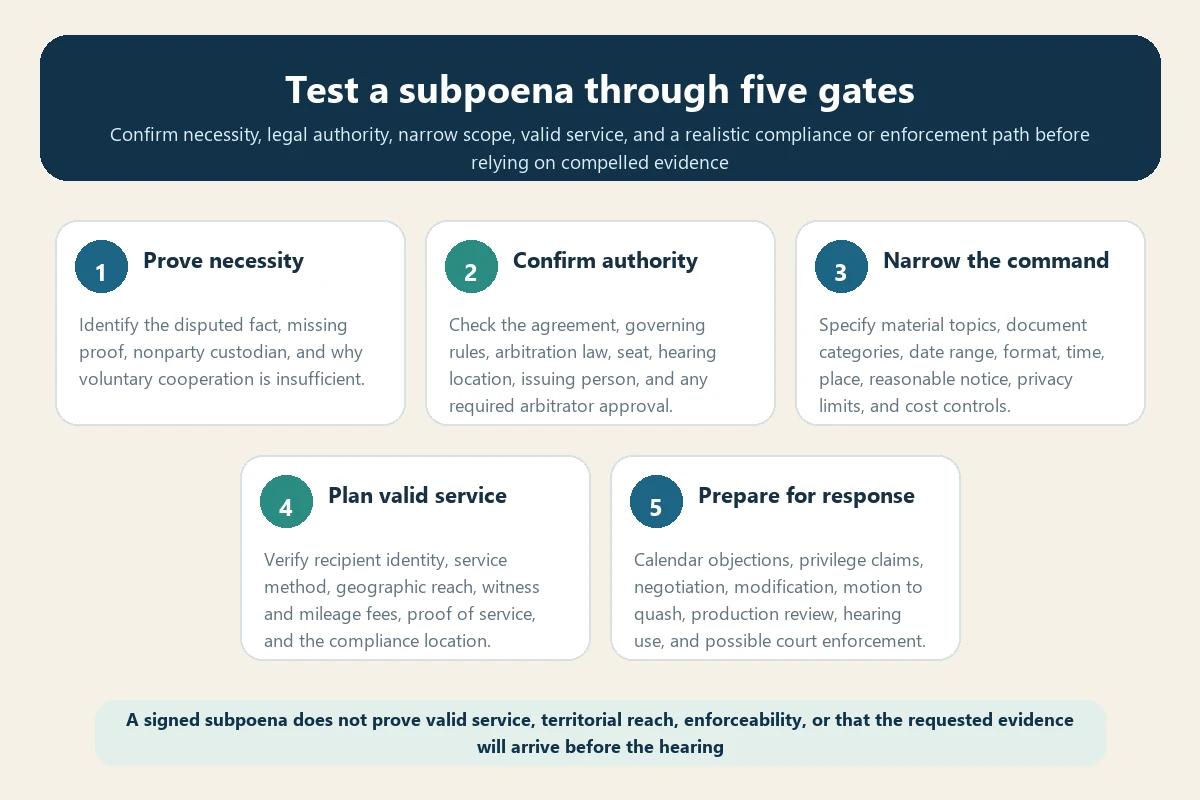
Work backward from the exchange cutoff, objection deadline, witness disclosure, technology test, final exhibit deadline, and hearing. Include time for voluntary outreach, arbitrator approval, drafting, service, response, negotiation, a possible court petition, production review, and follow-up.
Add every dependency to the arbitration timeline. If compelled evidence will not arrive on time, request relief promptly rather than assuming the record will remain open.
Common subpoena mistakes
- Using a subpoena before identifying a material evidence gap.
- Sending it to a brand name instead of the correct legal entity or custodian.
- Assuming a party or lawyer may sign without arbitrator or statutory authority.
- Demanding broad pre-hearing documents without checking controlling precedent.
- Ignoring territorial limits, compliance location, service, or witness fees.
- Requesting unrelated private or privileged information.
- Failing to copy other parties or use the administrator’s channel.
- Waiting until the final hearing is too close for objections and enforcement.
Final subpoena readiness checklist
- State the disputed fact and why the evidence is material.
- Confirm the evidence is unavailable through a simpler reliable route.
- Identify the correct recipient, custodian, and legal entity.
- Confirm governing rules, law, issuer, seat, hearing place, and court precedent.
- Draft a narrow command with reasonable time and privacy protection.
- Verify service, proof, fees, mileage, and geographic reach.
- Calendar objections, modification, enforcement, production review, and hearing use.
A well-planned subpoena is one controlled part of the evidence strategy, not a promise that missing proof will appear. Pair it with the arbitration hearing preparation checklist and preserve a backup proof route in case the witness, record, or enforcement process is unavailable.
