
Travel insurance complaint vs arbitration is a comparison between two processes that may involve the same denied or delayed claim but do not perform the same job. A state department of insurance complaint asks a regulator to review conduct within its authority. Arbitration asks an arbitrator to decide a dispute under an agreement and applicable law.
Do not assume that starting one process pauses, replaces, waives, or satisfies the other. The policy, arbitration provision, forum rules, state law, and facts can change the answer. This guide provides general information, not legal advice.
The short answer
A complaint is normally regulatory and administrative. The department may obtain the insurer’s explanation, examine claim handling, identify a violation, and require correction when state law authorizes it. The regulator does not become the policyholder’s lawyer.
Arbitration is adjudicative. If a valid arbitration agreement covers the dispute, a neutral arbitrator can receive the parties’ positions and issue an award. The agreement and forum rules may control initiation, selection, fees, discovery, hearing format, confidentiality, and review.
What a state insurance complaint can do
The National Association of Insurance Commissioners explains that a consumer may file with the state department of insurance after trying to resolve a problem with the insurer. The department can forward the complaint, obtain the company’s response, assess fairness under the policy, and require correction when it finds improper conduct within its authority.
Use the official NAIC complaint guide to locate the appropriate state department and understand the general workflow. Because authority varies by state, confirm jurisdiction for the policy, insurer, sale, residence, and loss rather than selecting a department only because the trip passed through that state.
A complaint can be useful when the issue involves unexplained delay, lack of communication, failure to follow claim-handling rules, inconsistent reasons, an unlicensed entity, or a policy term the insurer appears not to honor. Start with the state travel insurance complaint guide to prepare the filing.
What a regulator generally cannot do
The department’s consumer unit is not private counsel and its authority has limits. The NAIC’s official insurance department assistance page says departments cannot represent a consumer in court as personal legal counsel. A complaint closure also should not automatically be treated as a binding decision on every contractual fact or remedy.
New York’s Department of Financial Services provides a useful, line-specific example in its no-fault guidance: DFS lists a complaint and arbitration as distinct options and states that, although it will attempt to resolve disputed complaint claims, it cannot order an insurer to pay a disputed claim through that complaint route. Read the official New York no-fault arbitration page for that limited example; its no-fault rules are not travel insurance rules.
What arbitration is designed to do
Arbitration is a private dispute-resolution process whose authority usually begins with an agreement. The policy may incorporate separate rules or name an administrator. The arbitrator may decide contract interpretation, facts, damages, and defenses within the submitted scope, subject to the agreement and applicable law.
Read the entire policy and every endorsement. Search for “arbitration,” “dispute resolution,” “legal action,” “suit against us,” “choice of law,” “venue,” and “limitations.” A certificate, booking screen, benefits summary, or denial letter may not contain the complete provision.
Build an arbitration-clause checklist
Record the exact language addressing:
- Which parties and disputes are covered.
- Whether internal appeal, notice, or negotiation must occur first.
- The administrator, rules, filing address, and required form.
- Arbitrator selection and who decides questions about arbitrability.
- Seat, venue, hearing method, and governing law.
- Consumer filing fees and allocation of other costs.
- Discovery, witnesses, experts, and document exchange.
- Individual, collective, or class-treatment terms.
- Available remedies, written reasons, and award form.
- Filing limits and any contractual suit-limitation period.
Do not infer enforceability merely because the clause appears in the document. Insurance-specific state law, contract formation, notice, federal law, and the wording can matter. Obtain qualified advice when enforceability or the proper forum is genuinely disputed.
Also identify the legal entity named in the clause. A travel protection arrangement may involve an insurer, plan administrator, claims administrator, assistance company, booking platform, and travel supplier. The entity that issued the denial may not be the only party named in the agreement. Match each proposed respondent to the policy and transaction records before submitting a demand.
Does filing a complaint stop an arbitration deadline?
Never assume it does. A department may investigate while a contractual or statutory limitation period continues to run. Ask the department and arbitration forum what their published rules say, but recognize that staff may not give legal advice or determine a court deadline.
Make a deadline table that separately lists claim notice, proof of loss, document response, internal appeal, complaint response, arbitration demand, suit limitation, and statutory limitation dates. Mark the source for each date and preserve proof of submission. If a deadline is uncertain or close, seek state-specific legal guidance promptly.
Does a complaint waive arbitration?
Do not assume filing a complaint waives, invokes, preserves, or defeats arbitration. Waiver and enforceability can depend on governing law and conduct over time. Likewise, an insurer’s participation in a regulatory investigation does not necessarily mean it surrendered a contractual position.
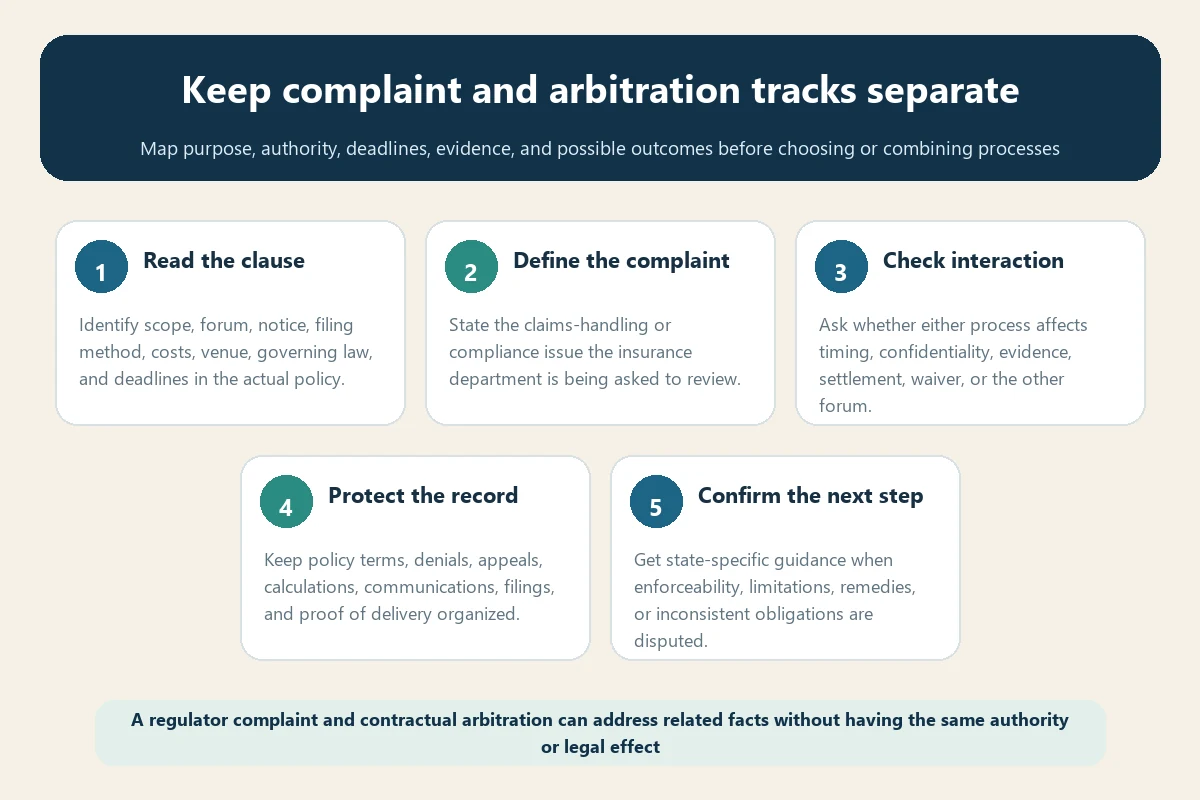
Use neutral language in both records. Identify the policy provision, facts, amount, and requested correction consistently. If positions must differ because the forums ask different questions, explain why instead of silently creating contradictions.
Can both processes proceed at the same time?
Possibly, but verify before proceeding. Tell each decision-maker about the other matter if its forms, rules, or orders require disclosure. Ask whether the regulator will continue, defer, narrow, or close its review. Ask the arbitration administrator whether a pending complaint changes any filing requirement; obtain written confirmation where available.
Parallel proceedings can increase cost and create duplicate submissions. They can also generate statements that the other side may try to use. A coordinated chronology and evidence index reduce accidental inconsistency.
Use one evidence file with two purpose statements
Maintain a master set containing the policy, endorsements, purchase record, covered-event evidence, claim, denial, appeals, insurer communications, calculations, and delivery receipts. Then create a cover sheet for each process.
For the complaint, state the claimed handling or compliance failure and the action requested from the regulator. For arbitration, state the contractual issue, factual findings requested, amount claimed, remedy, and basis for arbitrator authority. The documents may overlap, but the requested decision is not identical.
If the department record is needed later, follow the travel insurance complaint file request guide rather than assuming every internal note is available.
Compare evidence and confidentiality rules
A regulator complaint can be subject to state record-retention, confidentiality, and public-record rules. Arbitration may have confidentiality provisions in the agreement, administrator rules, protective orders, or applicable law—but do not assume the entire proceeding is automatically secret.
Before sending medical, financial, identity, or third-party records, check redaction and secure-upload instructions. Submit only what proves the issue. The complaint privacy and public-record guide explains how to separate necessary evidence from avoidable exposure.
Compare outcomes
A complaint may produce an insurer explanation, reopened review, corrected handling, regulatory finding, referral, enforcement action, or closure without a violation. Arbitration can produce a settlement, dismissal, procedural order, or award addressing the submitted dispute.
Do not describe a department’s “no violation” closure as an arbitration loss. Conversely, an award on a private contract dispute does not necessarily decide whether broader market conduct warrants regulatory attention. If the department closes the file and a review path exists, use the state complaint decision review guide.
Keep mediation and settlement separate too
Mediation helps parties explore voluntary resolution; a mediator generally does not impose an outcome. Arbitration normally ends with a decision unless the parties settle or the case ends procedurally. Informal regulator assistance may help communication without becoming either mediation or arbitration.
If a settlement offer arrives during either process, identify what the release covers, which filings must be withdrawn, payment timing, confidentiality, taxes, and what happens if payment is late. The settlement during a state complaint guide provides a focused checklist.
A practical decision sequence
- Obtain the complete policy and arbitration provision.
- Finish any required insurer appeal without missing other deadlines.
- Define whether the problem is regulatory, contractual, or both.
- Confirm the correct state department and its authority.
- Confirm the arbitration forum, rules, fees, and filing requirements.
- Create separate deadline and outcome tables.
- Ask in writing how simultaneous matters are handled.
- Submit consistent facts with forum-specific requests.
- Track every response, order, closure, settlement, and delivery receipt.
Bottom line
In a travel insurance complaint vs arbitration analysis, start with authority. The department reviews insurance conduct within state regulatory power; an arbitrator decides matters within an arbitration agreement and applicable law. The same evidence can support both, but deadlines, confidentiality, costs, remedies, and legal effects may differ.
Preserve every deadline, avoid unsupported assumptions about tolling or waiver, and obtain state-specific advice when the clause’s validity, forum, remedies, or interaction with a pending complaint could determine the claim.
