
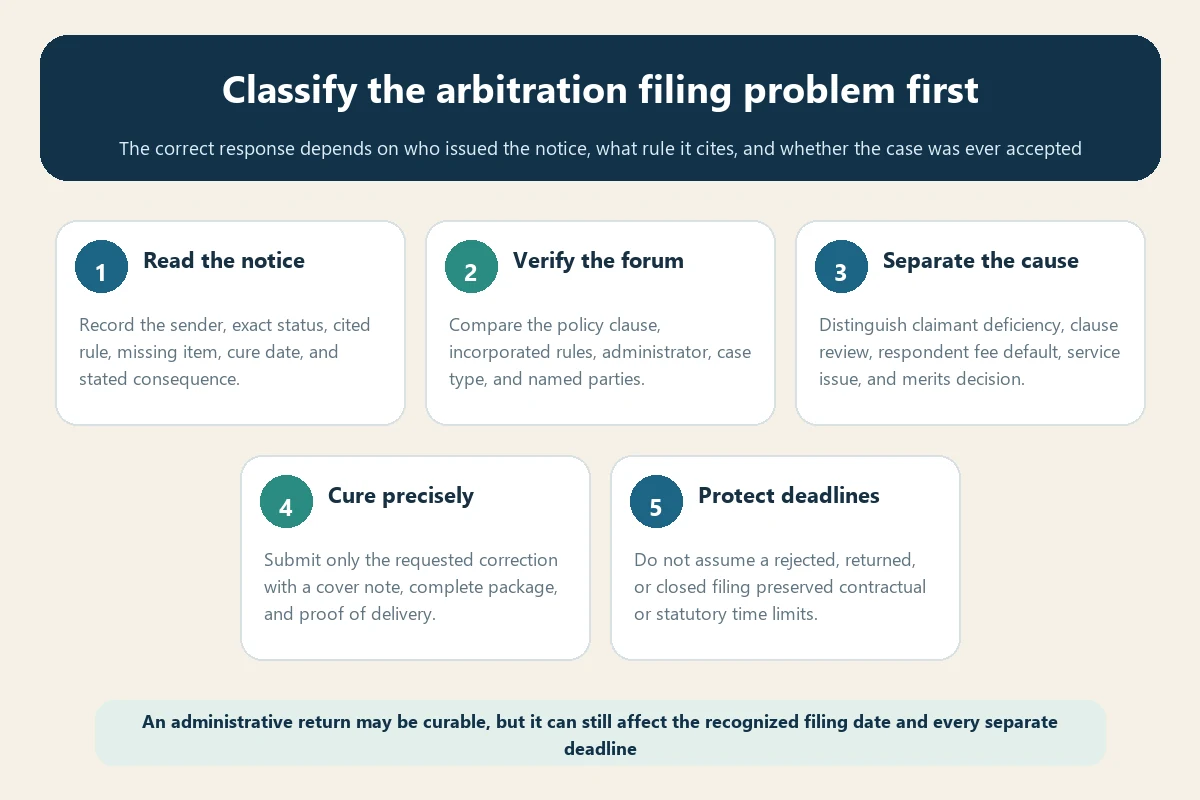
If a travel insurance arbitration demand is rejected, returned, marked deficient, or administratively closed, do not assume the insurer won. First identify who issued the notice, the exact status used, the rule cited, whether the case was accepted for administration, the missing requirement, and the cure deadline.
A claimant filing defect, wrong administrator, noncompliant arbitration clause, respondent fee default, service problem, and arbitrator dismissal are different events. Each calls for a different response. This guide provides general information, not legal advice.
Read the notice literally
Save the complete email, letter, portal message, attachments, envelope, and transmission headers. Record the case number, sender’s role, date and time zone, exact terminology, rule number, requested item, response method, cure date, and stated consequence.
Do not replace the administrator’s wording with “denied” in your notes. “Unable to process,” “filing requirements not met,” “returned,” “decline to administer,” “case closed,” and “claim dismissed” can have materially different meanings.
Identify the decision-maker
Determine whether the communication came from intake staff, a case administrator, the insurer, the insurer’s lawyer, a court clerk, or an appointed arbitrator. An insurer saying it “rejects arbitration” is not the same as an administrator refusing intake or an arbitrator issuing an order.
Ask what procedural authority the sender relied on. If the notice lacks a rule citation or cure instruction, request clarification in writing without arguing the merits in the same message.
Was the case ever filed for administration?
The answer can affect the recognized filing date. The current AAA Consumer Arbitration Rules state that AAA provides notice after administrative filing requirements are satisfied and that the date those requirements are satisfied establishes the filing date for administration. The rules also give AAA initial administrative authority to determine whether those filing requirements were met, subject to specified arbitral authority.
Do not assume the date an incomplete upload was attempted is the operative date for every purpose. Preserve the original timestamp, but separately verify the administrator’s accepted filing date and obtain qualified advice about contractual or statutory limitations when timing matters.
Classify the problem before correcting it
Create a one-line classification using one of these categories:
- Missing or incomplete demand form.
- Arbitration agreement or court order omitted.
- Agreement does not name the selected forum or rules.
- Wrong case type, administrator, portal, or form.
- Consumer filing fee missing, incorrect, or unprocessed.
- Required service or notice not demonstrated.
- Party identity or contact information incomplete.
- Claim amount or requested relief unclear.
- Clause under consumer due-process review.
- Business failed to pay or participate.
- Arbitrator or court issued a substantive or jurisdictional ruling.
If more than one applies, assign each a separate cure item. A revised demand should not obscure an unresolved forum problem.
Check the minimum filing package
The official AAA consumer rules, forms, and fees page says a consumer filing generally requires a Demand for Arbitration, a copy of the arbitration provision naming AAA or its rules, and the appropriate filing fee. The agreement also must comply with AAA’s Consumer Arbitration Rules and Consumer Due Process Protocol.
That checklist applies only when AAA is the proper administrator. If the clause names JAMS, an industry forum, a state program, or a selection process, use that authority’s current requirements. Follow the travel insurance arbitration demand filing guide to rebuild the core package.
Fix an incomplete demand form
Compare the returned form with the current official version field by field. Check legal names, addresses, representatives, policy and claim identifiers, amount, other relief, dispute summary, signature, date, attachments, and delivery details.
Submit a clean complete form rather than isolated pages unless the administrator directs otherwise. Add a short cover note listing the case number, notice date, each cited deficiency, the correction, and the file name where it appears.
Supply the controlling arbitration agreement
Attach the full policy provision and enough surrounding text to show the document, parties, effective date, amendments, named administrator, incorporated rules, prerequisites, and notice terms. A screenshot of one sentence may not establish the agreement.
If multiple versions exist, do not silently choose one. Provide a dated document index and explain which version governed the purchase and why. Preserve the purchase record and proof of delivery.
Correct a wrong-forum filing
Re-read the clause before transferring anything. It may name an administrator directly, incorporate an administrator’s rules, permit a choice, require mutual selection, or provide a fallback when the named organization is unavailable.
Ask the first administrator whether it will transfer files or refund any fee, but do not assume it will. A new forum may require a fresh form, fee, service, and filing date. Keep both case histories and confirmations.
Respond to consumer-clause review
AAA’s official consumer dispute resolution page explains that AAA reviews consumer clauses for compliance with its Consumer Due Process Protocol and may decline to administer arbitrations where a clause does not comply.
A clause-review issue is not cured by rewriting the consumer’s facts. Send the requested agreement and transaction materials, preserve the administrator’s determination, and distinguish whether the business can modify or waive an offending term. Do not sign a new procedural agreement without understanding how it changes rights, cost, forum, or remedies.
Handle a filing-fee problem
Verify the current fee schedule for the exact case type, who initiated the case, the agreement’s allocation, and whether a hardship waiver form is available. Do not rely on a fee quoted in an old article or archived form.
Save the invoice, payment attempt, bank or card record, portal receipt, reversal, waiver request, and administrator response. If payment failed technically, ask whether the case remains pending and what date will be recognized after cure.
Separate claimant fees from business nonpayment
A consumer’s missing filing fee and a respondent business’s later nonpayment are not the same defect. AAA’s official consumer fee schedule states that AAA may decline to administer future consumer arbitrations with a business when its failure to pay violates the Consumer Arbitration Rules.
If the case cannot proceed because the business did not pay, request a written status identifying the responsible party, unpaid amount category, applicable rule, closure date, and any options described by the administrator. Do not pay the business’s obligation without first understanding the rule and consequences.
Fix party-name and contact defects
Match each respondent to the policy and transaction record. Travel protection can involve an insurer, underwriter, claims administrator, assistance provider, seller, booking platform, and travel supplier. A trade name may not be the contracting legal entity.
Use official insurance-license and business records where appropriate. State each entity’s role and conduct separately. If the notice identifies a name mismatch, correct the caption, contact fields, service list, and claim narrative consistently.
Prove service without overclaiming
The administrator’s receipt may not prove service on the respondent. Review the arbitration agreement, forum rule, administrator instruction, policy notice provision, and applicable law for recipient, address, method, and timing.
Create a service certificate or log showing what was sent, to whom, at which address, by what method, with tracking or delivery confirmation. If a package was refused or returned, keep the envelope and ask what corrective method is permitted.
Do not confuse a prerequisite dispute with an intake defect
The insurer may argue that notice, proof of loss, appeal, negotiation, or a waiting period was not completed. AAA’s rules distinguish administrative filing determinations from disputes over whether a condition precedent was met, which may be raised for arbitrator determination under the rules.
Document each prerequisite with the clause, completion date, recipient, method, and proof. If an internal appeal remains useful and timely, the travel insurance claim appeal guide helps match evidence to the denial reason.
Protect every deadline during the cure
Build a deadline table for contractual arbitration demand, suit limitation, statutory limitation, claim notice, proof of loss, appeal, administrator cure, court filing, and service. Identify the source and time zone for each.
Do not assume a returned filing, informal email, pending clause review, regulator complaint, or settlement discussion tolls a deadline. When the original or corrected filing date could decide timeliness, seek jurisdiction-specific legal advice promptly.
If negotiations begin during the cure period, use the travel insurance settlement checklist to examine release scope, payment timing, withdrawal terms, and what happens after nonpayment. Obtain any agreed procedural stay in writing.
Use a deficiency response matrix
For each item in the notice, record:
- Notice quotation or precise paraphrase.
- Rule, form field, or agreement provision cited.
- Required correction.
- Document proving the correction.
- Responsible person.
- Cure deadline and time zone.
- Submission method and recipient.
- Proof of delivery.
- Written confirmation of acceptance.
This matrix prevents a fast resubmission from repeating one overlooked defect.
Ask for a written procedural status
After curing, request confirmation of the case number, accepted filing date, fee status, parties, governing rule set, next deadline, and whether any prior closure was reversed or a new case was opened. Save the response outside the portal.
If the administrator does not respond, log every follow-up. The insurer nonresponse documentation guide offers a useful chronology format, although administrator and insurer roles must remain distinct.
If the insurer says it refuses arbitration
Ask whether the insurer disputes the existence, scope, validity, prerequisite, party identity, forum, or timeliness of arbitration. Request the exact policy language and legal basis. Do not treat a general refusal as an administrator’s final determination.
New Jersey’s Department of Banking and Insurance discusses insurer refusal or delay in a specific uninsured/underinsured motorist context on its official UM/UIM consumer page. That state and coverage example does not establish a remedy for travel insurance, but it illustrates why the policy line and jurisdiction must be identified before choosing the next procedural step.
When a merits order requires a different response
If an appointed arbitrator dismissed a claim or issued an award, stop using an intake-deficiency checklist. Obtain the signed order, date of service, governing rules, correction or reconsideration provision, award-review rules, and applicable court deadlines.
Likewise, if a court stayed or refused arbitration, review the court order and docket. Administrative resubmission cannot override a judicial ruling.
Keep the regulator record accurate
If a state insurance complaint is also open, describe the event precisely: “administrator requested a missing agreement,” “case closed after business nonpayment,” or “arbitrator dismissed the claim.” Avoid saying arbitration proved regulatory misconduct unless an authoritative decision actually says so.
The complaint vs arbitration guide explains how the two records can involve shared facts without having identical authority or effect.
Final correction checklist
- Complete notice and attachments saved.
- Sender and procedural authority identified.
- Accepted filing status and date confirmed.
- Defect classified without guessing.
- Correct forum and rule set verified.
- Current form, agreement, fee, and parties checked.
- Service requirement documented.
- Targeted response submitted before the cure date.
- Acceptance confirmation requested and saved.
- All independent deadlines protected.
Bottom line
When a travel insurance arbitration demand is rejected or returned, the first task is classification, not argument. Determine whether the problem is an incomplete filing, wrong forum, clause review, fee issue, service defect, respondent nonpayment, prerequisite dispute, or actual adjudicative ruling.
Cure the exact administrative problem with a controlled package and written proof. Never assume the first attempted submission established the filing date or paused another deadline, and obtain qualified advice when timeliness, enforceability, court action, or an arbitrator’s order could control the outcome.
