
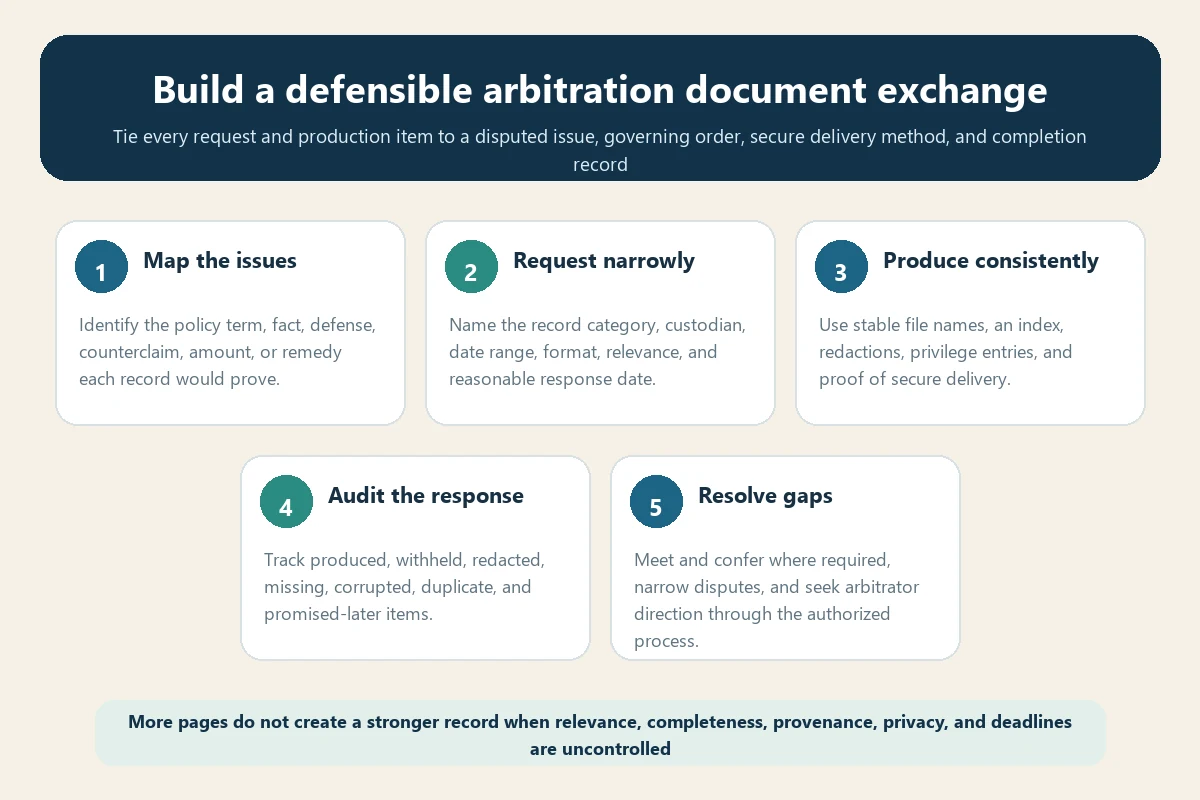
A travel insurance arbitration document exchange should give each party the nonprivileged information needed to present claims and defenses fairly without turning the case into uncontrolled court-style discovery. Every request should identify a disputed issue, record category, custodian, date range, format, and reasonable response date.
The arbitration agreement, governing rules, scheduling order, and arbitrator direction control. Do not assume that a party may demand every internal record or withhold everything labeled confidential. This guide provides general information, not legal advice.
Start with the written scheduling order
Extract every requirement about request dates, objections, production, follow-up, privilege, confidentiality, electronic format, exhibits, witnesses, motions, and hearing. Record the authorized delivery channel and time zone.
If the order is silent or ambiguous, request clarification through the administrator or arbitrator rather than inventing a procedure. The arbitration preliminary hearing checklist explains how to propose a clear exchange schedule before deadlines begin.
Read the governing information-exchange rule
The current AAA Consumer Arbitration Rules address information exchange and arbitrator authority in consumer cases. AAA’s official 2025 update says the rules were reworked to help ensure parties can fairly present their claims and defenses.
JAMS similarly states in its official Consumer Arbitration Minimum Standards that a pre-dispute consumer clause must allow discovery or exchange of nonprivileged information relevant to the dispute. These standards do not establish the exact requests, dates, or scope in a different forum; the accepted case rules and order remain controlling.
Build an issue-to-evidence map
List each disputed policy term, fact, exclusion, condition, causation question, amount, offset, defense, counterclaim, and remedy. For each issue, identify what document would prove or disprove it, who likely holds the record, and whether another source already provides the same information.
This map prevents generic requests for “all documents relating to the claim.” It also shows the arbitrator why a narrower request is necessary and proportional.
Separate records already in your possession
Inventory the policy, endorsements, purchase confirmation, claim, denial, appeal, communications, receipts, refunds, medical or supplier evidence, damages schedule, and service proof. Mark complete, partial, illegible, inconsistent, or missing versions.
Compare the inventory with the travel insurance arbitration demand guide so the exchange supplements rather than duplicates the filing package.
Draft requests by record category
A focused request identifies the specific category, relevant issue, custodian or system if known, date range, desired format, and reason the existing record is insufficient. Examples may include:
- The issued policy version and delivery record.
- Claim intake, status, and communication logs.
- The calculation worksheet supporting payment or denial.
- Documents relied on for a named exclusion or condition.
- Refund or credit verification for named suppliers.
- A medical review or expert material actually relied upon.
- Records supporting a timeliness or notice defense.
- Documents supporting a counterclaim or requested offset.
Do not request categories unrelated to a pleaded issue merely because they might be interesting.
Use definitions sparingly
Define the policy, claim, insured, respondent, administrator, trip, covered event, and relevant period once. Avoid expansive definitions that make a narrow request capture every affiliate, platform, communication, or system without a reason.
Specify whether “communication” includes email, portal messages, letters, call notes, or text messages. If metadata is requested, state which fields and why they matter.
Choose a defensible date range
Tie the start and end dates to purchase, policy delivery, event, notice, claim, review, denial, appeal, or arbitration. Explain why pre-purchase or post-denial records are relevant if included.
A broad “from the beginning of time to present” range invites burden objections and can hide the key period in noise.
Request usable electronic formats
PDF may suit letters and static records; native spreadsheet format may be necessary for formulas; image files may preserve original metadata; exported messages may retain dates and participants. Ask for searchable text where available.
Do not demand native files by default. Identify the function lost in a flattened copy—such as formulas, hidden columns, audit history, or timestamps—and ask only when relevant.
Address the claim file precisely
“Complete claim file” can be ambiguous. Break it into intake records, claim notes, correspondence, document logs, decision memoranda, calculation records, medical or technical review, supervisor review, fraud referral if actually at issue, and policy-version evidence.
Expect privilege, work-product, privacy, confidentiality, or relevance objections to some categories. Ask for an appropriate log or description when the order or governing law requires it rather than assuming every withheld page must be produced.
Distinguish ordinary handling from legal preparation
Record when the claim was handled in the ordinary course and when counsel or anticipated litigation allegedly changed the purpose of a document. The label “legal” or copying a lawyer does not by itself resolve privilege, but privilege law is jurisdiction-specific.
Do not make categorical legal conclusions without the controlling law. Request enough information to evaluate the claim of protection through the authorized process.
Design a privilege log
A useful log may identify a unique number, date, author, recipients, general document type, subject description that does not reveal protected substance, protection asserted, and basis. The exact required fields depend on the order and law.
Separate fully withheld documents from redacted documents and record whether an attachment is independently logged.
Protect medical and identity data
Limit production to records relevant to the claimed medical event, condition, date range, or damages. Redact unnecessary Social Security numbers, full account numbers, passport numbers, unrelated diagnoses, minor information, and third-party data where permitted.
The travel insurance privacy and public-record guide provides a separate framework for minimizing sensitive data in regulator records. Arbitration confidentiality and access rules must still be checked independently.
Use secure transfer and access controls. The official AAA portal terms describe online services and user obligations, but case-specific upload instructions and protective orders still control. No platform should be treated as eliminating every security risk.
Create a production protocol
Agree or request direction on file naming, numbering, folder structure, searchable text, native files, duplicates, color, password exchange, compression, size limits, redactions, metadata, and replacement files. Keep the protocol proportional to the case.
A simple naming convention might combine producing party, sequential number, date, and short description. Do not rename originals destructively; preserve source files separately.
Build a production index
For every item produced, record:
- Stable production number or file name.
- Document date and type.
- Author, sender, and recipient where applicable.
- Request or issue number.
- Page count and file format.
- Redaction or confidentiality status.
- Source or custodian.
- Production date and delivery receipt.
The index should let another person reproduce what was sent without relying on memory.
Use consistent redactions
Make redactions visible and, when required, label the basis. Do not place an opaque shape over text while leaving the underlying content extractable. Preserve an unredacted original securely.
Check headers, footers, comments, hidden spreadsheet cells, document properties, image layers, and file names for sensitive information.
Produce what you promised
Before delivery, compare the file set with each response. If a response says “produced,” verify the referenced files exist, open, and match the category. If production will be supplemented, identify the missing source and expected date rather than using an indefinite promise.
Never silently substitute a summary for an ordered source document.
Document secure delivery
Use the portal, secure link, encrypted transfer, or other channel required by the order. Record sender, recipients, upload time and zone, folder, file list, checksum where useful, expiration, password channel, download confirmation, and error messages.
Do not send passwords in the same unprotected message as the archive unless instructed. Verify recipient addresses before transmitting medical or financial material.
Audit the other side’s production
Create a response matrix with request number, response text, produced files, status, objection, withheld category, promised supplement, defect, follow-up, and deadline. Classify each as complete, partial, none, unclear, corrupted, duplicate, or pending.
Compare file counts and ranges. A gap in sequential production numbers is not proof of withholding, but it is a question to clarify.
Test completeness against the answer
For every defense and counterclaim, ask whether supporting records were produced. If the answer relies on an exclusion, calculation, refund, late notice, medical review, or prior release, locate the cited evidence.
The arbitration answer guide provides a defense matrix that can be cross-referenced with the production index.
Handle corrupted or inaccessible files
Record the file name, size, hash if available, error, operating system or application, and date tested. Ask for a replacement in a specified usable format. Do not repeatedly download or alter a file containing sensitive data without preserving the original.
For password failures, confirm the password channel and archive version before alleging nonproduction.
Resolve objections issue by issue
Separate relevance, burden, breadth, privilege, privacy, confidentiality, possession, duplication, and format objections. Propose a narrower date range, custodian, category, search term, sample, redaction, protective condition, or staged exchange.
Do not send one accusatory letter covering every request. A concise table makes genuine disputes easier to resolve.
Meet and confer with a written agenda
If required or useful, circulate request numbers, current status, narrowed proposal, disputed point, and requested outcome. During the discussion, record agreements, unresolved issues, responsible persons, and dates.
Confirm results in writing. An informal promise should not disappear from the audit trail.
Seek arbitrator direction through the authorized process
Follow page limits, permission requirements, certification, timing, and submission channels for an exchange dispute. Present the request, response, narrowing efforts, remaining issue, importance, burden, and specific relief sought.
Do not attach the entire correspondence history when a short chronology and disputed-request table will show the problem.
Prepare documents for hearing
Exchange production is not automatically the final exhibit set. Follow the order for exhibit numbering, joint exhibits, objections, witness use, demonstratives, translations, medical records, and technology testing.
Track which production file became which hearing exhibit so provenance and completeness remain clear.
Coordinate with regulator records carefully
A state complaint file may contain insurer responses or correspondence relevant to the arbitration, but access and use can be governed by state confidentiality and public-record rules. Follow the travel insurance complaint file request guide rather than assuming the regulator will produce its entire internal file.
Common mistakes
- Requesting every claim record without an issue map.
- Treating arbitration as unlimited court discovery.
- Using undefined terms or unlimited date ranges.
- Demanding native format without explaining why.
- Ignoring privilege, privacy, and third-party information.
- Producing files without an index or stable names.
- Using insecure channels for sensitive records.
- Failing to test links, archives, passwords, and files.
- Calling a partial response complete without auditing it.
- Escalating before making a focused narrowing proposal.
Final exchange checklist
- Rules and scheduling order extracted.
- Issue-to-evidence map completed.
- Existing records inventoried.
- Requests narrowed by category, custodian, date, and format.
- Privilege, privacy, and redaction process defined.
- Production protocol and index prepared.
- Secure delivery and receipts documented.
- Response matrix audited for gaps.
- Narrowing efforts confirmed in writing.
- Unresolved disputes presented through the authorized process.
Bottom line
A strong travel insurance arbitration document exchange is issue-driven, proportional, secure, and auditable. Request only records that matter, explain their relevance, preserve originals, index every production, protect sensitive data, and track each objection or missing item.
The governing rules and scheduling order—not a generic discovery template—control the process. Seek qualified advice when privilege, subpoenas, medical privacy, third-party records, sanctions, or court enforcement could materially affect the exchange.
