
A travel insurance arbitration opening statement should give the arbitrator a short, accurate roadmap before testimony and exhibits begin. It identifies what the case is about, which issues actually require a decision, how the evidence will address them, and what relief is requested. It is not the moment to testify, read every document, or argue facts that will never enter the record.
The arbitration agreement, governing rules, and hearing order control whether openings are permitted, their sequence, and any time limit. Confirm the procedure with the arbitrator or case administrator through the authorized channel. This U.S. consumer guide provides general information, not legal advice.
Understand the opening’s limited job
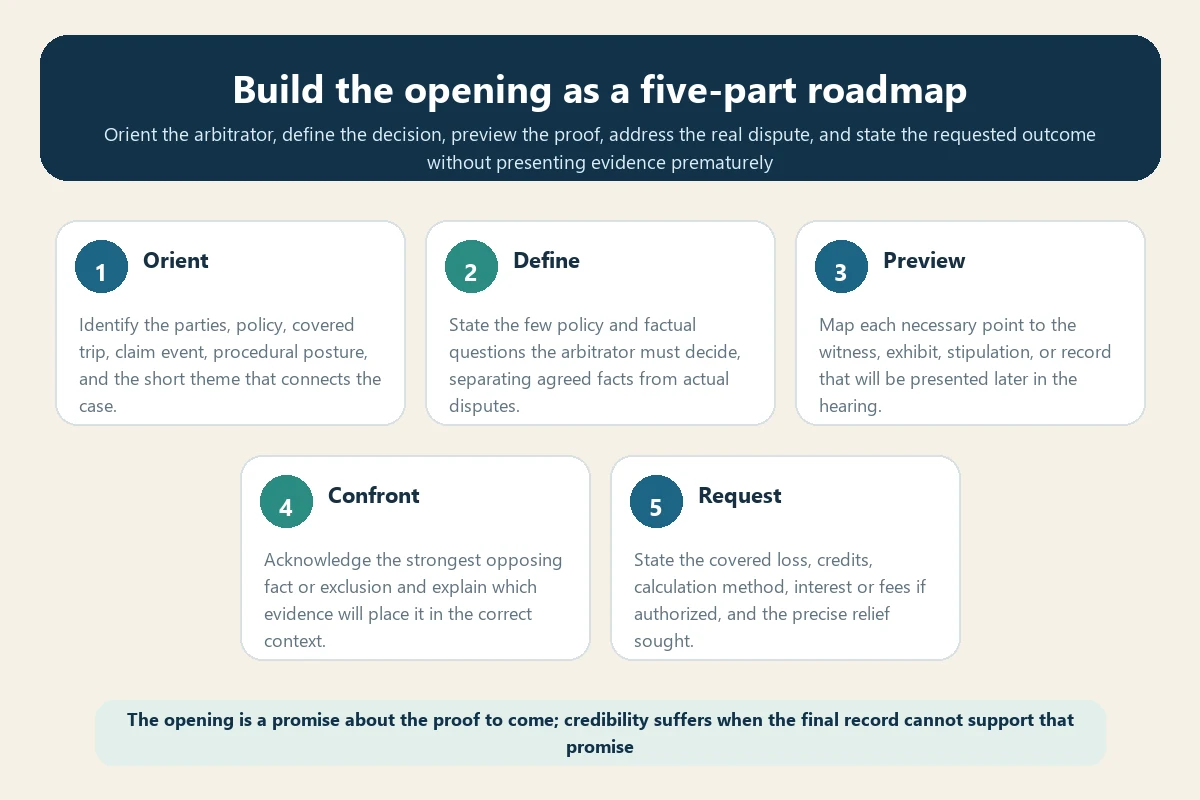
An opening orients. It should help the arbitrator recognize the parties, policy, trip, loss event, claim history, controlling coverage issue, evidence sequence, and requested outcome. Think of it as a map whose landmarks will later be proved.
FINRA’s official arbitration process guide describes opening statements as brief outlines of the issues and what each party will try to prove, not the appropriate time to present evidence. FINRA rules do not govern an AAA travel insurance case, but the distinction between roadmap and proof is a useful procedural illustration.
Start with the actual decision, not the whole history
Reduce the dispute to two or three questions. Examples: Did the event fall within the covered cancellation reason? Was the condition excluded or protected by a waiver? Were the claimed costs prepaid, nonrefundable, and unreimbursed? Did notice or documentation satisfy the policy?
Do not narrate every booking, call, and email. Include a date only if it changes coverage, credibility, causation, compliance, or damages. The detailed chronology belongs in the evidence presentation.
Write a one-sentence case theme
A useful theme combines the covered event, policy promise, proof, and requested result without exaggeration. For example: “The contemporaneous medical record, cancellation notice, and refund ledger will show that a covered event caused the insured loss and that the remaining unreimbursed amount is $X.”
Avoid slogans that assume the conclusion, attack motives, or promise evidence you do not have. The theme should survive comparison with the policy and final record.
Build an issue-to-proof map
| Decision point | Proof to preview | Limit to disclose |
|---|---|---|
| Policy and insured trip | Declarations, certificate, itinerary | Applicable form and dates |
| Covered event | Witness and contemporaneous record | What the witness knows firsthand |
| Exclusion or condition | Policy language and dated facts | Which element is disputed |
| Causation | Chronology and source records | Alternative explanation |
| Loss amount | Payment, refund, credit ledger | Offsets and unsupported items |
Link every promised point to an exchanged exhibit, disclosed witness, stipulation, or admissible record. Use the arbitration document exchange checklist to confirm the referenced material is in the correct final set.
Separate agreed facts from disputed facts
State useful agreements briefly: the policy was issued, the trip dates are undisputed, or the carrier refunded a specified amount. Then identify the remaining questions. This saves hearing time and signals that the opening is built around the decision rather than theater.
Do not represent a fact as stipulated unless the stipulation is clear and preserved. If the other party merely failed to emphasize an issue, describe the record accurately instead of inventing agreement.
Identify the controlling policy language
Quote or paraphrase only the provisions that matter: insuring agreement, covered reason, definition, exclusion, notice term, proof requirement, benefit limit, coordination clause, or waiver. Give the form name and page or section so the arbitrator can locate it later.
Do not isolate a favorable sentence from definitions or limitations. Explain how the provisions fit together and which element each side interprets differently.
Preview the evidence in hearing order
The arbitrator should know what comes next. Preview the traveler’s testimony, a treating clinician or custodian if applicable, supplier records, claim correspondence, refund evidence, and any expert testimony in the planned order.
Use the witness testimony guide to map each witness to personal knowledge and a matching exhibit. Do not summarize anticipated testimony as if it has already been accepted as fact.
State what each key exhibit will show
Refer to a small number of anchor exhibits: “Exhibit 4 is the policy form containing the covered-reason language”; “Exhibit 9 is the carrier ledger showing the refund”; “Exhibit 12 is the dated medical note.” This makes the later record easier to follow.
Avoid displaying or reading exhibits during the opening unless the arbitrator has authorized that procedure. Confirm whether demonstratives are permitted and whether they must be exchanged in advance.
Explain the claim history neutrally
Give only the procedural facts needed to understand the dispute: claim submission, request for additional information, decision, internal appeal, arbitration demand, answer, and current hearing. Use exact dates when timing is contested.
The travel insurance claim filing guide helps reconstruct the original record. An opening should not rewrite an incomplete initial claim; it should explain how the evidence now before the arbitrator addresses the actual decision.
Address the denial reason directly
Quote or accurately summarize the insurer’s stated basis and explain which evidence will answer each element. If the answer or hearing brief raises a new defense, distinguish it and identify the governing provision and responsive proof.
Use the claim denial reasons guide to separate eligibility, exclusion, documentation, timing, causation, and loss-amount issues. Do not attack a generic “bad denial” when the arbitrator must decide a specific contract question.
Confront the strongest adverse fact
Identify the record point the other side is most likely to emphasize: an earlier symptom, delayed notice, inconsistent date, missing receipt, supplier credit, or excluded event. State it fairly and preview the context or evidence that affects its meaning.
Ignoring an obvious problem lets the opposing opening define it first and can damage credibility. Addressing it does not require conceding the legal conclusion.
Do not testify during the opening
A self-represented traveler may be both party and witness, but the procedural stages remain distinct. During opening, describe what the evidence will show. During testimony, answer under the procedure established by the arbitrator and allow questioning.
Current AAA Consumer Arbitration Rules provide the broader hearing framework, including evidence, witness questioning, relevance, materiality, and the right to be heard. Check the rule version governing the case.
Do not promise excluded or unavailable proof
Before drafting, review exhibit rulings, witness availability, privilege issues, subpoena results, sanctions, and limitations in the hearing order. Remove any promise based on evidence that may not be presented.
If a record or witness remains uncertain, describe the point cautiously or omit it. The opening is a credibility commitment to the proof that will follow.
Present a transparent damages roadmap
State the requested benefit and the calculation method. Separate prepaid costs, nonrefundable amounts, supplier refunds, credits, other insurance, deductibles, policy limits, and unsupported items. Identify the exhibit that contains the final ledger.
Do not announce a round number without showing how the evidence will support it. If interest, fees, costs, or other relief is requested, identify the contractual or legal basis and keep it separate from the covered loss.
Tailor the opening to the assigned time
Ask whether opening is optional and how much time is available. A short consumer dispute may need only a few minutes. Prioritize decision questions, anchor proof, adverse fact, and relief.
Prepare a full version and a compressed version. If the arbitrator shortens the opening, preserve the core roadmap instead of speaking faster or reading every detail.
Use plain language and stable references
Prefer short sentences, defined names, chronological transitions, and exact exhibit numbers. Replace insurance jargon with a brief explanation unless the policy term itself is disputed.
The official AAA guide to preparing for arbitration emphasizes a coherent case theory, organized evidence, careful witness selection, and preparation of openings and closings. Clarity should make the proof easier to evaluate, not merely make the speaker sound polished.
Suggested opening structure
- Theme: one sentence connecting policy promise, event, proof, and outcome.
- Decision: two or three questions the arbitrator must resolve.
- Agreed facts: only useful points that truly are not disputed.
- Policy: controlling provisions and the parties’ interpretive difference.
- Proof: witnesses and anchor exhibits in presentation order.
- Adverse fact: the key weakness and evidence that provides context.
- Relief: amount, calculation, offsets, and any separately authorized request.
Practice delivery without memorizing a performance
Use a one-page outline with headings, key dates, exhibit numbers, and the final request. Practice aloud and time both versions. Mark words that are difficult to pronounce and numbers that require careful reading.
Speak to the arbitrator, pause between sections, and respond directly if interrupted with a question. Do not argue with the opposing party during its opening; note any issue and address it at the proper time.
Virtual opening statement checks
Confirm camera, microphone, screen name, lighting, background, internet, backup connection, exhibit-display permission, and private workspace. Keep the outline and final exhibit index available without covering the camera or producing loud page noise.
Do not screen-share a document unless authorized. Close unrelated windows and notifications to protect private information.
Common opening statement mistakes
- Retelling the entire trip instead of defining the decision.
- Reading the demand, brief, policy, or exhibit list word for word.
- Presenting testimony or documents before the evidence stage.
- Promising a witness, exhibit, or opinion that is unavailable or excluded.
- Ignoring the strongest adverse fact or actual denial reason.
- Using accusations, exaggeration, or motive arguments unsupported by proof.
- Requesting a total without explaining credits, limits, and calculation.
- Exceeding the assigned time or failing to prepare a shorter version.
Final opening-statement checklist
- Confirm openings are permitted, sequence, time limit, and demonstrative rules.
- State one accurate theme and no more than three decision questions.
- Match every promised fact to available proof.
- Use correct policy, witness, exhibit, and damages references.
- Address the real defense and strongest adverse fact fairly.
- Separate roadmap from testimony and evidence presentation.
- End with precise relief and a transparent calculation method.
Coordinate the opening with the complete arbitration hearing preparation checklist. The strongest opening is not the most dramatic; it is the one the final evidence allows the arbitrator to recognize as accurate.
