
Travel insurance arbitration hearing preparation should connect every disputed claim, defense, amount, and requested remedy to reliable evidence. Build a proof map, control exhibits, prepare witnesses and questions, test the hearing technology, plan objections, and follow the scheduling order exactly.
An arbitration hearing can be less formal than court, but it still requires disciplined preparation. The agreement, governing rules, and arbitrator’s orders control; court evidence rules may not apply in the same way. This guide provides general information, not legal advice.
Start with the final scheduling order
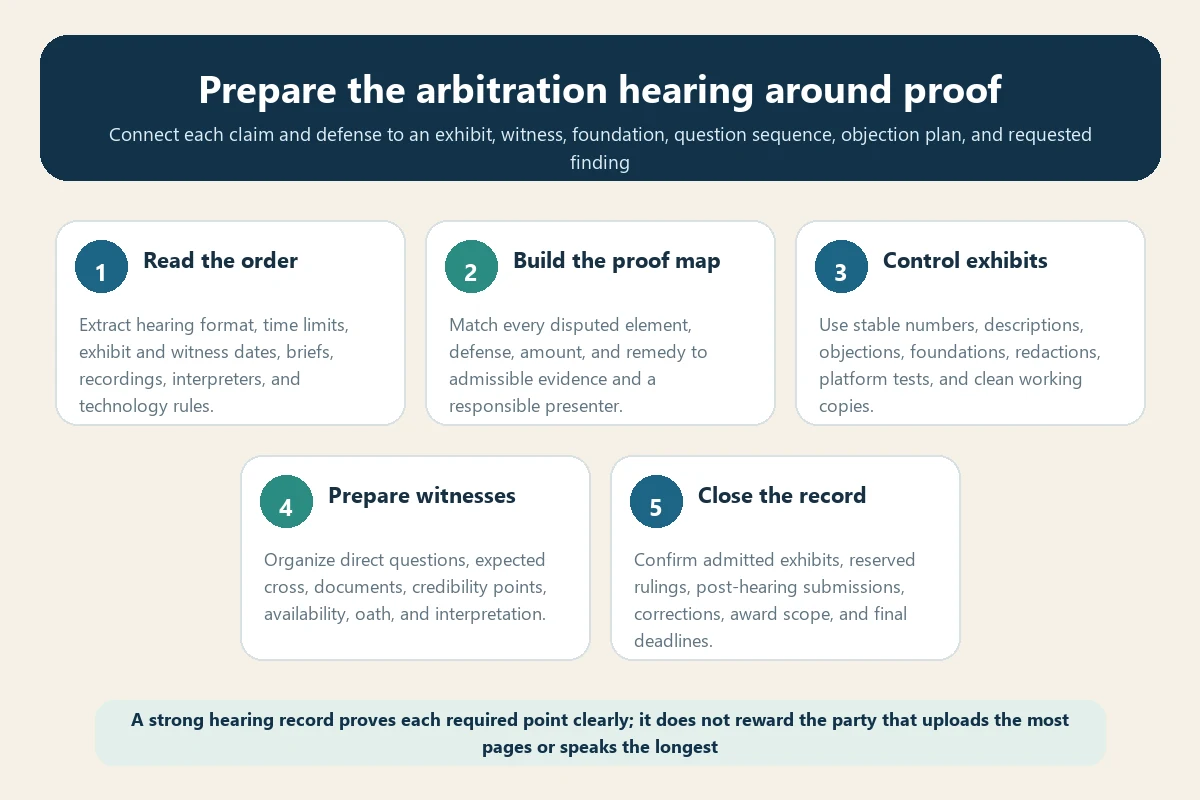
Extract hearing date, time zone, duration, format, location or platform, attendance, witness sequence, exhibit deadline, objection deadline, brief deadline, interpreter arrangements, transcript rules, recording restrictions, technology test, and post-hearing procedure.
Compare every date with the arbitration preliminary hearing checklist. If the written order differs from your notes, request clarification through the authorized channel.
Read the current hearing rules
For an AAA consumer case, use the current AAA Consumer Arbitration Rules. They address hearing attendance, oath, evidence, witnesses, transcript, interpreter, postponement, absence, post-hearing material, and award procedure.
The rules provide the general structure, but the case order may establish page limits, exhibit conventions, witness dates, time allocations, and technology procedures. Use both.
Define the decision the arbitrator must make
List each requested finding: policy existed, event occurred, notice was timely, condition was satisfied, exclusion does not apply, expense was incurred, loss was caused, amount is correct, offset is limited, and remedy is authorized. Add each defense and counterclaim.
Write the governing policy clause, fact, evidence, anticipated response, and requested finding next to every element. A persuasive story cannot replace a missing required point.
Build a burden-and-proof matrix
Use columns for issue, party bearing the burden under applicable authority, standard if established, policy or law, undisputed fact, disputed fact, exhibit, witness, foundation, objection risk, and requested finding.
Do not assume the burden from intuition. When the allocation or legal standard is contested, identify the issue for briefing or qualified advice.
Separate admissions from contested facts
Use the answer, stipulations, orders, and correspondence to identify facts that no longer require proof. Preserve qualified admissions precisely. Receipt of a document does not concede its truth or coverage effect.
The arbitration answer guide provides an allegation-by-allegation matrix for admissions, denials, defenses, and counterclaims.
Create a hearing exhibit list
For every proposed exhibit, record:
- Stable exhibit number and short description.
- Date, author, sender, recipient, and source.
- Pages and electronic format.
- Issue or element proved.
- Witness or other foundation.
- Confidentiality and redaction status.
- Stipulated, objected, admitted, excluded, or reserved status.
- Hearing presentation method.
Remove duplicates and drafts that add no proof. Keep original source files separately.
Reconcile production numbers with hearing numbers
If document-exchange numbers differ from hearing exhibit numbers, maintain a cross-reference table. Confirm that the final hearing file is the same version produced and cited.
Use the arbitration document exchange checklist to preserve provenance, redactions, privilege status, and delivery records.
Audit each exhibit for completeness
Check missing pages, attachments, backs of receipts, terms, email threads, signatures, timestamps, currency, translations, and legibility. A cropped screenshot may omit sender, date, URL, or context necessary to understand it.
Open every file on the hearing device. Test hyperlinks, bookmarks, video, audio, and native spreadsheets under the platform restrictions.
Prepare exhibit foundations
Identify how the exhibit will be recognized: participant testimony, business record, sender or recipient, custodian, metadata, stipulation, insurer production, or another permitted basis. Prepare short nonleading foundation questions where appropriate.
Do not assume an uploaded exhibit is admitted merely because the arbitrator can see it. Track the order’s procedure for objections and admission.
Build an objection table
For your exhibits and the insurer’s, list relevance, duplication, completeness, authenticity, foundation, privilege, confidentiality, unfair surprise, reliability, translation, expert qualification, or order violation concerns. Match each to the governing rule and requested ruling.
Arbitrators often have discretion over materiality and relevance. Make concise case-specific objections instead of reciting court terminology without explaining the problem.
Prepare the claimant’s chronology
Create a dated sequence from policy purchase through event, notice, assistance calls, claim, document requests, decision, appeal, arbitration, and current damages. Cite an exhibit and witness for each important event.
Distinguish event date, discovery date, notice date, claim date, receipt date, denial date, and appeal date. Timing disputes often turn on these differences.
Reconcile damages line by line
Use a schedule with expense, benefit, policy limit, deductible, currency, exchange source and date, refund, credit, other insurance, prior payment, disputed balance, and supporting exhibit. Remove duplicates.
If the insurer made a partial payment, use the partial travel insurance payment guide to bridge the claimed and paid amounts.
Identify fact witnesses by proposition
For each witness, list personal knowledge, facts established, exhibits introduced, estimated direct time, expected cross, language, location, availability, oath, and technology. Do not call multiple witnesses for the same uncontested fact.
Possible witnesses include the insured, travel companion, supplier representative, treating clinician, claims representative, assistance provider, records custodian, or another participant. Need depends on the disputed issues.
Prepare direct examination
Organize questions by element and chronology. Begin with identity and personal knowledge, then event, actions, documents, loss, and requested result. Use open questions for substantive testimony and the exhibit sequence for clarity.
Do not script false certainty. A witness should testify only to remembered facts and distinguish personal knowledge from information received from others.
Prepare for cross-examination
Identify vulnerable dates, inconsistent statements, incomplete records, memory limits, financial interest, alternative causes, refunds, prior conditions, and policy communications. Review the complete record rather than coaching around unfavorable facts.
Prepare the witness to listen, answer the question asked, request clarification, avoid guessing, and correct genuine mistakes.
Plan cross-examination of insurer witnesses
Link questions to disputed issues: role, personal knowledge, claim workflow, policy version, records reviewed, missing records, calculation, exclusion analysis, communications, medical review, refund verification, and authority for the final decision.
Use short questions tied to exhibits. Do not argue with the witness or ask about subjects that cannot affect a required finding.
Handle expert testimony
Confirm disclosure, report, qualifications, opinions, basis, materials considered, assumptions, methodology, compensation, availability, and rebuttal. Separate medical treatment testimony from retained expert opinion where applicable.
Prepare challenges to qualifications or scope under the governing order and rules. Do not assume court expert standards apply automatically.
Prepare an opening statement
State the dispute, policy promise, covered event, core evidence, denial issue, damages, and requested decision in a concise sequence. Identify genuinely disputed questions and avoid promising proof you cannot deliver.
An opening is a roadmap, not evidence. Keep legal assertions tied to the written authority you will provide.
Prepare a closing framework
Organize the closing by required finding. Cite admitted exhibits and testimony, address the strongest defense, reconcile damages, and specify the requested award. Update the outline during the hearing based on actual rulings and proof.
Do not cite an exhibit that was excluded or testimony that was not given.
Choose virtual, in-person, or hybrid logistics
AAA’s official 2025 consumer rule update states that virtual hearings became the default under revised consumer rules, while parties may request or agree to other formats and the arbitrator can resolve disputes. Follow the actual case order.
For in-person hearings, confirm room, travel, security, copies, equipment, witnesses, and accessibility. For hybrid hearings, specify which participant uses which mode and how exhibits and cross-examination remain fair.
Run a complete technology test
Test camera, microphone, speakers, headphones, bandwidth, backup connection, power, platform, screen sharing, exhibit opening, annotations, waiting room, interpreter channel, and private communication. Use the same device and network planned for the hearing.
Prepare offline exhibits and administrator contact details. Agree on what happens after disconnection.
Use the authorized exhibit platform correctly
AAA’s official Hearing Exhibits Space FAQ explains that parties and arbitrators generally upload, index, and manage exhibits and describes file naming, viewing, sorting, and downloading.
Do not assume the case manager checks exhibit completeness. Verify every file, number, description, access permission, and version yourself.
Arrange an interpreter early
Confirm language, dialect, consecutive or simultaneous method, credentials, cost, oath, platform channel, document translation, witness availability, and backup. Under AAA consumer rules, a party wanting an interpreter generally makes the arrangement and bears the cost, subject to applicable authority and order.
Do not use a family member for substantive interpretation without confirming permission and suitability.
Decide whether a transcript is needed
The current AAA consumer rules provide a process for arranging a transcript and notifying the arbitrator and other parties in advance; the requesting party generally pays, subject to the rule and any cost decision. Other recording is restricted absent agreement or direction.
Consider complexity, witness credibility, post-hearing briefing, contract-based appeal, court review, cost, and disputed amount. Confirm whether the transcript will be the official record.
Protect confidentiality during the hearing
Follow the protective order for attendance, exhibits, witness access, screen display, transcript, recording, medical information, and post-hearing retention. Verify who is present before sensitive testimony.
The arbitration confidentiality guide explains why a private hearing does not automatically make every party, exhibit, award, or court filing confidential.
Prepare a hearing day control sheet
Track time used, witness status, exhibits offered, objections, rulings, reserved decisions, stipulations, interpreter issues, technology incidents, breaks, follow-up evidence, and deadlines. Assign one reliable note source.
Do not create an unauthorized recording. Use the transcript or official record process if approved.
Handle absence and postponement correctly
If illness, emergency, missing witness, technology failure, or another problem arises, follow the rule and order for postponement. Submit evidence and notice promptly. Do not assume a request pauses the hearing until a written decision confirms it.
AAA rules allow a case to proceed after due notice when a party fails to appear, but an award is not based solely on default; the attending party must present evidence. Confirm the current rule.
Close the record deliberately
Before conclusion, confirm admitted and excluded exhibits, outstanding rulings, corrections, stipulated facts, transcript status, authorized post-hearing evidence, briefs, cost applications, and the date the record will close.
Do not submit new material after closure unless the arbitrator authorizes it and gives the other side the required opportunity to respond.
Common mistakes
- Preparing a story without mapping required proof.
- Uploading exhibits without foundation or issue relevance.
- Using inconsistent production and hearing exhibit versions.
- Overlooking admissions and wasting hearing time.
- Failing to reconcile damages and offsets.
- Preparing direct testimony but not expected cross.
- Assuming court evidence rules control automatically.
- Skipping technology, interpreter, or transcript deadlines.
- Recording without authorization.
- Submitting evidence after record closure without permission.
Final hearing checklist
- Rules and final order extracted.
- Claim, defense, burden, and proof matrix complete.
- Exhibits numbered, tested, and cross-referenced.
- Foundations and objections prepared.
- Damages reconciled.
- Witness direct and cross outlines ready.
- Opening and closing frameworks tied to proof.
- Technology, interpreter, transcript, and privacy plans confirmed.
- Hearing control sheet ready.
- Record-closure and post-hearing dates understood.
Bottom line
Travel insurance arbitration hearing preparation is a proof-control exercise. Match every required finding to reliable exhibits and testimony, prepare for defenses and objections, reconcile damages, and follow the hearing order.
Test the presentation before hearing day and confirm the record before it closes. Obtain qualified advice when burden allocation, evidence, experts, privilege, subpoenas, appeal rights, or court review could materially affect the case.
