
Travel insurance informal dispute resolution conference requirements can place a telephone or video meeting between a written notice and an arbitration filing. The conference may be optional to request yet mandatory to complete once requested, individualized to one traveler, and tied to a contractual waiting period.
This U.S. consumer guide explains how to identify the correct process, prepare the evidence and negotiation plan, participate in good faith, and preserve completion. It is not legal advice.
Start with the operative purchase-time terms
Preserve the terms accepted when the policy, booking, membership, or platform service was purchased. Save the policy, certificate, checkout terms, confirmation email, amendments, claim correspondence, and incorporated arbitration rules.
Search those records for “informal dispute resolution,” “meet and confer,” “conference,” “pre-arbitration,” “notice,” “condition precedent,” and “tolling.” A current website may not be the version governing an older transaction.
Identify which company the dispute concerns
A trip can involve an insurer, claims administrator, booking platform, airline, hotel, tour operator, and payment provider. Their contracts and dispute procedures are not interchangeable.
Priceline’s published terms, for example, state that trip protection offered through its site is provided through a separate Cover Genius relationship. A conference under platform terms may therefore address a platform dispute without deciding benefits owed under an insurer’s policy.
Separate the conference from the insurance claim
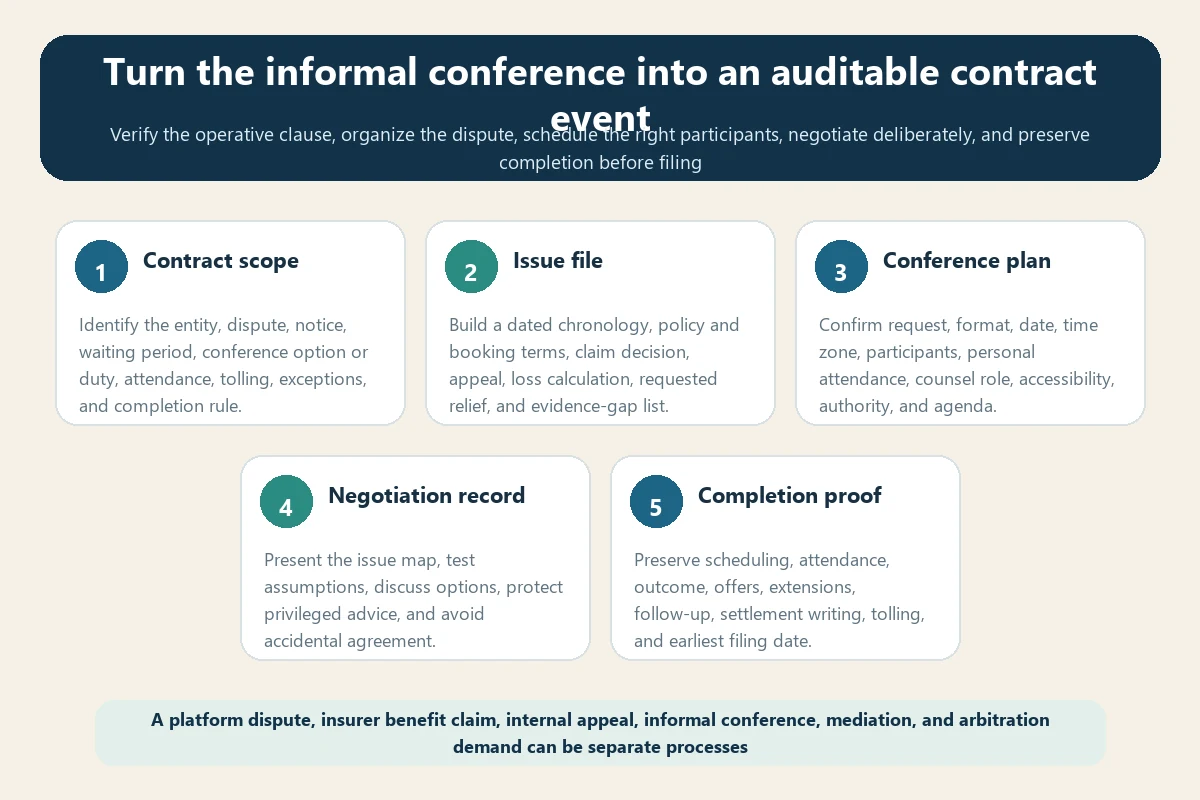
A claim requests policy benefits and supplies proof of a covered loss. The conference attempts to resolve an existing dispute before a specified forum filing. Completing one does not necessarily complete the other.
Use the travel insurance claim filing guide to keep proof-of-loss, benefit, deadline, submission, and acknowledgment records complete.
Separate written notice from the meeting
The written notice commonly starts informal resolution and identifies the claimant, dispute, and requested relief. The conference is a later conversation that one party may request during that period.
The notice-of-dispute guide explains content, signature, recipient, delivery, receipt, cure, and waiting-period proof. Do not treat a calendar invitation as a substitute for a compliant notice.
Determine whether the conference is optional or mandatory
Read each verb and condition. A contract may require good-faith informal efforts, permit either party to request a conference, and require personal participation if a conference is requested. Another clause may require a meeting in every dispute.
Build a four-column table: action, responsible party, trigger, and proof. Include consequences of nonparticipation and any authority assigned to a court or arbitrator.
Use travel-platform terms as examples, not templates
KAYAK’s official U.S. terms illustrate an informal process lasting 45 days. They allow either party to request a telephone meet-and-confer, require the user to participate personally even when represented, individualize the conference, and describe tolling during informal resolution.
Priceline’s official terms provide a different example: a 60-day informal process, an optional conference request during that period, individualized meetings, stated notice fields, and a later certification of completion. These examples prove why the actual contract—not a generic checklist—controls.
Build a one-page dispute map
List the disputed transaction, policy benefit, claim number, decision, challenged exclusion or condition, appeal result, and exact relief requested. Link every material statement to a dated document.
Separate undisputed facts, disputed facts, contract interpretation, missing evidence, legal issues, and dollar calculations. This structure keeps a short conference focused.
Prepare a reliable chronology
Record purchase, trip dates, covered event, notice of loss, claim submission, information requests, responses, denial, appeal, dispute notice, receipt, and conference request. Use one time zone consistently.
The arbitration timeline guide helps distinguish policy deadlines, contractual waiting periods, limitation periods, and administrator filing dates.
Reconcile the amount in dispute
Create a worksheet for each requested amount: prepaid loss, covered additional expense, policy limit, deductible, refund, credit, prior payment, interest, fee, and nonmonetary relief. Cite the supporting receipt and contract provision.
A negotiation range is not the same as the amount legally recoverable. Avoid double-counting a supplier refund and an insurance benefit for the same loss.
Audit the evidence before the call
Prepare a compact conference packet with the operative terms, policy page, denial, appeal, chronology, loss table, and several decisive exhibits. Keep the full claim file indexed but do not overwhelm the meeting.
Flag missing records, conflicting dates, unreadable receipts, untranslated documents, and metadata gaps. State uncertainty honestly rather than converting an assumption into a fact.
Confirm scheduling and format in writing
Preserve who requested the conference, request date, proposed dates, selected date, time zone, telephone or video platform, expected duration, dial-in details, accessibility needs, interpreter, and backup contact.
Do not send medical records or unnecessary identifiers in an unsecured calendar invitation. Confirm the permitted delivery channel first.
Identify every participant and role
List the traveler, company representative, claims professional, counsel, interpreter, support person, and decision-maker. Determine whether the contract requires the consumer’s personal attendance and whether counsel may participate.
Ask whether the company participant has settlement authority or can reach someone who does. Do not assume attendance creates authority to bind another entity.
Prepare a concise opening statement
In two minutes, identify the transaction, unresolved decision, two or three controlling documents, requested outcome, and why resolution now is practical. Avoid personal attacks and unsupported accusations.
Then ask targeted questions: Which term controls? What evidence is considered missing? Is the dispute with the correct company? What monetary and nonmonetary solutions are available?
Plan settlement authority and alternatives
Before the meeting, define the preferred outcome, acceptable range, nonmonetary options, payment timing, confidentiality needs, tax questions, releases, and the alternative if no agreement occurs.
The arbitration settlement guide covers scope, payment, release language, withdrawal, default remedies, and final closure. Never accept ambiguous oral terms simply to end a difficult call.
Protect sensitive and privileged information
Share only information necessary to explain the dispute. Redact unrelated account, payment, passport, and medical identifiers. Keep legal advice and attorney work product separate from merits exhibits.
An informal call is not automatically confidential merely because it occurs before arbitration. Identify contractual confidentiality, evidence rules, settlement protections, and permitted recipients before disclosing sensitive material.
Participate in good faith without surrendering accuracy
Good-faith participation generally favors timely scheduling, personal attendance where required, listening, explaining positions, considering proposals, and responding to reasonable follow-up. It does not require agreement, admission, or abandonment of a valid defense.
Correct material misunderstandings during the call and reserve issues that require document review. Do not guess.
Take a neutral conference record
Record date, start and end time, format, attendees, issues discussed, documents requested, proposals requiring follow-up, agreed deadlines, and whether the process concluded or remains open. Follow recording-consent laws and contract rules; written notes are often safer.
Keep negotiation notes separate from the merits evidence file. A settlement proposal does not by itself prove liability or coverage.
Document nonattendance or scheduling failure
If the other party does not attend, preserve the request, delivery, confirmations, reminders, waiting time, attempted contact, and any explanation. Offer reasonable rescheduling when appropriate without silently extending a legal deadline.
Do not declare the condition satisfied solely because a call failed. Review prevention, waiver, cure, completion, and decision-maker language with case-specific counsel when timing is consequential.
Confirm any resolution in a complete writing
If agreement is reached, document parties, covered claims, exact payment or performance, deadlines, tax treatment, confidentiality, release scope, dismissal or withdrawal, default remedy, signatures, and effective date.
Do not withdraw an appeal, complaint, court action, or arbitration demand before the signed agreement says when that action must occur and what happens if performance fails.
Calculate the completion and filing dates
Identify whether the waiting period starts on sending, delivery, receipt, acknowledgment, or another event. Determine whether the conference changes the end date and whether the contract requires both expiration and meeting completion.
Quote any tolling provision rather than paraphrasing it. Maintain separate clocks for policy suit limitations, statutes of limitation, small claims, regulatory complaints, appeals, and arbitration administration.
Prepare the later arbitration certification
Some clauses require the demand to certify completion of informal resolution. Preserve the operative clause, notice, delivery proof, scheduling record, attendance note, follow-up, waiting-period calculation, and unresolved outcome.
The AAA’s official consumer arbitration page explains that a consumer filing generally includes a demand, the arbitration provision, and the applicable fee. Contractual preconditions remain a separate audit item. Use the travel insurance arbitration demand guide to reconcile parties, claims, relief, attachments, service, and filing proof.
Avoid common conference mistakes
- Using current terms instead of purchase-time terms.
- Invoking the platform’s clause for an insurer-only dispute.
- Skipping the required written notice.
- Assuming an optional request means optional attendance after request.
- Missing a personal-participation requirement.
- Joining unrelated claimants when the clause requires individualization.
- Attending without a chronology, loss calculation, or settlement plan.
- Disclosing unnecessary sensitive or privileged information.
- Recording without checking consent law.
- Assuming negotiation automatically tolls every deadline.
- Filing without proof of completion.
Final informal conference checklist
- Preserve the operative terms and correct contracting entity.
- Separate the claim, appeal, notice, conference, and demand.
- Map whether request and attendance are optional or mandatory.
- Build the issue map, chronology, loss table, and evidence packet.
- Confirm format, time zone, participants, and accessibility.
- Prepare questions, authority, range, and alternatives.
- Protect confidential, privileged, and sensitive information.
- Document attendance, follow-up, nonattendance, and extensions.
- Put any settlement in a complete signed writing.
- Calculate completion, tolling, and earliest filing dates.
- Preserve the certification packet for any later demand.
A professional informal dispute resolution conference is a controlled contract event, not an improvised customer-service call. The traveler enters with the correct clause, entity, chronology, proof, valuation, and negotiation plan—and leaves with a reliable record of settlement or completion.
