
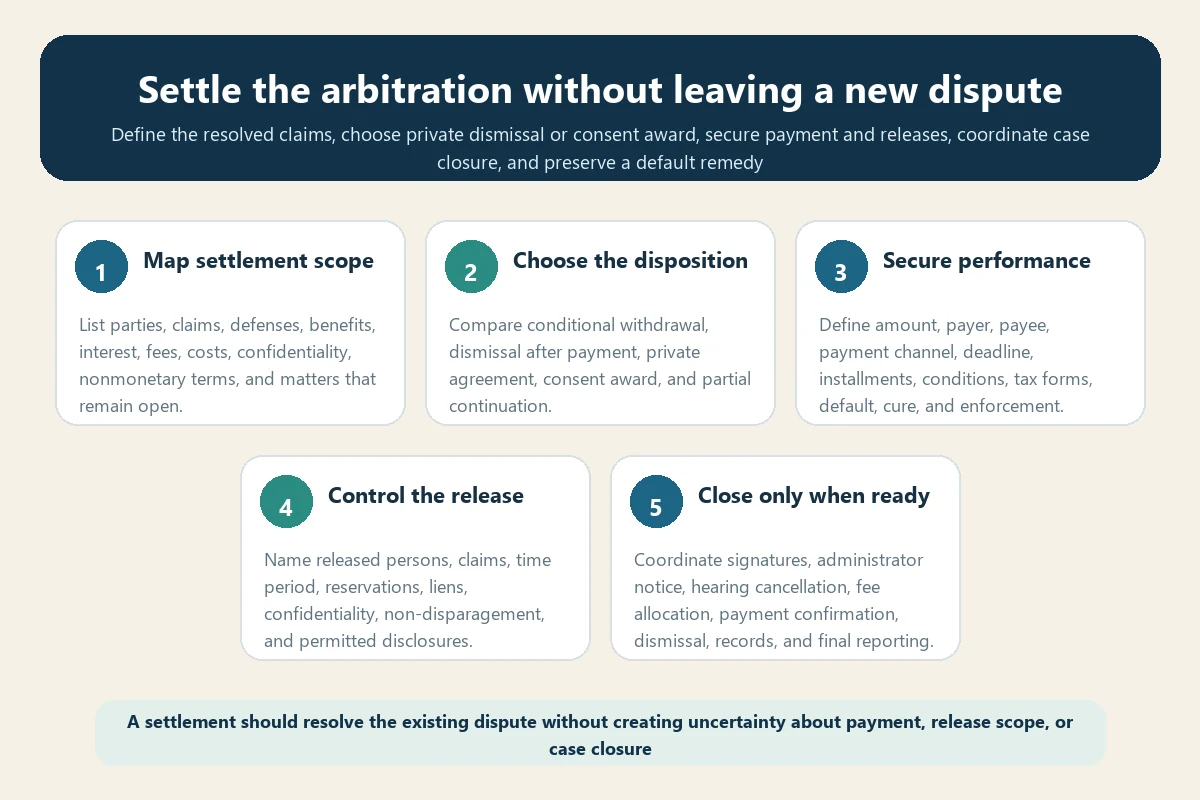
A travel insurance arbitration settlement can resolve a coverage or payment dispute before the arbitrator issues a final award. The parties should document more than the headline amount: scope, payment, releases, confidentiality, fees, dismissal timing, consent-award choice, default remedies, and any claims that remain open.
Do not cancel a hearing or withdraw the arbitration merely because negotiations appear promising. Confirm who has authority, when an agreement becomes binding, what conditions remain, and how the case will close. This guide provides general information, not legal, tax, insurance, or settlement advice.
Settlement can happen at any arbitration stage
Parties can negotiate before the answer, during document exchange, after motions, at mediation, before the final hearing, during a hearing break, or after the hearing but before an award. Timing changes leverage, remaining cost, available information, and procedural risk.
Ask whether deadlines continue while negotiations occur. Unless the administrator or arbitrator changes an order, prepare the case and comply with deadlines as though no settlement will occur.
Confirm settlement authority
Identify the claimant, insurer legal entity, authorized representative, counsel, estate or guardian if applicable, and anyone whose consent is required. An adjuster’s negotiating authority, an attorney’s authority to transmit an offer, and authority to bind the party may be different questions.
Record whether approval is needed from a supervisor, committee, reinsurer, plan sponsor, lienholder, court, probate representative, or another person. Do not describe an offer as final approval until every stated approval condition is satisfied.
Separate an offer from an agreement
Preserve the complete offer, expiration time, conditions, attachments, release form, payment schedule, tax language, confidentiality term, and proposed case disposition. Identify whether acceptance must be signed, emailed, placed on the hearing record, or followed by a long-form agreement.
Do not accept only the dollar figure while leaving material terms unresolved. State law governs contract formation and can treat oral, email, electronic-signature, or term-sheet communications differently.
Use a settlement scope matrix
| Scope item | Question | Settlement text |
|---|---|---|
| Claims | Which demand, counterclaim, benefit, and theory resolve? | Identify by case and claim |
| Money | Principal, interest, fees, costs, and credits? | Exact gross and net amounts |
| Nonmonetary terms | Correction, letter, record, or other act? | Actor, deliverable, deadline |
| Release | Who and what are released? | Named persons, claims, period |
| Open matters | What survives? | Express exclusions and reservations |
| Case closure | Withdrawal, dismissal, consent award, or partial continuation? | Sequence and responsible filer |
Reconcile the settlement amount
Start with the disputed benefits, then list supplier refunds, insurer payments, deductible, policy limit, offsets, other insurance, interest, attorney fees, arbitration fees, expert costs, tax withholding, and any nonmonetary value.
The partial-payment guide helps prevent a prior payment from being counted twice. Label whether the settlement amount is gross, net, inclusive of costs, or additional to earlier payments.
Write payment terms that can be performed
Name the payer and payee, amount, currency, method, secure instructions, due date, time zone, installment dates, condition precedent, required tax form, remittance reference, and event that counts as payment. Distinguish “sent,” “received,” and “cleared.”
If payment depends on a signed release, lien information, vendor form, court approval, or dismissal, state who supplies it and how quickly. Avoid circular conditions in which neither side must perform first.
Decide whether dismissal follows payment
A claimant may prefer to dismiss only after cleared payment, while the insurer may request dismissal or a signed release before paying. Resolve the sequence explicitly. Alternatives can include signed documents held pending payment, conditional withdrawal, staged dismissal, or another lawful security mechanism.
Do not withdraw first without understanding the remedy if payment fails and whether the arbitration can be reopened. The administrator’s closure rules and the settlement’s enforcement clause matter. If negotiations fail and an award later issues, use the travel insurance arbitration award guide to preserve delivery, reconcile relief, and calendar post-award routes.
Distinguish private settlement from consent award
Under current AAA Consumer Arbitration Rules, parties who settle during the arbitration may jointly request that the arbitrator state the settlement in a consent award. The rule also addresses allocation of arbitration costs.
A consent award is not automatic and is not the same as a confidential private agreement followed by withdrawal. Ask counsel about enforceability, confidentiality, publication, fees, arbitrator authority, timing, and whether every settlement term should appear in an award.
Choose the case-disposition route deliberately
- Private agreement and withdrawal: the settlement contract governs performance and the arbitration closes.
- Dismissal after payment: the case remains pending until the agreed performance occurs.
- Consent award: the parties request an award reflecting agreed terms under the applicable rule.
- Partial settlement: resolved issues close while identified claims continue to decision.
- Suspension or adjournment: deadlines pause only if authorized while performance occurs.
Document who will notify the administrator, what the notice says, when hearings cancel, and whether the arbitrator retains any role.
Coordinate with the case administrator
Use the authorized communication channel and copy required recipients. Ask what signed notice, withdrawal, joint request, fee payment, consent-award submission, or status report the administrator needs.
Do not send confidential negotiation details unless required and agreed. A simple status notice can state that settlement is being documented without disclosing terms.
Use mediation without confusing the roles
The AAA’s current mediation guidance describes mediation as voluntary, neutral, and confidential. A mediator helps the parties negotiate but does not impose an arbitration award. The travel insurance complaint mediation guide compares this with state-program mediation, where eligibility and administrative effects require separate review.
The AAA consumer dispute page notes that a mediated resolution becomes binding when the parties sign a settlement agreement. Confirm the actual applicable law and signed terms rather than assuming the mediator’s summary is enough.
Keep mediator and arbitrator communications separate
Settlement positions, concessions, private caucus statements, and mediator impressions should not flow to the arbitrator unless the parties and governing rules expressly authorize a particular disclosure. Identify who may communicate what, through which channel.
If a mixed mediation-arbitration process is proposed, obtain informed written agreement about role changes, confidentiality, disqualification, and what information the decision maker may use.
Draft the release by categories
List the releasing and released persons, case, policy, trip, claim dates, known claims, unknown claims, contractual claims, statutory claims, bad-faith or extra-contractual claims, fee claims, interest, costs, subrogation, contribution, liens, tax issues, and future obligations.
Do not assume “all claims” means the same thing to both sides. Expressly reserve unrelated policies, future trips, unpaid benefits, ongoing medical issues, regulatory rights, or claims against nonparties when the bargain requires them to remain open.
Check nonparty and affiliated-entity language
A proposed release may include the insurer, underwriter, administrator, assistance company, adjusters, officers, affiliates, parents, subsidiaries, agents, reinsurers, vendors, attorneys, and successors. Confirm the identity and reason for each category.
Do not release an unknown entity merely because a template uses a broad list. Conversely, failure to include an intended participant can leave the same dispute alive elsewhere.
Handle liens, subrogation, and other payers
Determine whether health insurance, Medicare, Medicaid, a card benefit, employer plan, supplier refund, medical provider, attorney, funding company, or another person asserts an interest in the proceeds. Do not promise lien resolution without verified facts and authority.
State who investigates, negotiates, pays, indemnifies, holds back, or reports each item. Use qualified advice for government-benefit, tax, bankruptcy, probate, and lien issues.
Limit confidentiality to a workable scope
The arbitration confidentiality guide distinguishes provider confidentiality, private obligations, legal disclosures, and public court filings. Define what is confidential: amount, negotiations, documents, allegations, agreement, or all of them.
List permitted disclosures to attorneys, tax advisers, immediate family, regulators, courts, auditors, reinsurers, government programs, and persons needed for performance. Address subpoenas, legal duties, redaction, notice, and remedies.
Separate confidentiality from non-disparagement
A confidentiality clause restricts specified information. A non-disparagement clause regulates statements and may raise different enforceability and public-policy questions. Define speaker, subject, audience, truthfulness, protected activity, legal process, and remedy.
Do not agree to a clause that prevents lawful regulator cooperation, court compliance, tax reporting, or protected communications without qualified review.
Define default, cure, and enforcement
State what constitutes payment default, missed installment, failed transfer, rejected documentation, disclosure breach, or failure to dismiss. Include notice method, cure period, acceleration if agreed, interest basis, fee treatment, forum, governing law, and available remedy.
A default clause should not silently impose a penalty or expand the released claim beyond lawful limits. If a consent award is considered as security, confirm the administrator and arbitrator can implement the proposed structure.
Do not rely on an oral “deal” to cancel deadlines
Until the binding point is clear, preserve hearing preparation, witness availability, exhibits, and deadlines. Ask the arbitrator for an extension or adjournment through the permitted channel when needed.
The state-complaint settlement guide covers a different forum but reinforces the same discipline: a regulator’s case closure and the parties’ contract are separate events.
Plan for partial settlement
Specify each resolved claim and each continuing claim. Recalculate the remaining amount, evidence, defenses, remedies, hearing time, and fees. Ask for a revised procedural order when necessary.
Do not let broad release language extinguish the issue the parties intended to continue. Likewise, do not submit evidence about settled issues unless it remains relevant and admissible under the order.
Compare settlement with likely award outcomes
Evaluate the provable claim, defenses, policy limit, refunds, prior payments, fees, hearing cost, delay, collection risk, confidentiality, nonmonetary value, and range of plausible awards. Use ranges and evidence, not certainty.
The decision is not only “settlement amount versus demand amount.” Time to cleared funds, release breadth, enforcement security, tax treatment, reputational terms, and unresolved rights can change value.
Document negotiation versions
Keep dated drafts, redlines, clean copies, term sheets, authority confirmations, accepted changes, signatures, and final attachments. Mark drafts accurately and prevent signature pages from being attached to the wrong version.
Use one closing checklist with responsible person and completion evidence for every condition. Preserve electronic-signature certificates and delivery receipts.
A settlement closing checklist
- Correct parties, authority, case, policy, and claims.
- Exact amount, credits, interest, fees, taxes, and costs.
- Payment method, deadline, conditions, and cleared-funds rule.
- Release categories, reservations, liens, and nonparties.
- Confidentiality, permitted disclosures, and non-disparagement.
- Withdrawal, dismissal, consent award, or partial continuation.
- Default, cure, enforcement, forum, and governing law.
- Signatures, attachments, administrator notice, and fee allocation.
- Payment proof, final case notice, and retained records.
Bottom line
A travel insurance arbitration settlement should end the intended dispute and create a reliable path to performance. Define the exact scope, amount, release, confidentiality, payment sequence, default remedy, and case-disposition route before canceling deadlines.
Private agreement, withdrawal, mediation settlement, and consent award are not interchangeable. Close the arbitration only when the signed bargain and required performance make the chosen route safe and complete.
