
Travel insurance arbitration deadline tolling can suspend a named limitations period while the parties complete informal resolution. It does not necessarily stop every policy, appeal, complaint, court, small-claims, or arbitration clock connected to the trip.
This U.S. consumer guide explains how to inventory deadlines, identify valid tolling authority, prove start and end events, calculate adjusted dates, and preserve filing options. It is not legal advice.
Build a separate ledger for every deadline
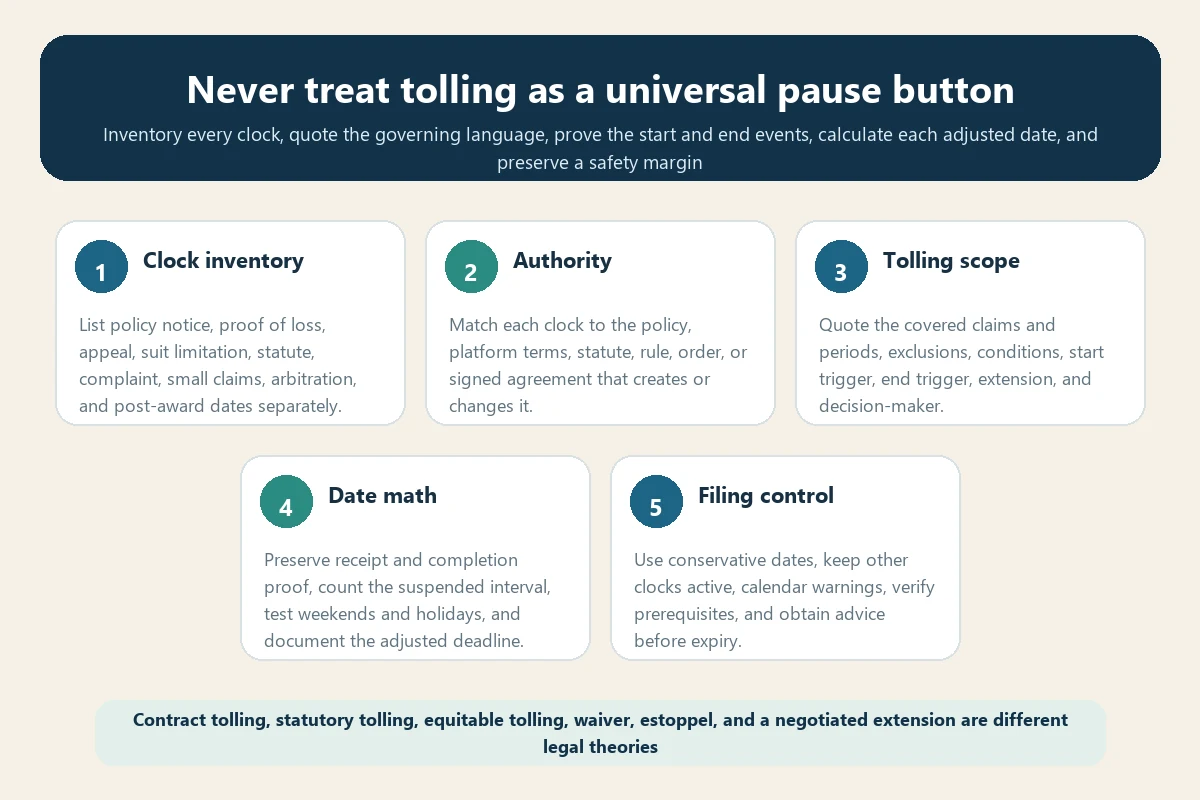
Begin with the policy notice deadline, proof-of-loss date, document-response date, internal appeal, contractual suit limitation, statute of limitation, regulatory complaint, small-claims filing, pre-arbitration notice period, arbitration demand, and post-award dates.
For each clock, record the source, covered claim, trigger, original deadline, counting rule, tolling authority, adjusted deadline, evidence, and owner. Never place unrelated clocks in one calendar entry.
Understand what tolling does
Tolling generally suspends the running of a specified period during a defined interval. The remaining time resumes after the end event unless the governing language instead creates a new fixed date.
An extension, waiver, estoppel, accrual rule, equitable-tolling doctrine, statutory suspension, and contract-based tolling provision are not synonyms. Identify the actual theory and its requirements.
Preserve the operative contract version
Save the policy, certificate, booking terms, checkout terms, confirmation email, amendments, dispute clause, and incorporated administrator rules from the transaction date. Current online terms may use a different period or trigger.
Record which entity issued each document. An insurer, claims administrator, booking platform, cruise line, or travel supplier may control a different dispute and deadline.
Separate the insurance claim from a platform dispute
A booking platform’s informal-resolution clause may toll claims against the platform without changing the insurer’s proof-of-loss or suit-limitation provisions. Conversely, policy correspondence may not alter a platform arbitration deadline.
Use the travel insurance claim filing guide to preserve the policy-side notice, evidence, acknowledgment, and deadline record independently.
Identify the exact period being tolled
Quote whether the clause covers a “statute of limitations,” “contractual limitations period,” “filing deadline,” or another named clock. Determine whether it applies to every dispute, only claims in the notice, or only specified relief.
Do not enlarge the language. A clause tolling “applicable statutes of limitation” may not automatically suspend a policy appeal date or a regulator’s complaint deadline.
Identify the start event
The tolling interval may begin when a complete notice is received, when informal negotiations start, when the recipient acknowledges the notice, or on a date stated in a signed agreement. Sending an incomplete notice may not trigger the period.
The notice-of-dispute guide helps audit content, signature, recipient, delivery, receipt, cure, and proof.
Prove completeness and receipt
Preserve the final notice, attachments, email headers, portal confirmation, postal tracking, delivery signature, acknowledgment, and any cure request. Note the date, time, and time zone.
If a company says the notice was deficient, preserve its response and the corrected submission. Do not silently replace the original file or assume that cure relates back.
Identify the end event
The interval may end after a fixed number of days, when an individualized conference is completed, when one party terminates negotiations, when a notice is withdrawn, or on a signed date. Some clauses use the later of two events.
Record the contractual definition of completion. A missed call, open follow-up request, or ongoing settlement discussion may create uncertainty rather than an automatic end date.
Study a detailed travel-contract example
Celebrity Cruises’ official U.S. guest terms illustrate a defined “Informal Resolution Period.” The published language ties tolling to receipt of a fully complete notice and ends the interval on the later of 60 days or completion of a timely requested settlement conference.
This is an example, not a rule for another booking, cruise, platform, or insurance policy.
Compare different travel-platform clauses
KAYAK’s official terms describe a 45-day informal-resolution process and state that limitations and filing deadlines are tolled while the parties engage in it. Priceline’s official terms describe a 60-day process with tolling during informal resolution.
Different durations, recipients, notice fields, conference rules, forums, and completion certifications demonstrate why copying another company’s calculation is unsafe.
Audit whether a conference changes the interval
A clause may allow either party to request an individualized telephone or video meeting. Determine the request deadline, attendance duty, scheduling process, personal-participation requirement, and whether the conference can occur after the base waiting period.
The informal dispute resolution conference guide covers preparation, participants, evidence, negotiation, nonattendance, settlement, and completion proof.
Calculate the suspended interval transparently
Write down the original accrual date, original deadline, tolling start, tolling end, number of suspended days, and adjusted deadline. Show the formula rather than relying on a calendar reminder.
Confirm whether the start or end day is included, how partial days are treated, and whether the rule uses calendar or business days.
Test weekends, holidays, and time zones
A rule, statute, contract, or forum procedure may move a deadline falling on a weekend or holiday. A midnight cutoff may follow a stated time zone or the filing system’s location.
Never assume that a weekend rule governing an arbitration demand also governs a policy proof-of-loss deadline.
Keep a conservative control date
Maintain an internal safety date earlier than the calculated deadline. Calendar warnings at several intervals and assign a named owner. A disputed tolling theory should not become the only protection against expiration.
The arbitration timeline guide helps consolidate notices, waiting periods, conferences, filing, fees, hearing, award, and court dates without merging their legal sources.
Model more than one date when facts are disputed
If receipt, completeness, accrual, conference completion, or counting rules are uncertain, calculate a conservative, expected, and latest arguable deadline. State the assumption supporting each date and attach the evidence that would confirm or reject it.
Use the earliest defensible date for operational control while the legal question is investigated. This scenario method exposes the practical consequence of a disputed day and prevents a favorable assumption from becoming an unnoticed single point of failure.
Do not assume negotiation pauses the clock
Customer-service messages, settlement offers, claim review, mediation discussions, or a request for more documents may continue while a deadline runs. Look for express contractual, statutory, judicial, or signed authority.
Statements such as “we are still reviewing” should not be treated as a tolling agreement unless the applicable law and communication actually support that result.
Use written tolling agreements carefully
A negotiated agreement should identify the parties, claims, original period, start and end, effect on remaining time, excluded deadlines, governing law, extension mechanics, reservation of rights, signatures, and effective date.
Confirm that the signer has authority. Avoid vague language such as “deadlines are paused” when multiple policies, parties, forums, and claims exist.
Separate tolling from waiver and estoppel
Waiver may concern intentional relinquishment or inconsistent conduct. Estoppel may concern reliance on conduct or representations. Tolling concerns the running of time. Their elements and available evidence depend on governing law.
Preserve every representation and action, but label the legal theory only after applying the correct authority.
Check who decides a tolling dispute
The contract may assign notice sufficiency, limitations, enforceability, or procedural prerequisites to a court or arbitrator. A delegation clause and administrator rules may affect that allocation.
Do not assume that an arbitration administrator’s acceptance of a demand finally decides timeliness.
Verify the arbitration filing packet
Before filing, assemble the clause, complete notice, delivery proof, conference record, tolling calculation, demand, claim statement, requested relief, service, and fee evidence. Explain any adjusted date clearly.
Use the arbitration demand guide to reconcile party names, claims, amount, attachments, administrator, service, and confirmation.
Track post-award deadlines separately
Correction, modification, vacatur, confirmation, service, and appeal-related periods can arise after an award. A pre-filing informal-resolution clause should not be assumed to alter those later statutory clocks.
Create a new post-award ledger when the decision is delivered and preserve the exact delivery event.
Avoid common deadline-tolling mistakes
- Treating tolling as a pause on every deadline.
- Using current terms for an older transaction.
- Applying platform tolling to an insurer-only claim.
- Starting the interval on sending when the clause requires receipt.
- Ignoring notice completeness or cure.
- Ending the interval before a requested conference is completed.
- Counting days without documenting the formula.
- Assuming ordinary negotiation creates tolling.
- Relying on a vague oral extension.
- Ignoring unrelated policy or regulatory deadlines.
- Filing on the last calculated day.
Final tolling audit checklist
- Inventory every deadline and governing source.
- Preserve the operative contract and correct entity.
- Quote the exact tolling language and covered claims.
- Prove the notice’s completeness and receipt.
- Identify conference and other completion conditions.
- Document the start event, end event, and suspended days.
- Test counting rules, weekends, holidays, and time zones.
- Keep noncovered clocks active.
- Use a conservative internal filing date.
- Preserve any signed extension or tolling agreement.
- Obtain case-specific advice before a right may expire.
A reliable tolling analysis names the exact clock, authority, claim, trigger, interval, end event, and adjusted date. It never replaces disciplined filing control with a broad assumption that “negotiations stopped the deadline.”