

A travel insurance arbitration award payment should move through a documented chain: issued obligation, verified payoff, secure instructions, cleared funds, reconciliation, and satisfaction. A screenshot of a transfer or an unsigned “paid” note is not enough when the amount includes interest, credits, fees, multiple recipients, or continuing duties.
The award, arbitration agreement, provider rules, governing law, payment-system terms, and any court judgment control. This U.S. consumer guide is general information, not legal, banking, tax, or financial advice. Do not send sensitive account details through an unverified message or assume that voluntary payment resolves every independent claim.
Preserve the operative award
Save the signed award, transmission notice, attachments, administrator messages, and any later clarification or correction. Record the exact delivery date and version. If a corrected award exists, keep both versions and a change log.
Use the arbitration award guide to extract the result. Payment should follow the operative text, not a party’s last demand, proposed award, closing brief, or verbal recollection.
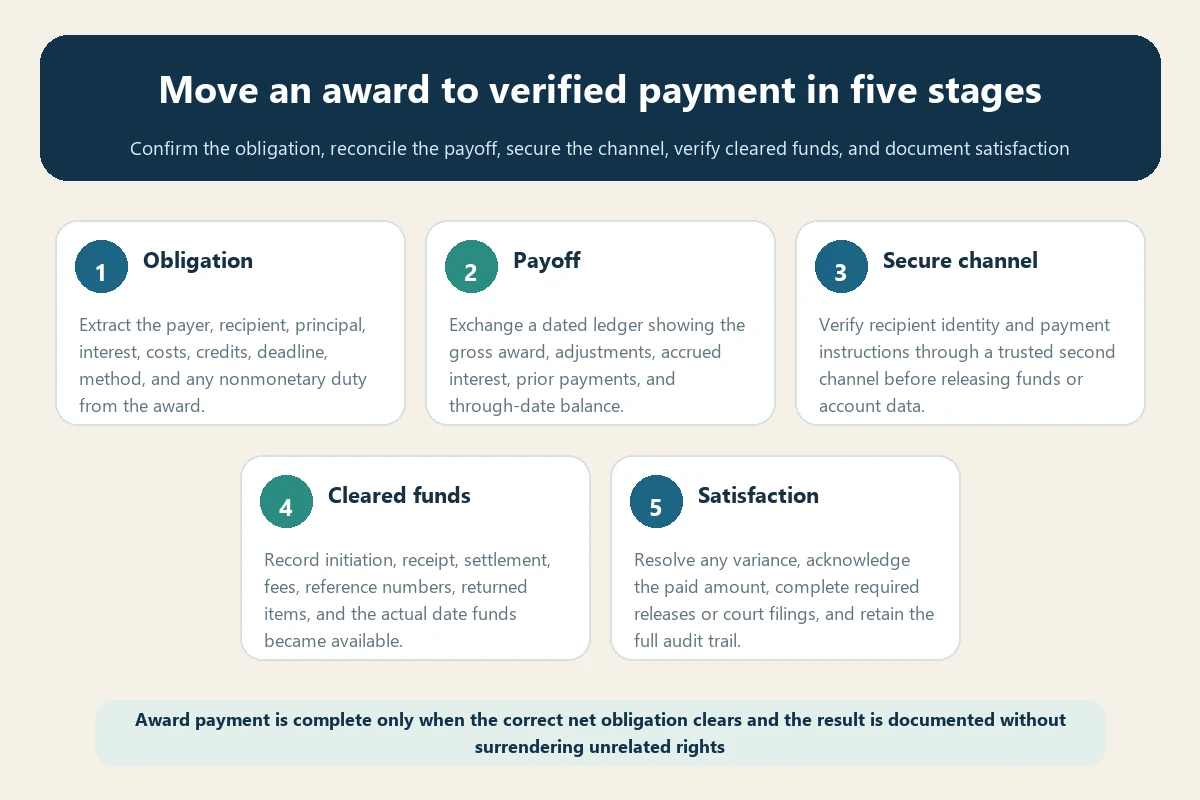
Build an obligation table
Translate the award into one row per duty. For money, identify the payer, recipient, gross amount, benefit category, deductible, refund or offset, interest, arbitration costs, attorney fees if awarded, due date, and payment method. For nonmonetary relief, identify the document, action, recipient, format, and deadline.
Do not combine unrelated duties into one line. A payment to a traveler, reimbursement to a provider, and delivery of a coverage letter may have different completion evidence.
Confirm whether the amount is final
Check for a pending provider clarification, computational correction, or court order that affects the amount. The award correction guide explains why a clerical fix is different from re-deciding a claim.
Do not delay an undisputed amount merely because a separate issue remains open unless the award, agreement, law, or order permits it. Conversely, do not describe a transfer as full satisfaction when the operative amount is unresolved.
Read the payment deadline exactly
The award may set a calendar date, a number of days after transmission, or a condition tied to receipt of information. Identify whether the clock uses calendar or business days and which event starts it. Account for weekends and holidays only under the controlling rule.
Current AAA Consumer Arbitration Rules should be read with the agreement and award. Do not import a payment deadline from another arbitration program, insurance line, or state.
Prepare a dated payoff statement
The recipient should provide a calculation that another person can reproduce. Show:
- gross awarded principal;
- each authorized deduction or credit;
- interest period, rate, and through-date;
- prior partial payments and receipt dates;
- fees or costs included by the award;
- current net balance;
- daily accrual after the through-date, if applicable;
- requested payment method and reference information.
The award interest guide provides a period-by-period ledger method. Do not add a daily amount without showing the authority and principal behind it.
Reconcile refunds and prior payments
Travel claims frequently involve airline refunds, hotel credits, chargebacks, supplier vouchers, earlier insurer advances, other insurance, or deductible adjustments. Record each item separately with date, amount, source, and whether it has actually cleared.
The claim partial-payment guide helps reconcile benefit categories before the award stage. After the award, use the award’s treatment of credits rather than independently recalculating claim coverage.
Verify recipient identity
Confirm the legal payee, mailing address, tax or claimant identifier when legitimately required, and authorized representative. If the award names more than one recipient, determine whether payment must be joint, divided, sent to counsel, or sent directly.
Do not change the payee based solely on an email request. Obtain written authority and verify it through a trusted contact already in the case record.
Use a secure payment channel
Payment-instruction fraud can occur when email accounts or message threads are compromised. Before sending a wire or ACH transfer, confirm instructions through a known telephone number or authenticated portal. Read back critical routing details without disclosing more account information than necessary.
For checks, confirm the payee, delivery address, tracking, restrictive endorsement requirements, and whether a joint payee can deposit the item. Do not place a policy number, medical diagnosis, or unnecessary personal data on the memo line.
Document authorization and release
The payer should retain internal authorization identifying the award, approved amount, funding account, payee, method, and approver. The recipient should retain the payoff statement and verified instructions sent.
A payment authorization is not the same as proof of receipt. A release is not automatically required merely because the award orders payment. Review any proposed release for scope, confidentiality, tax language, indemnity, non-disparagement, unknown claims, and unrelated rights.
Track payment from initiation to cleared funds
Create a status log containing the initiated date, bank or check reference, amount, delivery confirmation, recipient acknowledgment, settlement date, returned-item notice, stop-payment event, and actual availability of funds.
A wire confirmation shows that an instruction was sent; it does not by itself prove the correct recipient received usable funds. A check tracking page proves delivery of an envelope, not deposit or clearance.
Account for transfer fees and currency
If the award is denominated in U.S. dollars, determine whether bank fees reduce the amount received. For a recipient abroad, identify who bears intermediary-bank charges and whether the payment must remain in the awarded currency.
Do not convert currencies using an unstated consumer rate. If conversion is authorized, record the source, timestamp, rate, fee, and resulting amount. A currency variance should not be hidden as a rounding adjustment.
Apply a partial payment transparently
When less than the payoff arrives, record the actual cleared amount and the allocation required by the award, agreement, or law. Possible categories include costs, accrued interest, and principal. The allocation affects the future balance.
Send a written acknowledgment that identifies the amount received, date, allocation, remaining balance, and whether acceptance is without waiver of the remainder. Avoid marking the entire matter satisfied unless the full obligation is resolved.
Resolve overpayment or duplicate payment
If two transfers arrive or a supplier refund posts after the payoff, stop and reconcile. Preserve both transactions, the award, the credit rule, and communications. Do not send money to new instructions supplied in an unsolicited message.
Agree in writing on the overpayment amount, return method, recipient, and effect on the balance. Keep proof of the return and updated ledger.
Separate payment from settlement
Compliance with an existing award is not necessarily a negotiated settlement. A settlement may change timing, amount, installment structure, release, confidentiality, or remedies for default.
If the parties negotiate different terms, use the arbitration settlement guide to document the agreement. State whether the award remains enforceable until cleared payment and what happens after a missed installment.
Preserve challenge deadlines and stay orders
A party considering a challenge should not assume that payment, nonpayment, a provider request, or negotiation automatically extends a statutory deadline. Review the award, applicable law, and any stay or bond order.
The award challenge guide explains the narrow nature of judicial review. Record whether payment is voluntary, compelled, conditional, or made under a specific reservation recognized by applicable law.
Know when confirmation changes the process
Section 13 of the Federal Arbitration Act provides that a judgment entered on an award has the same force and effect as a judgment in an action and may be enforced accordingly. An award and a court judgment are distinct documents, even when the judgment confirms the same sum.
The award enforcement guide explains confirmation and lawful collection. Do not threaten a remedy before establishing jurisdiction and the governing procedure.
Understand federal execution procedure
Federal Rule of Civil Procedure 69 states that a money judgment is enforced by a writ of execution unless the court directs otherwise. Execution procedure generally follows the state where the federal court is located, except when a federal statute applies. The rule also addresses discovery in aid of judgment or execution.
Rule 69 concerns a money judgment, not informal collection of an unconfirmed award. State exemption, levy, lien, notice, and satisfaction rules require jurisdiction-specific analysis.
Document satisfaction after judgment
Cornell’s satisfaction of judgment definition describes a document signed by the judgment creditor and generally filed with the court to indicate that a judgment has been paid in full. A recorded lien may also require recording the satisfaction with the relevant deeds office.
Use the form, deadline, signature, notarization, service, filing, and recording requirements of the actual jurisdiction. A private receipt may not release a docketed judgment or property lien.
Issue a clear payment acknowledgment
An acknowledgment should identify the case, award date, payer, recipient, cleared amount, settlement date, covered obligation, any remaining balance, and the document’s limited purpose. If the obligation is fully resolved, say whether interest and awarded costs are included through the receipt date.
Do not state that all claims are released unless that broader release was knowingly agreed. Preserve privacy by omitting diagnoses, passport data, and full bank numbers.
Maintain the final audit package
Store the award, correction, payoff ledger, instructions, verification record, internal authorization, transfer or check proof, bank settlement evidence, acknowledgments, correspondence, release if any, judgment, and satisfaction filing. Use versioned filenames and restrict access to financial data.
The audit package should allow a reviewer to answer four questions: what was owed, what changed the balance, what cleared, and what document closed the obligation.
Avoid common award-payment mistakes
- Paying from a demand instead of the operative award.
- Ignoring interest, credits, or awarded costs.
- Sending funds to instructions verified only by email.
- Using the wrong payee or joint-payee format.
- Treating initiation as proof of cleared payment.
- Failing to allocate a partial payment.
- Requiring an unrelated broad release.
- Assuming negotiation extends challenge deadlines.
- Using collection procedures before obtaining required judgment authority.
- Failing to file or record satisfaction after full payment.
Final award payment checklist
- Preserve the operative award and delivery proof.
- List every monetary and nonmonetary duty.
- Confirm the deadline and payoff through-date.
- Reconcile interest, credits, and prior payments.
- Verify recipient authority and instructions securely.
- Track payment through cleared funds.
- Allocate partial payment and resolve variance.
- Issue an accurate acknowledgment.
- Complete required judgment-satisfaction filings.
- Retain the full audit package.
A well-controlled award payment protects both sides. The payer can prove exactly what was sent and why; the recipient can prove what cleared and what remains; and the final acknowledgment or satisfaction closes the correct obligation without erasing the evidence or surrendering unrelated rights.
