
Travel insurance notice prejudice arbitration disputes arise when a claim or loss was reported late and the insurer argues that coverage was forfeited. Some jurisdictions require proof that delay materially harmed the insurer; others treat particular notice requirements differently. Arbitration waiver and pre-arbitration notice are separate questions.
This U.S. guide shows how to preserve the notice timeline, identify governing law, test actual prejudice, allocate burdens, and assign each coverage or arbitration issue to the correct decision-maker. It is educational, not legal advice.
Quote every notice provision
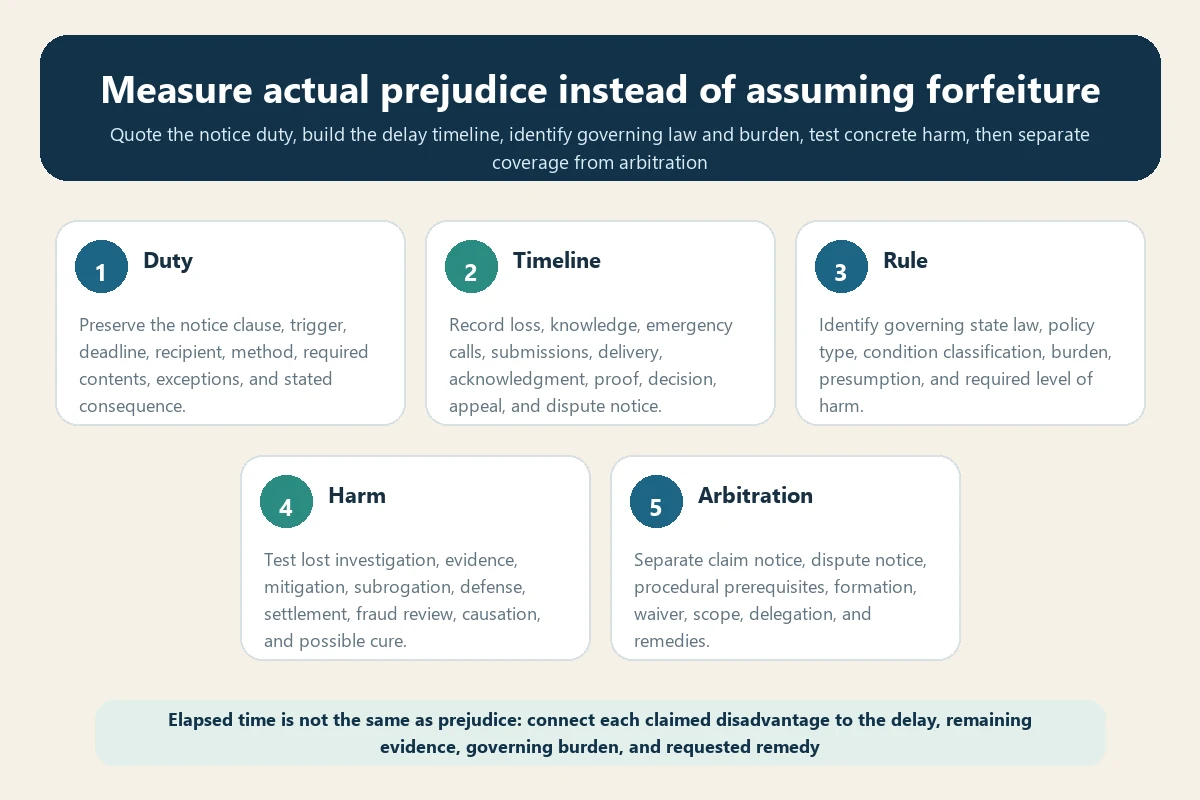
Collect the clause requiring notice of loss, claim, occurrence, medical event, delay, baggage problem, suit, appeal, or dispute. Preserve deadlines, recipients, methods, required contents, exceptions, and stated consequences.
Do not merge immediate emergency contact, prompt claim notice, formal proof of loss, and pre-arbitration notice. Each can serve a different purpose.
Collect the complete policy package
Preserve the certificate, schedule, benefits, definitions, exclusions, conditions, endorsements, application, claim instructions, purchase confirmation, and incorporated documents. Match form numbers, revision dates, state, plan, travelers, and coverage dates.
Use the incorporation-by-reference guide if notice rules appear only in an external portal, administrator guide, or arbitral rules.
Identify the triggering event
Determine what starts the clock: the covered event, knowledge of possible loss, diagnosis, treatment, carrier confirmation, baggage delivery failure, receipt of a demand, claim denial, or another event.
Record when the traveler actually knew each fact and when a reasonable person allegedly should have known it. Avoid using hindsight to move the trigger earlier.
Build a minute-by-minute timeline where needed
List loss, discovery, emergency assistance calls, medical treatment, carrier reports, police reports, portal attempts, emails, mailed submissions, acknowledgment, follow-up, proof of loss, decision, appeal, and arbitration demand.
Preserve timestamps, time zones, screenshots, call logs, attachments, tracking, delivery receipts, and server errors. A conclusory statement that notice was prompt or late is weaker than the underlying record.
Use the travel-insurance claim-filing guide to inventory submission channels and ordinary supporting records. Then preserve any evidence showing why the required channel was unavailable or why another authorized recipient received the same essential information.
Classify the notice obligation
Determine whether notice is a condition to coverage, a condition to payment, a cooperation duty, a claim-processing requirement, a suit limitation prerequisite, or a pre-arbitration procedural step.
The condition-precedent arbitration guide explains why classification affects the consequence, defense, and decision-maker.
Determine governing state law
Review choice-of-law wording, state of residence, policy situs, place of contracting, forum rules, and insurance statutes. Notice-prejudice rules differ across states and can differ by policy type.
Do not cite a California, Colorado, Louisiana, Massachusetts, or New York rule without completing the applicable conflicts analysis.
Separate occurrence from claims-made policies
An occurrence policy typically ties coverage to an event during the policy period. A claims-made or claims-made-and-reported policy can make reporting within the period part of the coverage boundary.
Travel insurance does not fit every commercial-liability label neatly. Quote the actual trigger and reporting provisions rather than assigning a category by analogy alone.
Read UNUM v. Ward narrowly
In UNUM Life Insurance Co. v. Ward, the Supreme Court addressed California’s notice-prejudice rule in an ERISA insurance setting. The opinion discusses a rule requiring the insurer to show actual prejudice from delayed proof.
The case is not a nationwide travel-insurance holding. Confirm the state rule, plan type, federal issues, and later authority before applying it.
Define prejudice as concrete harm
Ask what the insurer lost because of delay: a timely investigation, inspection, medical review, recovery from a carrier, subrogation, mitigation opportunity, witness evidence, fraud detection, settlement option, or defense control.
A longer timeline alone does not quantify harm. Connect each claimed loss to evidence and show why it could not be cured.
Preserve evidence that remained available
Collect medical records, receipts, carrier files, police reports, photos, videos, location data, witness contacts, damaged property, repair records, and communications. Document when each item was created and whether it remained verifiable.
Evidence that the insurer could still investigate can rebut a broad claim of prejudice, but it may not eliminate every lost opportunity.
Test causation
Separate harm caused by late notice from harm caused by the event itself, normal passage of time, a third party, or the insurer’s own delay after receiving notice.
Build a counterfactual: what specific action would the insurer have taken with timely notice, and how would that action likely have changed the position?
Allocate the burden correctly
Depending on governing law, the insurer may bear the burden of proving material prejudice, the insured may need to rebut a presumption, or strict compliance may apply to a defined reporting condition.
State the source of the burden and the required level of proof. Do not assume the same burden controls notice, cooperation, proof of loss, and arbitration waiver.
Use current appellate authority carefully
A 2025 Fifth Circuit insurance decision discusses actual prejudice under Louisiana law and distinguishes notice wording that is not an express condition precedent.
Its marine-insurance context and governing law matter. Use it to illustrate analysis, not as a universal travel-policy rule.
Compare a state supreme court framework
In Friedland v. Travelers, the Colorado Supreme Court described a multi-step notice-prejudice approach for liability policies, including a presumption where notice followed settlement.
A travel claim reported after treatment or return is not automatically equivalent to a liability claim reported after settlement. Compare the lost controls and evidence rather than only the elapsed days.
Document the reason for delay
Preserve emergency circumstances, hospitalization, incapacity, lack of connectivity, unavailable forms, language barriers, reliance on an agent, mistaken policy delivery, portal failure, or uncertainty about whether a loss was covered.
Explain dates and supporting evidence. A credible excuse can matter to timeliness, waiver, equitable relief, or factual evaluation even where prejudice is a separate element.
Analyze substantial compliance
Determine whether the insurer or administrator received essential information through another channel. An assistance call, carrier report, agent email, or partial portal submission might provide actual notice under some facts and law.
Identify precisely what information was received, by whom, when, and whether that recipient had authority.
Test waiver and estoppel separately
Look for acceptance of late documents, continued merits investigation, requests for additional proof, payment, failure to reserve, or inconsistent instructions. Preserve the complete communication rather than a favorable excerpt.
The equitable-estoppel arbitration guide provides the distinct reliance and detriment analysis.
Distinguish late notice from missing proof
The insurer may receive timely notice but incomplete proof. Create separate fields for initial notice, formal claim form, proof of loss, medical authorization, receipts, and follow-up answers.
A denial letter should identify which obligation allegedly failed and how that failure affected evaluation. Compare it with the travel-insurance claim-denial guide.
Separate claim notice from dispute notice
A policy can require claim notice shortly after loss and a later written dispute notice before arbitration. Compliance with one does not establish compliance with the other.
Quote recipients, addresses, contents, cure periods, negotiation windows, and delivery methods for each step.
Analyze arbitration waiver under its own rule
A party may allegedly waive arbitration through litigation conduct or inconsistent action. Do not transplant an insurance notice-prejudice rule automatically into arbitration waiver.
In Morgan v. Sundance, the Supreme Court rejected an arbitration-specific prejudice requirement in the federal waiver analysis at issue. Confirm governing waiver law and facts.
Keep procedural prerequisites distinct
Pre-arbitration notice, negotiation, appeal, or mediation can be a procedural condition. Identify whether noncompliance affects formation, scope, timing, admissibility, stay, dismissal, or cure.
Do not assume a missed step permanently destroys arbitration rights. The contract and governing law may allow cure.
Apply the FAA accurately
9 U.S.C. §2 addresses written arbitration agreements involving commerce and generally applicable contract grounds. It does not supply the state notice-prejudice rule for insurance coverage.
Analyze coverage forfeiture, arbitration formation, waiver, scope, and procedural arbitrability as separate legal questions.
Create a prejudice evidence matrix
Use columns for notice duty, trigger, deadline, actual notice, delay, reason, governing rule, burden, claimed harm, causal link, remaining evidence, cure, waiver, decision-maker, and remedy.
Mark each item proven, disputed, or unknown. Avoid replacing evidence with the word prejudiced.
Connect the finding to the remedy
Specify whether the requested result is benefit payment, renewed investigation, denial reversal, reduced payment, stay, cure period, arbitration, court litigation, fees, or another remedy.
A finding of no prejudice may defeat one late-notice defense without proving every coverage element or damage amount.
Questions for qualified counsel
- Which state’s notice-prejudice rule governs?
- What type of notice obligation and policy trigger are involved?
- Who bears the burden, and is prejudice presumed?
- What concrete harm was caused by delay?
- Do excuse, substantial compliance, waiver, or cure apply?
- Who decides coverage, waiver, scope, and procedural prerequisites?
Practical takeaway
Late travel-insurance notice does not have one automatic outcome. Quote the clause, identify the trigger, build the chronology, determine governing law and policy type, allocate the burden, and test actual prejudice with causal evidence.
Keep coverage notice separate from pre-arbitration notice and arbitration waiver. The existence of prejudice can matter in one analysis and be irrelevant or impermissible in another.
A cooperation clause does not make every request unlimited, and an incomplete response is not automatically a material, prejudicial refusal. Use this travel insurance cooperation clause arbitration guide to map each request, authority, relevance, response, obstacle, prejudice claim, cure, and the separate arbitration questions.
An examination under oath is not an ordinary claims call or arbitration deposition; its authority, scope, scheduling, production, and consequence come from the issued policy and governing law. Use this travel insurance examination under oath arbitration guide to preserve the request, prepare accurate evidence, test reasonableness and prejudice, and separate claim investigation from arbitral discovery.
