
Travel insurance cooperation clause arbitration disputes arise when an insurer requests documents, medical authorization, an interview, examination, or other assistance and alleges that the traveler failed to cooperate. The outcome depends on the exact clause, reasonable relevance, governing law, response record, materiality, prejudice, and available cure.
This U.S. guide provides a document-first method for evaluating cooperation without treating every incomplete response as forfeiture. It separately addresses arbitration formation, scope, delegation, evidence, and remedies. It is educational, not legal advice.
Quote the cooperation clause
Copy the entire provision, including duties to supply records, authorize releases, answer questions, submit proof, attend an interview or examination under oath, protect recovery rights, and assist with investigation or defense.
Preserve limits such as reasonable, relevant, material, requested, as often as required, or at the insurer’s expense. Record the stated consequence of noncompliance.
Collect the complete policy package
Gather the certificate, schedule, benefits, definitions, exclusions, conditions, endorsements, application, claim forms, medical-release forms, privacy notices, and incorporated documents. Match form numbers, dates, state, plan, travelers, and loss.
Use the incorporation-by-reference guide if investigation procedures or arbitral evidence rules appear outside the issued policy.
Inventory each request separately
Create one row per request. Record date, sender, recipient, exact item, stated purpose, policy authority, deadline, delivery, response, follow-up, and current status.
Do not label a claim uncooperative because one broad email contains twenty requests and three remain disputed. Measure performance item by item.
Start with the ordinary evidence categories in the travel-insurance claim-filing guide, then document why any additional request is material to this claim rather than merely convenient or standard.
Identify the requester’s authority
Determine whether the insurer, administrator, assistance company, investigator, attorney, medical reviewer, or vendor issued the request. Preserve delegation and agency evidence.
A familiar logo does not prove contractual authority. Use the arbitration agency guide if the requesting party’s role is disputed.
Test relevance and proportionality
Connect each requested item to eligibility, the covered event, amount, exclusion, causation, pre-existing condition, mitigation, other insurance, subrogation, or fraud review. Ask whether a narrower record would answer the question.
A request can be burdensome yet relevant, or easy yet unrelated. Document both dimensions rather than relying on labels.
Distinguish inability from refusal
Record whether the traveler possessed the item, could lawfully obtain it, requested it from a third party, needed translation, lacked authority for another person’s records, or faced a provider or portal delay.
Preserve efforts, dates, receipts, denials, alternative proposals, and expected availability. A good-faith obstacle is factually different from willful refusal.
Handle medical records lawfully
Medical claims can require records supporting diagnosis, treatment, stability, causation, and expense. Obtain the insured person’s valid permission and use secure delivery.
HHS explains that where HIPAA authorization is required, ordinary consent may be insufficient and the authorization must contain specified elements. Review the official HHS authorization guidance.
Make the authorization specific
Identify the provider, recipient, records, purpose, period, expiration, and signature authority. Avoid changing or signing a blank form without understanding its reach.
HHS notes that an authorization for an entire medical record can be valid if it describes the information specifically and meaningfully. See the official medical-record authorization guidance.
Use access rights as a practical path
When a provider will not send records directly to an insurer, the traveler may be able to request a copy and forward it securely. HHS describes individual access to medical and billing records in its medical-record rights guidance.
Access rights have exceptions and timing rules. Preserve the request, identity verification, fee, response, and any denial.
Protect another person’s privacy
A trip-cancellation claim can depend on a relative’s illness. The traveler may not have authority to release that person’s records. Identify the patient, personal representative, authorization, provider, and minimum facts needed.
Offer a targeted physician statement or patient-signed release where appropriate instead of pretending the claimant controls records they cannot lawfully obtain.
Audit interviews and recorded statements
Record who requested the interview, proposed subjects, oath status, recording, location, interpreter, representation, scheduling options, and document list. Ask for written confirmation of scope.
Prepare a chronology and answer accurately. Do not guess about medical facts, dates, or documents; identify what requires verification.
Distinguish an examination under oath
An examination under oath can be a formal policy condition distinct from an ordinary call or deposition. Quote the clause, governing law, place, frequency, reasonable scheduling, expenses, and requested production.
An official Fifth Circuit insurance decision discusses refusal to attend examinations under oath, missing documents, material breach, and prejudice under the law applied there.
Determine governing state law
Review choice-of-law wording, residence, policy situs, contracting location, forum rules, and insurance statutes. States differ on diligence, willfulness, materiality, substantial compliance, prejudice, burden, waiver, and cure.
Do not import a homeowners, auto, liability, or marine rule into travel insurance without verifying legal and factual fit.
Test insurer diligence
Some legal standards consider whether the insurer made reasonable efforts to obtain cooperation. Preserve clear requests, explanations, reminders, extensions, scheduling alternatives, accessible forms, and responses to objections.
Repeated identical demands do not necessarily show diligence if the insurer ignores a documented obstacle or narrower alternative.
Measure materiality
Ask whether the missing act concerned a central coverage fact or a peripheral detail. Identify what decision could not be made and why the available record was insufficient.
A technical imperfection should not be called material without linking it to the policy duty and claim evaluation.
Measure actual prejudice
Identify lost evidence, inability to verify treatment, blocked fraud investigation, lost subrogation, inability to value loss, or another concrete disadvantage caused by noncooperation.
The notice-prejudice arbitration guide provides a causal matrix for separating elapsed time from actual harm.
Consider substantial compliance
Determine whether the traveler supplied the essential information through another format. A targeted physician letter, certified bill, carrier record, or written response may address the request’s purpose even if the preferred form was unavailable.
Document what remained unanswered. Substantial compliance depends on governing law and cannot be assumed.
Offer cure in writing
If a response is incomplete, state what can be provided, what cannot, why, and when remaining items are expected. Propose a narrowed authorization, alternative interview date, or substitute proof.
Request confirmation that the cure will preserve claim review. Do not assume silence equals acceptance.
Analyze waiver and estoppel separately
Preserve conduct such as deciding the merits, accepting substitute proof, extending deadlines, continuing investigation, or failing to reserve the cooperation defense. Identify reliance and prejudice rather than asserting unfairness generally.
Waiver of a cooperation condition is different from waiver of arbitration.
Separate cooperation from claim notice
A traveler can report the loss timely yet later dispute an investigation request. Conversely, a complete document response does not cure late initial notice automatically.
Use separate timeline fields for notice, proof, authorization, interview, examination, and follow-up.
Separate coverage cooperation from arbitration discovery
Pre-dispute policy cooperation occurs during claim investigation. Arbitration discovery occurs after a dispute is filed and is governed by the agreement, applicable rules, orders, and law.
Do not treat a discovery objection as retroactive breach of the claim-cooperation clause without contractual and legal support.
Test arbitration formation and scope
Preserve offer, assent, delivery, incorporation, parties, authority, and version. Then quote which claims and disputes the formed agreement covers.
A dispute about cooperation may be within scope, but a broad clause cannot cure absent assent.
Keep delegation separate
Identify any provision assigning arbitrability to an arbitrator. Preserve incorporated rules, clarity, formation, and the challenge directed specifically to delegation.
Map who decides formation, scope, procedural compliance, discovery, coverage breach, prejudice, and remedies.
Apply the FAA accurately
9 U.S.C. §2 addresses written arbitration provisions involving commerce and generally applicable contract grounds. It does not define the traveler’s cooperation duty.
State insurance law can govern the merits while arbitration law governs forum questions. Keep the analyses separate.
Create a cooperation matrix
Use columns for request, clause authority, requester, relevance, burden, deadline, response, obstacle, alternative, cure, materiality, claimed prejudice, governing law, decision-maker, and remedy.
Mark each item complete, partial, disputed, unavailable, or refused. This produces a more accurate record than a single cooperative or uncooperative label.
Connect breach to remedy
Specify whether the requested consequence is more time, narrowed production, continued investigation, claim denial, stay, evidentiary order, fee allocation, arbitration, or court relief.
Even material noncooperation concerning one benefit may not resolve unrelated benefits or every claim.
If the insurer denies the claim, compare the stated breach and supporting record with the travel-insurance claim-denial guide. Preserve whether a final cure opportunity was offered before the file closed.
Questions for qualified counsel
- Which cooperation duties are explicit in the issued policy?
- Were the requests authorized, relevant, reasonable, and proportionate?
- Was the response incomplete, impossible, or willfully refused?
- Are materiality and actual prejudice required?
- Can the failure be cured or excused?
- Who decides formation, scope, cooperation breach, discovery, and remedies?
Practical takeaway
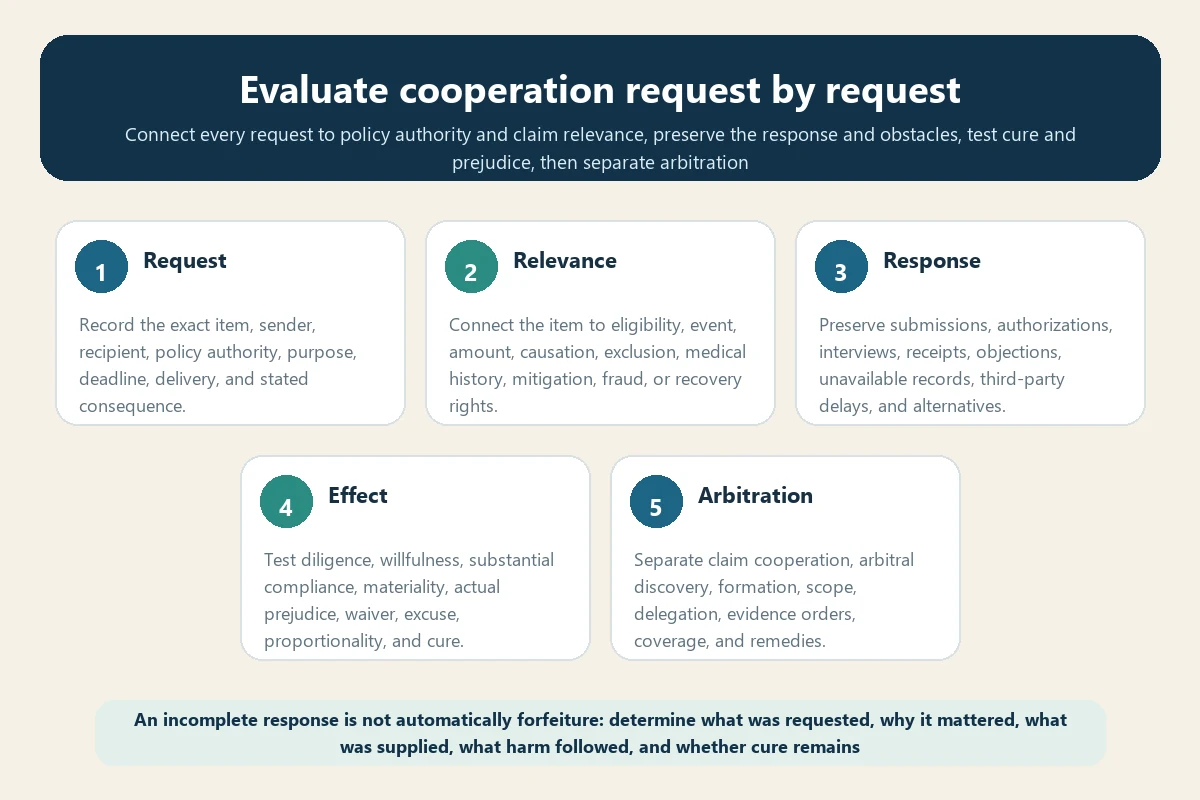
Evaluate travel-insurance cooperation request by request. Quote the clause, identify authority and relevance, preserve the response and obstacles, offer reasonable alternatives, and test materiality, prejudice, waiver, and cure under governing law.
Keep claim investigation separate from arbitration discovery and forum questions. Cooperation merits, formation, scope, delegation, evidence, and remedies can belong to different decision-makers.
An examination under oath is not an ordinary claims call or arbitration deposition; its authority, scope, scheduling, production, and consequence come from the issued policy and governing law. Use this travel insurance examination under oath arbitration guide to preserve the request, prepare accurate evidence, test reasonableness and prejudice, and separate claim investigation from arbitral discovery.
Appraisal usually addresses the amount or value of a covered loss, while arbitration can address a broader contractual dispute; neither label should substitute for the issued clause. Use this travel insurance appraisal clause arbitration guide to classify the dispute, satisfy prerequisites, select qualified neutrals, preserve valuation evidence, and separate coverage from amount.
