

Travel insurance arbitration award interest can involve several different time periods, legal authorities, rates, and principal amounts. A reliable calculation does not multiply the headline award by one percentage. It identifies which sum earns interest, when each period begins and ends, which source supplies the rate, and how payments or credits change the balance.
The award, arbitration agreement, current provider rules, governing substantive law, confirmation judgment, and court law can all matter. This U.S. consumer guide is general information, not legal, tax, or financial advice. State law varies, and federal post-judgment rules do not automatically govern every arbitration award.
Start with the issued award
Preserve the signed award, delivery notice, attachments, and any later clarification or correction. Extract every monetary component into a table: policy benefits, consequential amounts if any, interest, attorney fees, arbitration fees, costs, offsets, refunds, prior payments, and performance dates.
The arbitration award guide explains how to inventory the result. Do not calculate from a demand, closing request, or hearing statement when the award uses a different principal or start date.
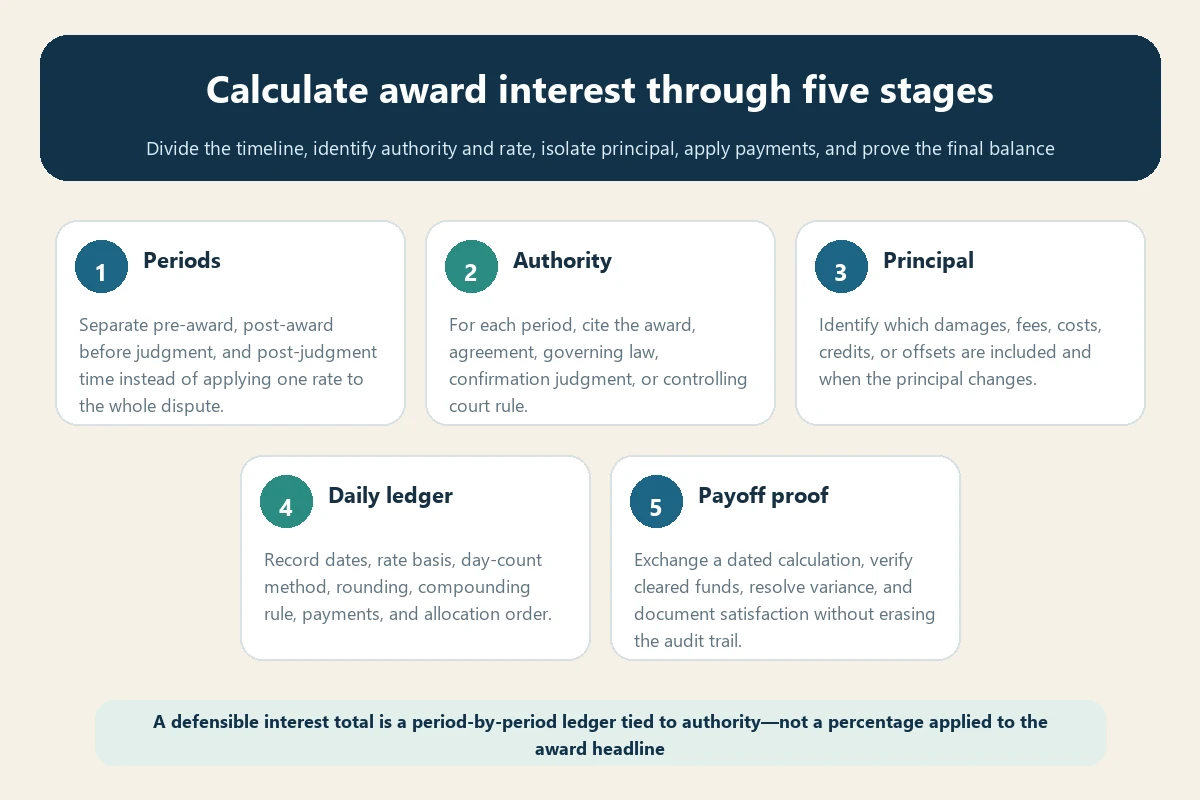
Divide interest into separate periods
Interest labels are often used loosely. Create distinct rows for each potentially relevant period:
- Pre-award interest: a period ending when the arbitrator issues the award, if authorized and awarded.
- Post-award, pre-judgment interest: time after the award but before a court enters judgment, when applicable authority permits it.
- Post-judgment interest: time after entry of a court judgment confirming or otherwise reducing the award to judgment.
These periods may use different rates, start dates, compounding rules, and principal. A gap or overlap in the timeline should be resolved by the controlling text, not hidden inside a spreadsheet.
Identify authority for every period
Place a source citation beside each interest row. Possible sources include the parties’ contract, the issued policy, a statute, the governing law, the award, a confirmation judgment, and applicable court rules. Confirm whether the cited authority actually covers arbitration awards and the specific phase.
Current AAA Consumer Arbitration Rules should be checked together with the agreement and applicable law. Provider administration does not create a universal interest rate, and an award under another organization’s rules requires its own analysis.
Request interest before the record closes
If a party seeks interest in the arbitration, identify it as a distinct item of relief with the proposed period, legal basis, rate, principal, and calculation. Do not wait for the award and assume the arbitrator will reconstruct an unstated request.
AAA’s official guidance on an issues and relief statement illustrates why parties should identify requested outcomes clearly. The arbitration demand guide helps organize claimed amounts, while the closing argument guide helps reconcile the final requested relief with the admitted record.
Separate damages from interest
List the principal categories before adding interest. A travel insurance award might include an unpaid covered expense, a trip-cost benefit, a supplier refund offset, a deductible, or another amount. Attorney fees, arbitration costs, and interest are not automatically part of the same principal.
Use the arbitration cost guide to keep administrator fees, arbitrator compensation, party expenses, and fee-shifting separate. State why each category does or does not earn interest under the controlling authority.
Read the interest clause word for word
Extract the exact start date, end event, annual rate or rate source, simple or compound method, and covered principal. Watch for wording such as “from the date of loss,” “from denial,” “from filing,” “from award,” “until paid,” or “as provided by law.” These phrases are not interchangeable.
If the award specifies a rate but not a day-count convention or compounding method, do not silently choose the most favorable method. Seek agreement, clarification, or jurisdiction-specific advice as appropriate.
Verify whether the award needs correction
A transposed rate, incorrect total, or computational mismatch may raise a limited post-award issue. The award correction guide explains the current AAA clarification process and the difference between a mechanical defect and re-determining the merits.
Do not use a correction request merely to add interest that was never awarded or to change the legal basis after losing the issue. Preserve every independent deadline while the request is pending.
Build a transparent daily ledger
A useful ledger has one row for every event that changes the balance or rate. Include:
- period start and end dates;
- number of included days and the inclusion convention;
- principal at the start of the period;
- annual rate and authoritative source;
- simple or compound method;
- unrounded period interest;
- payment, refund, offset, or adjustment date;
- allocation between interest, costs, and principal;
- new running balance.
For a simple daily calculation, a common mathematical structure is principal multiplied by annual rate multiplied by days divided by the applicable year basis. That is only arithmetic—not authority to use a particular principal, rate, date range, or 365-day convention.
Do not round every day
Premature rounding can create a variance over a long period. Retain sufficient decimal precision in intermediate calculations and round only as the controlling document or accepted accounting method requires. Display the final rounded amount and the underlying formula.
Have a second person reproduce the total from the inputs. A spreadsheet that produces a number without exposing formulas, dates, and rate changes is not an auditable calculation.
Handle partial payments and credits carefully
Record the date funds became available, not merely the date a check was printed, unless the controlling rule says otherwise. Identify how a partial payment is allocated among costs, accrued interest, and principal. The allocation rule can change future interest materially.
Supplier refunds, chargebacks, prior claim payments, deductibles, salvage, or settlement credits may affect the net balance. Preserve the original award amount and add adjustments as separate ledger entries instead of rewriting history.
Distinguish an award from a federal judgment
Section 13 of the Federal Arbitration Act states that a judgment entered on an award has the same force and effect as a judgment in an action and may be enforced accordingly. Entry of judgment is therefore a legally significant event, not just a new spreadsheet label.
The award enforcement guide explains confirmation, judgment entry, payment demand, and lawful collection at a general level. Court jurisdiction and the governing statute must be established before applying a federal rule.
Apply federal post-judgment interest accurately
28 U.S.C. § 1961 provides interest on a money judgment in a civil case recovered in federal district court. Its rate is tied to the weekly average one-year constant-maturity Treasury yield for the calendar week preceding judgment entry. The statute says interest is computed daily to payment and compounded annually, subject to its stated exceptions.
That statutory description does not prove that a particular award has become a qualifying federal money judgment or determine interest for the pre-judgment period. Save the actual judgment entry date and the published rate source used for that week.
Do not transplant the federal rate into state court
State judgments can use different statutory rates, variable-rate formulas, accrual dates, compounding rules, and satisfaction procedures. An award confirmed in state court needs a state-specific analysis. The parties’ contract may also generate a dispute about a contractual rate.
Document which court entered judgment, which jurisdiction’s law applies, and why. “Federal case nearby used this rate” is not an interest authority.
Track a pending challenge separately
A motion to vacate or modify can affect strategy, but do not assume it automatically stops accrual, enforcement, or a payment obligation. Check the award, any stay, bond, court order, and applicable law.
The award challenge guide separates correction from statutory review. Maintain the interest ledger during the dispute so each scenario can be updated without recreating months of data.
Document settlement treatment of interest
If the parties resolve the award, say whether the settlement amount includes interest through a specified date, whether additional daily interest accrues during a payment window, and what happens after a missed installment. Identify the effect of timely cleared payment.
Use the arbitration settlement guide to document releases, payment mechanics, confidentiality, defaults, and dismissal. Avoid phrases such as “full amount” when the treatment of accrued interest is unclear.
Confirm payoff and satisfaction
Before payment, exchange a payoff statement with a through-date, principal, accrued interest, per-day amount if applicable, credits, and wiring or check instructions. Verify instructions through a trusted channel to reduce payment fraud risk.
After funds clear, update the ledger to the actual receipt date. Obtain the appropriate receipt, release, acknowledgment, or satisfaction filing required by the agreement or court. Preserve proof of cleared funds and the final zero balance.
Review possible tax reporting separately
Tax characterization does not necessarily match the arbitration ledger labels. Interest, damages, reimbursements, fees, and settlement amounts can have different reporting consequences depending on the facts.
The claim interest and Form 1099 guide provides a document checklist. Obtain qualified tax advice rather than changing an award calculation to obtain a preferred tax result.
Avoid common interest errors
- Applying one rate to every period.
- Using the demand amount instead of awarded principal.
- Including fees or costs without authority.
- Starting accrual from an assumed date.
- Using a current rate instead of the rate fixed for the relevant date.
- Confusing simple and compound interest.
- Rounding each daily entry prematurely.
- Ignoring partial payments and supplier refunds.
- Assuming a challenge stops interest automatically.
- Failing to document satisfaction after payment.
Final award interest checklist
- Preserve the award, corrections, delivery proof, and judgment.
- Separate pre-award, post-award, and post-judgment periods.
- Cite authority for every principal, rate, and date.
- Identify simple or compound treatment.
- Use an auditable day-by-day ledger.
- Apply payments, credits, and offsets on documented dates.
- Preserve correction, challenge, and enforcement deadlines.
- Exchange a dated payoff statement.
- Verify cleared funds and final balance.
- Document satisfaction and retain the full audit trail.
A defensible award-interest calculation is transparent from beginning to end. It divides the timeline correctly, connects every input to authority, exposes the arithmetic, records every payment, and produces a payoff that another person can reproduce without guessing.
