
Travel insurance arbitration class action waiver language may require individual dispute resolution and restrict class, collective, consolidated, private-attorney-general, or representative procedures. The exact wording determines which procedure is limited and what individual or regulatory paths remain.
A class waiver is not automatically the same as an arbitration agreement, jury waiver, claim release, settlement exclusion, or opt-out. This U.S. consumer guide provides a contract-and-record framework, not legal advice or a prediction about enforceability.
Start with the complete purchase-time agreement
Preserve the policy, certificate, booking terms, plan description, website terms, confirmation email, amendments, and every document referenced by the dispute section. Identify the insurer, administrator, booking platform, supplier, purchaser, and covered traveler.
Use the terms accepted or delivered at purchase. A current page may contain different class, arbitration, opt-out, batching, or severability language.
Separate five different waivers
- Class-action waiver: limits participation as a class representative or member.
- Class-arbitration waiver: prohibits arbitration on behalf of a class.
- Collective or representative waiver: addresses distinct procedural forms under specific laws.
- Jury waiver: relinquishes adjudication by a jury in covered disputes.
- Claim release: extinguishes specified claims, often through settlement.
Quote each term. Do not infer that one label necessarily includes the others.
Review the federal framework
The Congressional Research Service’s official overview, The Federal Arbitration Act and Class Action Waivers, explains the FAA framework and major Supreme Court decisions involving state unconscionability rules, individual arbitration, and federal statutory claims.
Use it as orientation, then apply current controlling statutes and cases. The governing outcome can depend on assent, contract text, delegation, state law, federal preemption, claim type, and forum.
Understand individual arbitration
Individual arbitration ordinarily means one claimant pursues that claimant’s own dispute and relief. A clause may prohibit joining unrelated claimants, class treatment, consolidation, or representative relief while allowing coordinated administration or contractual batching.
Identify whether the agreement restricts only class arbitration, class litigation too, or all aggregate procedures. Record any exception requiring written consent by both parties.
Read Epic Systems without overextending it
The official Supreme Court opinion in Epic Systems Corp. v. Lewis enforced employment agreements requiring individualized arbitration and addressed the relationship between the FAA and federal labor statutes.
It was not a travel insurance coverage decision and does not answer every consumer contract issue. Use it for the propositions it decided, then identify law controlling the actual travel dispute.
Look at a travel-related appellate example
In Phillips v. NCL Corp., the Eleventh Circuit addressed cruise passengers, travel insurance-related claims, an arbitration clause, and language denying the arbitrator authority to hear claims on a class basis.
The case illustrates the need to map the guest contract, travel protection package, parties, claim relationship, and class language together. It is not a universal rule for every policy or jurisdiction.
Map the exact prohibited procedures
Create rows for class litigation, class arbitration, collective action, consolidated action, representative action, private-attorney-general procedure, mass arbitration, batch administration, multi-claimant filing, and joinder. Mark allowed, prohibited, conditional, or silent.
Silence is not permission or prohibition by itself. Identify controlling contract interpretation and arbitration law.
Do not confuse mass arbitration with class arbitration
Mass arbitration generally involves many individual demands, each asserting an individual claim, sometimes subject to staged or batch procedures. Class arbitration adjudicates representative claims for absent class members under a class mechanism.
Check any threshold, bellwether, batching, fee, mediation, and appointment terms. Preserve the administrator rules governing the actual filing.
Identify any opt-out right
An arbitration agreement may permit timely rejection of arbitration and related waivers. Determine whether the opt-out covers the entire arbitration section, only a new amendment, or specified class terms.
The arbitration opt-out guide explains deadline triggers, notice content, delivery, proof, and scope. Do not assume opting out of arbitration automatically preserves every aggregate procedure.
Audit small-claims and court carve-outs
Many consumer clauses preserve eligible individual small-claims cases. Others permit provisional court relief, intellectual-property claims, enforcement proceedings, or claims that cannot lawfully be arbitrated.
Read the carve-out and the court’s current jurisdiction rules. An individual court option does not itself create a class procedure.
Keep government complaints separate
Private arbitration language may not prohibit complaints to state insurance departments, attorneys general, or other government agencies. But an agency complaint is not the same as a private class claim for damages.
The complaint versus arbitration guide maps regulatory and private remedies. Preserve both tracks without double-counting relief.
Audit assent to the class language
Preserve checkout screens, hyperlink placement, button text, checkbox language, email delivery, attachments, timestamps, and amendments. Identify whether the class waiver was conspicuous and part of the accepted agreement under governing law.
Formation must be established before scope is applied. Do not rely on a screenshot from a different purchase flow or date.
Separate formation, enforceability, and scope
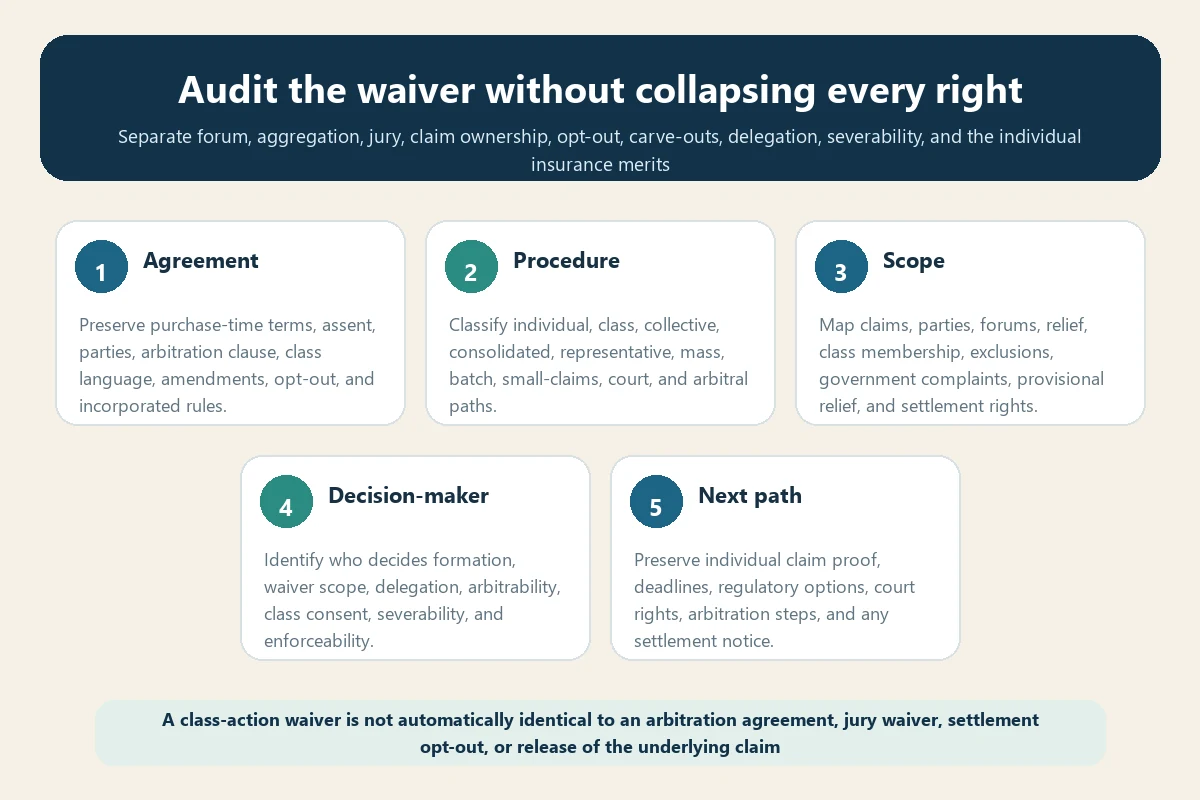
Formation asks whether the parties agreed. Enforceability asks whether the term can be enforced. Scope asks whether the waiver covers this procedure, party, claim, or forum. These questions may have different decision-makers.
The arbitrability guide helps identify who decides each gateway issue.
Review delegation and class consent
A delegation clause may assign enforceability or scope questions to an arbitrator, subject to applicable law. Separately, class arbitration generally requires a contractual basis showing consent to that procedure.
Quote the delegation, class, and silence provisions independently. Do not assume a broad clause necessarily authorizes class arbitration.
Analyze unconscionability and federal limits
Apply the controlling state’s neutral contract doctrine to the purchase process and exact challenged term. Then assess whether the proposed rule treats arbitration differently or conflicts with federal law.
The unconscionability guide provides a two-sided evidence matrix for assent, surprise, fees, venue, mutuality, remedies, opt-out, and severability.
Read the severability consequences
Some agreements say an invalid class waiver is severed while individual arbitration remains. Others state that if class treatment is permitted, the arbitration agreement becomes void and class claims proceed in court.
The severability guide helps map the exact contractual layer and remedy. Never infer the consequence without reading the clause.
Protect class-settlement rights separately
If a class settlement exists, the notice may define class membership, exclusion deadline, objection procedure, claim form, release, payment, and hearing. Those rights arise from the settlement and court order, not merely the underlying arbitration clause.
Preserve the official notice and docket. A settlement opt-out is different from an earlier arbitration opt-out.
Keep the individual insurance merits complete
A class waiver does not decide whether trip cancellation, interruption, delay, baggage, medical expense, or evacuation is covered. Preserve the policy, exclusions, chronology, proof, causation, valuation, denial, appeal, and damages.
Continue meeting claim and legal deadlines while procedural questions are evaluated.
Create a rights-and-pathways matrix
Use columns for procedure, contract text, governing authority, decision-maker, deadline, required filing, available relief, and current status. Include individual arbitration, small claims, court litigation, government complaint, mediation, and any settlement process.
This matrix prevents the inaccurate conclusion that a class waiver eliminates the underlying individual claim or every public remedy.
Confirm who owns each claim and benefit
A travel protection purchase can involve a cardholder, trip purchaser, named insured, additional traveler, beneficiary, estate, assignee, travel supplier, and subrogated insurer. A class waiver signed by one person does not answer every question about another person’s agreement, standing, benefit, or claim ownership.
Create a party matrix listing each person’s contractual role, covered benefit, alleged injury, agreement version, assent evidence, requested relief, and relationship to the entity invoking the waiver. Check beneficiary, agency, assignment, third-party, survival, and estate provisions under governing law.
Keep claim ownership separate from aggregation. A person may possess an individual claim yet be restricted from presenting it through a class procedure; another person may lack an individual claim regardless of the class language. This distinction also matters when a settlement notice defines class membership differently from the original contract.
Preserve probate documents, assignments, subrogation notices, beneficiary designations, and purchase records when they bear on who may pursue the individual benefit.
Avoid common class-waiver mistakes
- Equating a class waiver with a release of the claim.
- Combining class, collective, consolidated, and representative procedures.
- Assuming class litigation and class arbitration are treated identically.
- Using current terms instead of purchase-time terms.
- Ignoring opt-out, small-claims, and government carve-outs.
- Confusing mass arbitration with class arbitration.
- Failing to identify delegation and decision-maker.
- Ignoring the class waiver’s special severability rule.
- Treating one Supreme Court case as resolving every claim type.
- Neglecting the individual travel insurance merits and deadlines.
Final class-action waiver checklist
- Preserve the complete purchase-time agreement and amendments.
- Quote arbitration, class, collective, jury, and release terms separately.
- Map every prohibited and permitted procedure.
- Identify opt-out, small-claims, court, and government paths.
- Establish assent under controlling law.
- Separate formation, enforceability, scope, and merits.
- Identify delegation and class-consent questions.
- Analyze federal limits and state contract defenses.
- Read the exact severability consequence.
- Preserve individual claim proof, settlement rights, and deadlines.
A professional class-waiver audit does not assume the consumer has no remedy. It maps the exact aggregate procedures restricted, the individual and public pathways left open, the proper decision-maker, and the contract-specific result if any term is invalid.
