
Travel insurance choice of law clause questions arise when a policy, traveler, insurer, trip, and loss connect to different states or countries. The clause may nominate a body of law, but it does not automatically select a court, create jurisdiction, or displace every mandatory insurance rule.
This U.S. guide explains how to preserve the issued contract, map relevant contacts, distinguish governing law from forum selection, test state protections, compare deadlines, and build a reviewable dispute record. It is educational, not legal advice.
Find the exact choice-of-law language
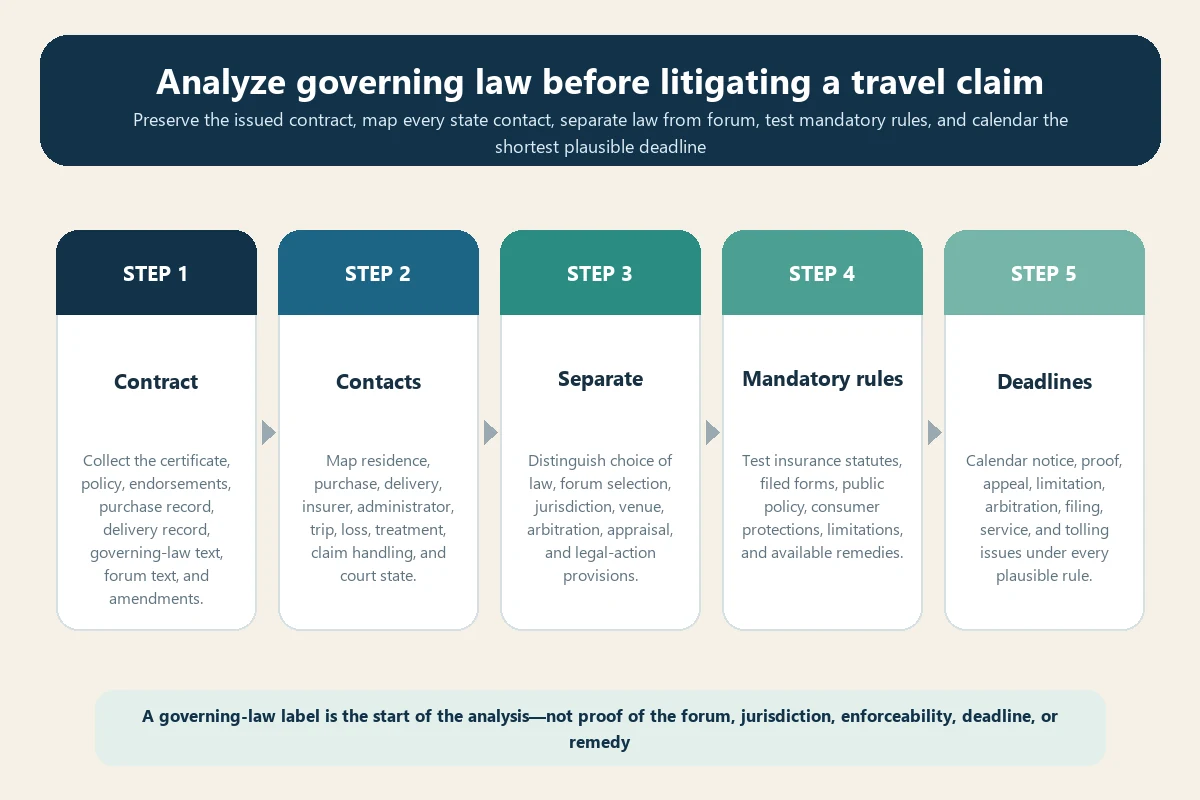
Collect the policy, certificate, schedule, endorsements, state notices, purchase confirmation, and version delivered to the traveler. Search for governing law, applicable law, construed, jurisdiction, forum, venue, legal action, arbitration, and service of process.
Quote the complete paragraph. A heading or isolated sentence can hide conditions, exceptions, or a different rule for arbitration.
Confirm that the clause was part of the issued policy
Record purchase date, delivery date, delivery method, accessible links, certificate number, policy number, edition, and amendments. Preserve the checkout screen and archived files when available.
A clause found later on a generic website may not prove which wording governed the actual trip.
Map every relevant location
Create a contact map for the traveler’s residence, purchase, delivery, insurer domicile, administrator, producer, trip destination, loss, medical treatment, claim handling, denial, and proposed court.
Do not assume the vacation destination supplies the governing law. The legally important contacts depend on the forum’s conflict-of-laws rules and the issue presented.
Separate governing law from forum selection
A choice-of-law clause identifies rules proposed for interpreting or enforcing the contract. A forum-selection clause identifies where litigation must or may proceed. Jurisdiction asks whether a court has authority over parties and subject matter; venue identifies the proper geographic court.
One paragraph can contain several concepts. Analyze each phrase independently.
Do not confuse the clause with arbitration
An arbitration provision can select a private decision-maker, seat, rules, delegation standard, and governing law. Those selections may not match the law governing the policy’s substantive coverage terms.
Use the appraisal-clause and arbitration guide when the contract also includes a valuation mechanism.
Identify the precise legal issue
Different law may be argued for contract interpretation, formation, limitations, bad faith, unfair claims practices, damages, evidence, procedure, arbitration, or attorney fees. Avoid asking only which state’s law governs the entire case.
Build an issue-by-issue table with proposed law, supporting clause, competing rule, material difference, and evidence needed.
Start with state regulation of insurance
15 U.S.C. §1012 states that the business of insurance is subject to state laws regulating it and limits displacement of those laws by federal statutes that do not specifically relate to insurance.
This does not decide a particular conflict. It explains why state insurance law remains central and why a generic contract rule may be incomplete.
Check the travel-insurance statute in each plausible state
Travel-insurance statutes can address licensing, disclosures, premium tax, policy forms, sales practices, and enforcement. For example, Washington maintains a specific Travel Insurance Act in chapter 48.216 RCW.
Confirm the law in effect on the relevant dates. A model act, current code, and historical policy period may differ.
Use regulatory context without overstating it
The NAIC travel-insurance overview describes the model-law project and state enactment activity. It is useful for locating the regulatory framework, but it is not a substitute for the enacted law of the governing state.
Verify definitions because cancellation waivers and assistance services may not be regulated exactly like insurance benefits.
Read Great Lakes narrowly
In Great Lakes Insurance SE v. Raiders Retreat Realty Co., the U.S. Supreme Court addressed choice-of-law provisions in maritime contracts under federal maritime law and generally enforced them subject to identified exceptions.
The case involved marine insurance, not ordinary retail travel insurance. It is strong authority for its maritime holding, not a universal answer for every state-regulated travel policy.
Test whether federal maritime law is actually involved
A cruise, boat excursion, or loss near navigable water does not automatically convert a travel-policy dispute into a maritime contract controversy. Identify the contract’s nature and the claim’s legal basis.
Do not cite a maritime rule merely because the itinerary included a ship.
Identify mandatory statutes and public policy
List state insurance mandates, prohibited provisions, filing requirements, notice rules, remedies, and nonwaivable consumer protections. Determine whether a proposed governing law conflicts with a materially applicable rule.
A strong public-policy argument needs the actual statute, scope, effective date, and connection to the dispute—not a general statement that one law is more favorable.
Compare policy-form filings
Where accessible, obtain the filed or approved form, state variation, filing disposition, and effective date from the relevant insurance regulator. Match identifiers to the traveler’s issued documents.
A filing can help establish wording and regulatory treatment. It does not by itself prove assent, coverage, or claim value.
Preserve the sales and delivery record
Keep the quote, product description, checkout disclosures, consent, confirmation, certificate, policy link, emails, and later modifications. Note whether the traveler bought through an airline, cruise line, hotel, tour operator, agent, or direct insurer channel.
Formation and notice questions can precede enforcement of the selected law.
Build a complete claim timeline
Record loss, notice, proof request, submission, examination, information exchange, decision, appeal, reconsideration, tolling statement, arbitration demand, and filing dates. Attach the document supporting each event.
The travel-insurance claim-filing guide provides a document-first structure for the underlying claim record.
Compare every potentially applicable deadline
Review contractual suit limitations, statutory limitations, notice periods, administrative deadlines, arbitration demands, service rules, accrual, discovery, tolling, waiver, and equitable doctrines. Calendar the earliest plausible date.
Do not wait for a court to resolve governing law before protecting a deadline under a competing rule.
Distinguish substantive and procedural rules
A forum may apply selected substantive law while using its own procedure. Classification can affect limitations, evidence, burdens, damages, and remedies, and classifications differ among jurisdictions.
Label each disputed rule and research how the proposed forum classifies it.
Analyze the legal-action clause separately
A legal-action provision may condition suit on compliance with policy duties or establish a contractual period. It may coexist with governing-law, forum, arbitration, and appraisal clauses.
Use the condition-precedent guide to organize claimed prerequisites without assuming every duty has the same consequence.
Preserve the insurer’s stated position
Request the exact policy provision, governing-law position, factual findings, exclusions, limitations, and appeal procedure supporting a denial or partial payment. Separate coverage grounds from procedural defenses.
Compare that record with the travel-insurance claim-denial guide before escalating a conflict-of-laws issue.
Do not overlook claim-handling law
The law governing contract interpretation may not necessarily resolve every statutory claim-handling or extra-contractual issue. Identify where communications, investigation, and decisions occurred and which statutes claim applicability.
A disagreement over applicable law is not proof that either side handled the claim improperly.
Coordinate cooperation requests with the law analysis
Preserve requests for records, materiality explanations, responses, objections, extensions, and claimed prejudice. A governing-law dispute should not cause the factual record to disappear.
The cooperation-clause guide helps distinguish necessary claim information from overbroad or duplicative demands.
Account for international contacts
For policies sold or delivered across borders, record citizenship, residence, purchase channel, insurer identity, certificate issuer, currency, language, destination, and dispute clause. Determine whether a treaty, foreign mandatory law, or recognition issue is genuinely implicated.
International facts increase the need for qualified advice; they do not justify guessing from the travel destination.
Create a governing-law matrix
Use columns for issue, clause text, proposed law, competing law, forum, relevant contacts, material conflict, mandatory statute, authority, evidence, deadline, and unresolved question. Add a separate row for each remedy.
This matrix exposes when the parties agree on outcomes even though they disagree on labels.
Prove that the competing laws materially differ
A court may not need to complete a conflicts analysis when the proposed laws produce the same result. For each disputed issue, place the relevant statutes, policy rules, limitations, and remedies side by side. Cite current authority and explain the outcome-changing difference.
Examples may include how a state interprets an exclusion, calculates accrual, enforces a contractual limitation, recognizes a statutory remedy, or treats attorney fees. Avoid presenting a broad philosophical difference as an actual conflict.
Also record which party bears the burden of raising foreign or sister-state law and what notice the procedural rules require. If no material conflict exists, state that conclusion clearly and preserve the authorities used. This focused comparison makes the governing-law position testable instead of rhetorical.
Questions for qualified counsel
- Was the governing-law clause delivered and incorporated into this policy?
- Which law does the proposed forum use to test the clause?
- Are choice of law, forum, jurisdiction, and arbitration being kept separate?
- Which mandatory insurance rules or filed forms may apply?
- Do competing laws produce a material difference for this issue?
- What is the earliest defensible deadline under any plausible rule?
Practical takeaway
Begin with the exact issued travel policy, not a generic clause. Map every state and international contact, identify the specific disputed issue, distinguish governing law from forum and arbitration, and test mandatory insurance protections with current primary authority.
Preserve the sales record, claim timeline, regulatory materials, competing rules, and earliest deadline. A choice-of-law clause is important evidence, but enforceability, scope, forum, procedure, and remedies require separate analysis.
A suit limitation clause sets a potential filing deadline, but notice, proof of loss, appeal, arbitration, and court filing can each have a different clock. Use this travel insurance suit limitation clause guide to identify the trigger, compare state rules, preserve tolling and waiver evidence, and protect the earliest plausible deadline.
A mistake, disputed estimate, omission, and intentional material false statement are not interchangeable. Use this travel insurance concealment or fraud clause guide to identify the exact statement, speaker, timing, knowledge, materiality, reliance, evidence, and claimed consequence before responding.
