
Travel insurance arbitration severability concerns which part of a travel protection agreement is actually being challenged. Under U.S. arbitration doctrine, an arbitration provision can be treated separately from the larger contract; a delegation term can, in turn, be analyzed separately from the rest of the arbitration agreement.
This is different from a standard severability clause saying the remaining contract survives if one term is invalid. It is also different from deciding whether an invalid fee, remedy, venue, or class term can be removed while arbitration continues. This guide organizes the issues for U.S. consumers and is not legal advice.
Use precise terms from the beginning
Courts and commentators use “severability” and “separability” for the doctrine that treats an arbitration provision as distinct from its container contract. Contracts also use “severability” for a remedial instruction about invalid terms. State the meaning intended every time.
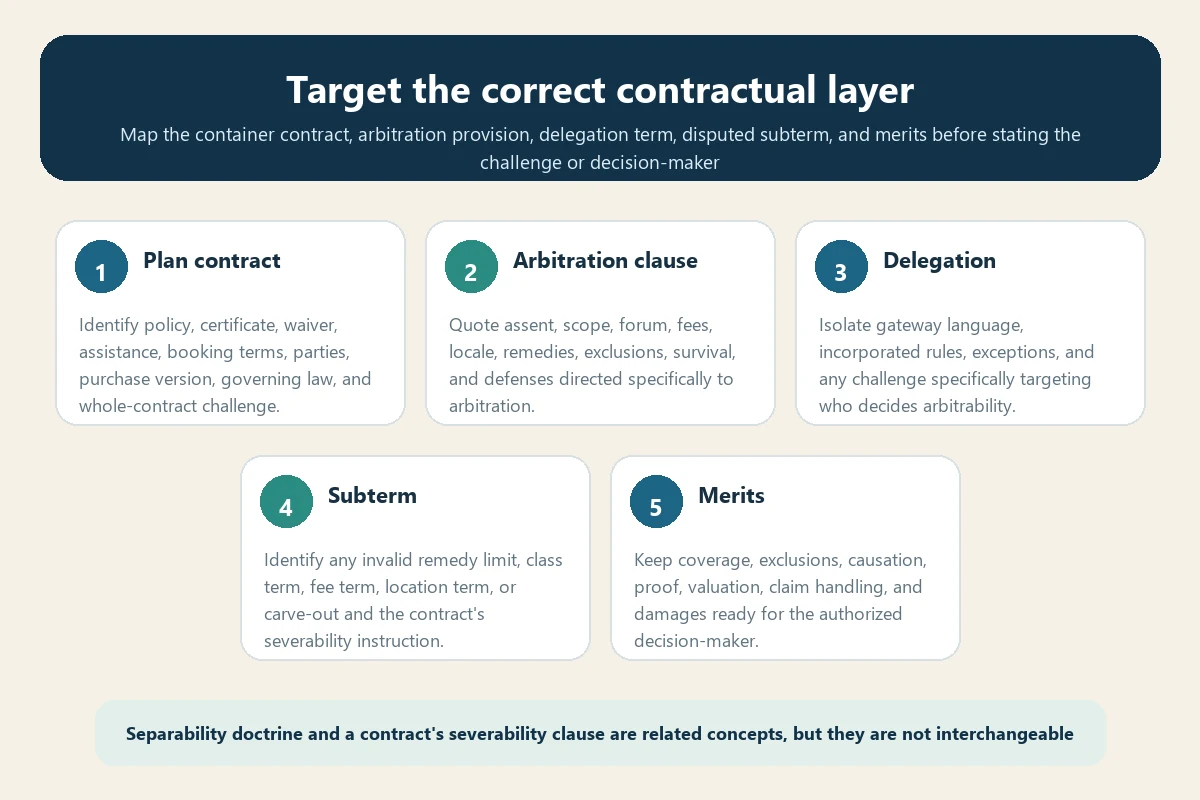
Write the challenged layer in one sentence: the whole travel protection contract, the arbitration provision, a delegation term, or one subterm within arbitration. That sentence guides the evidence, authority, decision-maker, and requested relief.
Understand the container-contract concept
A travel protection purchase may bundle an insurance policy, certificate, supplier cancellation waiver, assistance services, booking-platform terms, disclosures, and website terms. The arbitration clause may appear in only one document or in terms attributed to a different entity.
Preserve the exact version delivered at purchase. Map each document’s issuer, parties, assent event, incorporation language, governing law, and dispute terms. Do not assume every product in the package shares one arbitration provision.
Start with FAA Section 2
Section 2 of the Federal Arbitration Act addresses a written provision to settle a controversy by arbitration and places arbitration agreements on the same contractual footing as other agreements, subject to generally applicable revocation grounds and other statutory limits.
The statutory language focuses analysis on the specific written arbitration provision. Still, the FAA’s application, governing state law, formation, jurisdiction, and the exact challenge must be established in the actual case.
Read Buckeye Check Cashing as a validity decision
In Buckeye Check Cashing v. Cardegna, the U.S. Supreme Court explained that, as a matter of substantive federal arbitration law, an arbitration provision is severable from the remainder of the contract. A challenge to the validity of the contract as a whole, rather than specifically to the arbitration provision, was for the arbitrator in the first instance.
Buckeye involved a whole-contract illegality challenge, not every possible dispute about whether an arbitration agreement was formed. Avoid turning its holding into a slogan that all contract questions always go to an arbitrator.
Separate formation from validity
Formation asks whether the parties made the relevant agreement. Validity asks whether an agreement that was made can be enforced. Scope asks whether it covers the party, claim, date, conduct, or remedy. These classifications can affect who decides.
The arbitrability guide provides a gateway decision map. For severability analysis, identify whether the evidence attacks assent to the arbitration provision itself or only the legality or validity of the broader plan.
Isolate the arbitration-specific challenge
Quote the exact provision being challenged. Then state the arbitration-specific facts: how the clause was presented, who accepted it, what costs or location it imposes, which remedies it restricts, whether it is mutual, and which rules it incorporates.
Do not merely repeat a whole-contract allegation under an “arbitration clause” heading. Explain why the asserted defense applies independently to the arbitration provision under controlling law.
Analyze delegation as another layer
A delegation term assigns specified gateway questions to an arbitrator. The official U.S. Supreme Court bound volume containing Rent-A-Center, West v. Jackson explains that a delegation provision can be treated as a separate agreement to arbitrate a particular controversy about enforceability.
Identify a challenge directed specifically to delegation, not only to the arbitration agreement generally. Quote its wording, scope, exceptions, incorporated rules, and the evidence supporting the requested decision-maker.
Do not confuse delegation with separability
Separability describes the treatment of contractual layers. Delegation asks who decides a gateway issue. They interact, but one does not answer every question posed by the other.
The arbitration due process guide adds a fairness audit. Keep administrative clause review, arbitrator jurisdiction, and court enforceability decisions distinct.
Review the current administrator rule
The current AAA Consumer Arbitration Rules include a jurisdiction rule and treat an arbitration clause as an agreement independent from the other contract terms. The rule also addresses the timing of jurisdiction or arbitrability objections.
Use the rule edition governing the filing. An administrator’s decision to accept or decline a case is not a substitute for a court ruling under applicable law.
Distinguish doctrine from a contract severability clause
A contract may say that an invalid provision is severed while the remaining agreement continues. Read its exact language: it may address unenforceable applications, prohibited remedies, class terms, mass filing procedures, venue, fee allocation, or the entire arbitration agreement.
Contractual language does not automatically determine what federal or state arbitration doctrine requires. Conversely, the doctrine does not eliminate the need to interpret the parties’ remedial instructions.
Map the allegedly invalid subterm
Create a table with the subterm, asserted defect, governing authority, affected party or claim, severability text, requested modification, and effect on the remaining bargain. Explain whether the proposed removal preserves or rewrites the agreed process.
Common disputed terms concern fees, location, limitations periods, remedy restrictions, confidentiality, class treatment, mass filing, or unilateral amendment. Do not assume the same remedy applies to every term.
Address remedy limits separately
A challenge to a damages limitation or remedy waiver may concern the merits, the arbitration procedure, or both. Identify whether the arbitrator can grant the same individual relief a court could grant under the governing rules and law.
The reasoned award guide helps map issues and relief. A later award should show which remedy questions were decided without implying that the entire travel insurance contract was valid.
Keep the insurance merits distinct
Whether cancellation, interruption, delay, medical expense, evacuation, or baggage loss is covered depends on policy language, exclusions, facts, proof, causation, valuation, and claim handling. Separability determines how a dispute is routed; it does not resolve coverage.
Maintain a separate merits file so no deadline or evidence is lost while gateway issues are briefed. Cross-reference the files using claim number, exhibit number, and chronology.
Build a provision-by-provision evidence matrix
Use one row for the plan contract, one for the arbitration clause, one for delegation, and additional rows for disputed subterms. Add columns for assent evidence, challenge, authority, decision-maker, response, requested relief, and ruling.
The document exchange checklist helps request the purchase-time terms, version history, delivery evidence, click records, amendments, and entity relationships proportionally.
Draft the challenge with exact targeting
Begin with the layer challenged. Quote the language, identify the independent factual basis, apply the controlling rule, name the proper decision-maker, and state the requested result. Address contrary characterization directly.
The arbitration motion practice guide helps organize the issue, evidence, authority, response schedule, and proposed order. Avoid requesting broader relief than the analysis supports.
Preserve objections and timing
Record when each party received the agreement, raised the challenge, answered, requested information, and obtained a ruling. Current rules and court procedures can set early deadlines for jurisdiction or arbitrability objections.
The arbitration timeline guide provides a ledger. A severability dispute does not necessarily pause contractual, statutory, court, or arbitral deadlines.
State what the ruling actually resolves
A ruling may decide only who addresses a validity challenge, whether a subterm is severed, whether arbitration proceeds, or whether one claim remains in court. It may not decide the policy merits or every defense.
Record included and excluded parties and claims, the operative agreement, severed language, replacement procedure if any, preserved objections, and next deadlines. Do not describe a narrow gateway ruling as a final coverage decision.
Avoid common severability mistakes
- Using separability doctrine and contractual severability as synonyms.
- Attacking the whole plan without targeting the arbitration clause.
- Combining formation, validity, scope, and merits.
- Ignoring a separate delegation provision.
- Assuming Buckeye sends every contract dispute to arbitration.
- Relying on current terms instead of purchase-time terms.
- Removing a subterm without analyzing the remaining bargain.
- Treating AAA administration as a judicial ruling.
- Missing objection or merits deadlines during gateway briefing.
- Overstating what a severability ruling decided.
Final severability checklist
- Preserve the complete purchase-time travel protection package.
- Map the container contract, arbitration clause, and delegation term.
- Classify formation, validity, scope, procedure, and merits.
- Quote every challenged provision and independent factual basis.
- Identify the governing law, rule edition, and decision-maker.
- Read the contract’s own severability instructions.
- Analyze invalid subterms and proposed remedies separately.
- Maintain a provision-by-provision evidence matrix.
- Preserve objections, responses, rulings, and all deadlines.
- Keep the travel insurance merits file complete and distinct.
A strong severability analysis targets the correct contractual layer. It distinguishes the travel protection plan from the arbitration clause, the clause from delegation, and delegation from individual subterms—while preserving the underlying insurance evidence for the decision-maker authorized to reach the merits.
