
If a travel insurance claim virtual card expired before you used the full payment, first determine whether only the card credential expired or whether the underlying balance was affected. Do not discard the email, card statement, or claim decision, and do not pay an unsolicited person to “unlock” the money.
Virtual claim cards, prepaid accounts, debit-card transfers, digital wallets, single-use card numbers, and gift cards are not interchangeable. Their replacement rules, fees, acceptance, expiration, and error protections can differ. This U.S.-focused guide provides a practical recovery process, not legal, banking, tax, cybersecurity, or insurance advice.
Identify the exact payment product
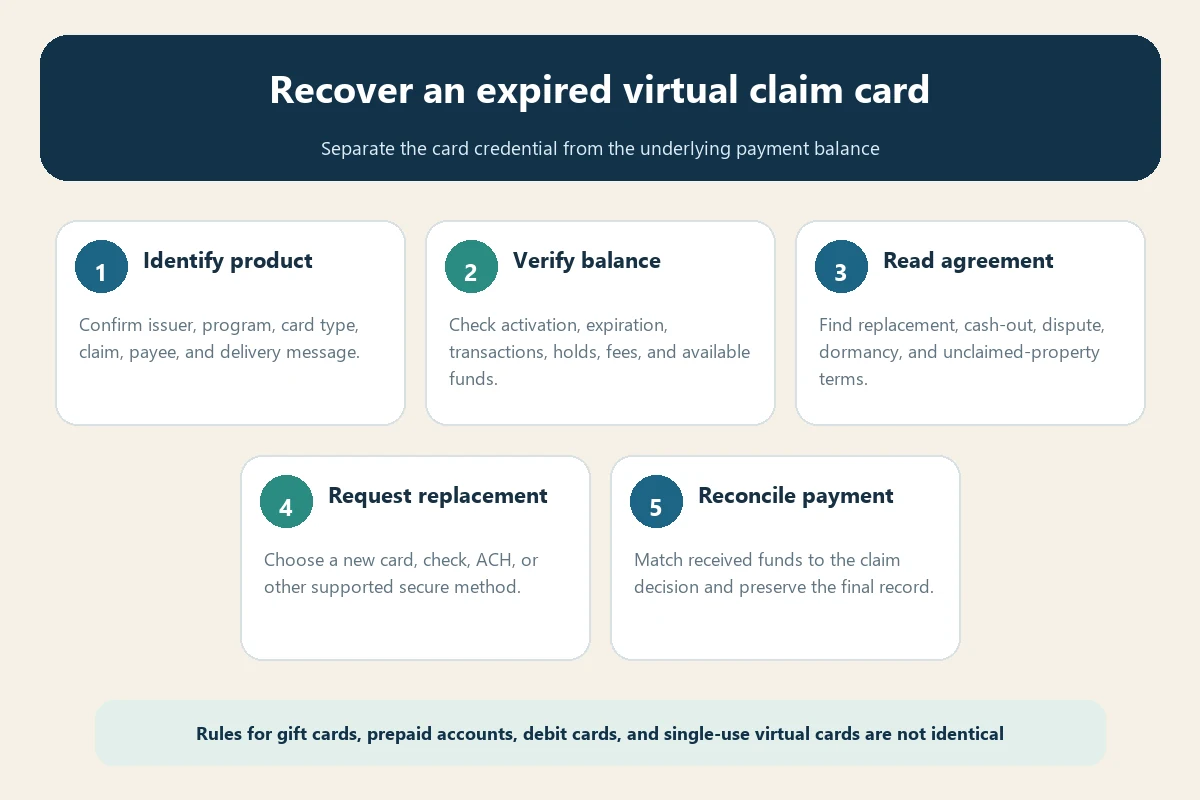
Start with the claim decision and payment notice. Record the legal insurer, claim administrator, payment platform, card issuer, network, claimant, amount, issue date, expiration date, and support contact. Ask whether the payment is a virtual prepaid account, a single-use virtual card, a push-to-debit-card transfer, or merely an online view of another payment method.
| Product label | How it may work | Question to answer |
|---|---|---|
| Single-use virtual card | One card number for one claim payment | Who can process it and for what amount? |
| Prepaid account or card | Funds held in a program account | Can the balance be replaced or cashed out? |
| Push-to-card payment | Funds sent to an existing eligible debit card | Did the transfer post to the linked account? |
| Digital wallet | Payment accepted through a platform account | Was it accepted, rejected, or returned? |
| Gift card | Stored value with separate federal rules | Is it truly a covered gift-card product? |
Card expiration may differ from funds expiration
The Consumer Financial Protection Bureau says that when a prepaid card expires with money remaining, a consumer may be able to request a replacement or close the account and request the balance by check, subject to the cardholder agreement and possible fees. Review the official CFPB prepaid-card expiration answer.
That guidance does not prove that every virtual insurance payment has the same rights. The product may be outside a particular prepaid-account category, may have a limited redemption window, or may automatically convert to another payment method. Obtain the agreement for the program actually named in the payment notice.
Do not apply gift-card rules automatically
Federal rules distinguish gift certificates, store gift cards, general-use prepaid cards, and other products. The CFPB’s Regulation E gift-card provision includes protections about expiration and replacement for covered products. A claim disbursement card is not necessarily a gift card merely because it has a card number and stored balance.
Ask the issuer to identify the product classification and the section of the cardholder agreement governing expiration, remaining funds, replacement, closing the account, inactivity, and unclaimed property. Avoid asserting a five-year rule until the product and applicable law are confirmed.
Verify activation and the current balance
Use the support number or website independently verified through the insurer and issuer. Record whether the card was activated, the original load, available balance, pending authorizations, completed transactions, reversals, declined attempts, fees, and expiration status.
If the balance is zero, ask for a transaction history rather than assuming the claim was never funded. A merchant hold, prior partial use, unauthorized transaction, service fee, reversal, or transfer may explain the difference. Save the history and dispute instructions.
Separate activation, redemption, and settlement
Opening an email or accepting a payment may activate a card without moving money to a bank account. Entering the card at a merchant may create an authorization that later settles, reverses, or expires. A portal status of “delivered” may mean the credential was sent, not that the claimant received cash.
Build a timeline containing claim approval, payment selection, delivery email, identity verification, activation, each attempted transaction, authorization, final settlement or reversal, expiration, and first replacement request. The claim status follow-up guide helps assign an owner and dated next step.
Single-use cards can have exact redemption conditions
A single-use virtual card can require one transaction for the exact amount, a certain merchant type, a specific billing ZIP code, and processing before the printed expiration date. It may be designed for a provider rather than a consumer purchase.
UnitedHealthcare’s provider guidance gives an industry example: its virtual cards use a unique number for each claim payment, can require the exact displayed amount and a healthcare-coded terminal, and have an expiration process. Its current materials describe conversion or reissue after expiration. This concerns healthcare-provider payments, not a promise about a travel-insurance program. Use it only to understand why the card instructions matter. See the official UHC virtual card payment guidance.
Ask for a replacement without exposing the card
Contact both the claim payer and card issuer through verified channels. Provide the claim number, card program, issue and expiration dates, original amount, current balance, last four digits, and error message. Do not email the full card number, security code, password, PIN, or one-time code.
Ask whether the available options are:
- a new virtual card number;
- a physical replacement card;
- transfer of the balance to an authenticated bank account;
- a mailed check;
- another digital payment route;
- closure of the card account and balance refund.
Request a case number, documents required, fees, delivery method, replacement timeline, and confirmation that the old credential will be disabled.
Read fees and limits before choosing the replacement
The card agreement may list replacement, expedited delivery, ATM, cash withdrawal, teller, transfer, inactivity, foreign transaction, balance inquiry, or account-closing fees. The CFPB’s prepaid-account rule recognizes replacement or reissue fees as a disclosure category for covered prepaid accounts, including expired cards. See Regulation E section 1005.18.
Ask the claim administrator whether it selected the payment method, whether fees reduce the claim proceeds, and whether a fee-free alternative exists. Do not assume that a processor fee changes the insurer’s approved benefit; reconcile them as separate amounts.
Declines before expiration need their own diagnosis
A decline can result from nonactivation, wrong billing data, merchant category restrictions, transaction amount, cash-access prohibition, online or international controls, expiration, frozen account, suspected fraud, or unsupported recurring payment. Capture the exact decline date, merchant, amount, channel, and message.
Do not test the card repeatedly at multiple merchants or post screenshots containing the card number. Ask issuer support which control caused the decline and whether a pending authorization is holding part of the balance.
Report loss or unauthorized transactions promptly
If the virtual number or email was exposed, secure the associated email and claim portal, change reused passwords, and contact the issuer immediately. The CFPB advises consumers to report a lost prepaid card, PIN, or unauthorized charge promptly and notes that protections can depend on registration and product type. Review its prepaid-card loss and error guidance.
Preserve the transaction history, access alerts, email headers, device details, card status, dispute number, provisional-credit information, and issuer decision. Do not confuse a merchant reversal or temporary hold with an unauthorized completed transaction.
Verify the payment offer is genuine
A digital payment message can be spoofed. Validate the sender through the issued policy or official claim portal. Confirm the legal payment vendor and domain with the insurer before following a link. The claim payment scam guide covers fake portals, urgent activation, recovery fees, and account takeover.
A legitimate payer should not require you to buy another prepaid card, send cryptocurrency, share remote computer access, or reveal a one-time authentication code to release an approved claim.
Reconcile a partial card balance
If some funds were spent before expiration, compare the original claim payment with completed transactions, reversed transactions, holds, fees, and remaining balance. Request replacement only for the amount still due, while preserving proof of the amount already received.
The partial claim payment guide helps distinguish a partial disbursement from a partial claim approval. Do not reopen settled claim line items merely because the payment instrument failed, and do not let a replacement instrument waive a separate unpaid claim balance.
Switch payment methods safely
If the virtual card is unsuitable, compare ACH and check using the claim payment method guide. Verify payee, address, account ownership, delivery, fees, traceability, and replacement procedures.
Ask whether switching methods closes the card and transfers only its remaining balance or causes the insurer to void and reissue the entire claim payment. Obtain a written reconciliation so both instruments cannot later be used.
If the replacement is mailed and later becomes too old to deposit, follow the expired claim check reissue guide rather than treating the card and check as the same instrument.
Check unclaimed property after a long delay
Unused balances may eventually be handled under state unclaimed-property law. Ask the issuer whether the funds were reported, to which state, under what holder name, and with what property reference. If reported, use the official state program rather than an unsolicited finder.
USAGov’s unclaimed-money page explains that states hold most unclaimed funds and links consumers to official state searches. Check states connected to your current and prior addresses and the payer’s records, while following the state program’s identity requirements.
Escalate with one complete payment record
If replacement stalls, send the claim administrator and issuer a concise packet: decision, payment amount, program and issuer, masked card reference, issue and expiration dates, activation status, transaction history, remaining balance, prior cases, agreement section, requested remedy, and deadline response.
Ask each company to state which party controls the funds and replacement. If necessary, identify the applicable insurance or financial regulator based on the responsible entity and product. The NAIC state insurance department directory links to official insurance regulators; a card-issuer dispute may require a different complaint route.
Bottom line
When a virtual travel claim card expires, identify the product before assuming the money is gone. Verify the issuer, activation, available balance, transactions, expiration terms, fees, and replacement choices. Disable the old credential, obtain the new payment reference, and match the funds finally received to the written claim decision.
