
Travel insurance complaint retaliation may be a concern when an insurer takes an unfavorable action soon after a consumer contacts a state insurance department. The right response is to preserve the exact action, timeline, written reason, policy facts, and communications—then ask the regulator which state rule and review process apply.
Timing alone does not prove retaliation. A claim decision, nonrenewal, cancellation, underwriting outcome, fraud referral, request for records, or change in communication may have an independent lawful basis. Conversely, a legitimate-sounding label does not end the inquiry if evidence shows the complaint caused improper treatment. This guide is general information, not legal advice.
Know the national consumer guidance
The National Association of Insurance Commissioners states in its consumer complaint guidance that an insurer cannot discriminate against a consumer in the future for filing a complaint. The same page explains that state complaint procedures vary and that a department generally forwards an accepted complaint to the company for a response.
That guidance is an important starting point, but a specific dispute still depends on the state’s statutes, regulations, policy type, facts, and regulator authority. Ask the department to identify the applicable state protection rather than citing a general webpage as if it were the complete legal test.
Define the adverse action precisely
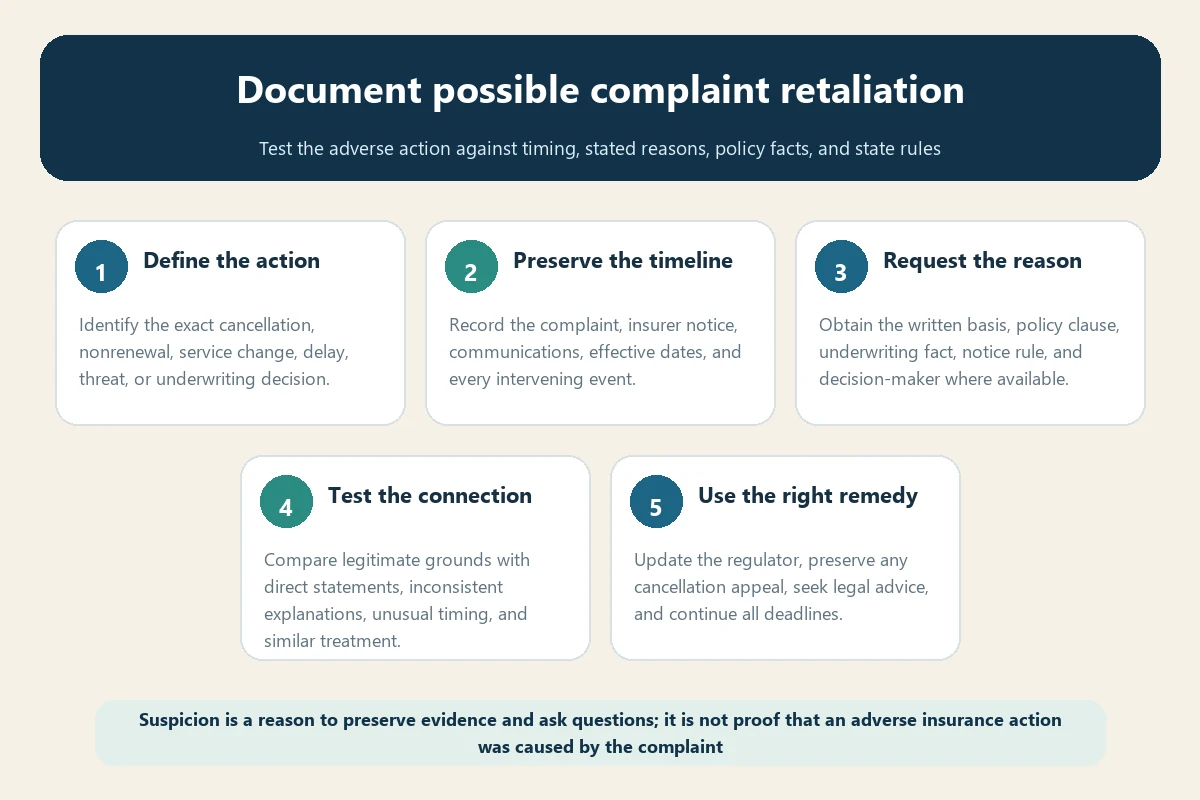
Replace “the insurer retaliated” with a verifiable event. Examples include:
- A written cancellation or nonrenewal notice.
- A refusal to quote or issue another policy.
- A new claim denial, delay, reserve, or documentation demand.
- Loss of portal access or a change in assigned personnel.
- A threat tied directly to regulator contact.
- A fraud referral or investigation notice.
- Different treatment of a pending appeal or assistance request.
- An agent or representative discouraging cooperation with the regulator.
Some items may be inconvenient without being adverse, and some may be adverse without being unlawful. Record who acted, what changed, when it became effective, and what measurable effect followed.
Build a two-track timeline
Use one column for complaint events and another for insurer actions. Include the original claim, denial, internal appeal, regulator submission, department acknowledgment, date the company received the complaint, company response, closure, later notices, phone calls, portal changes, and payments.
Preserve original timestamps, email headers, envelopes, certified-mail records, screenshots with visible dates, call logs, and policy documents. Do not edit screenshots or rely only on a reconstructed narrative.
Request the insurer’s written reason
Ask the company to identify the decision, effective date, policy or application involved, factual basis, contractual provision, underwriting guideline where disclosable, notice requirement, and review or appeal rights. If it says the action is unrelated to the complaint, ask for the actual reason without arguing by phone.
A written explanation allows comparison with the policy, application, claim history, state rules, and prior communications. It also prevents the dispute from collapsing into conflicting recollections.
Compare that explanation with the insurer’s earlier regulator submission using the travel insurance complaint response review guide. Changing reasons can be relevant, but they must be assessed in context.
Distinguish correlation from causation
An action occurring after a complaint is correlated in time. Evidence of causation can be stronger when the decision-maker mentions the complaint, the explanation changes, stated facts are demonstrably false, normal procedures are skipped, similarly situated transactions are treated differently, or an action begins immediately after company receipt without another apparent trigger.
Evidence against causation may include a notice prepared before the complaint, a policy-wide product withdrawal, an independently documented material misrepresentation, a missed premium, expiration of a single-trip policy, or a rule applied consistently to comparable cases. Evaluate both sides honestly.
Travel insurance creates special timing questions
Many travel policies cover a single trip and naturally end after the insured period. The company may not offer renewal at all. A later quote can also involve a different destination, traveler age, trip cost, medical information, residence, distribution channel, or product availability.
Do not call expiration retaliation. Identify whether the company terminated an in-force contract, declined a new application, removed an optional benefit, closed a claim, or simply reached the scheduled end date. Each event has a different legal and factual framework.
Separate complaint handling from claim investigation
Once the regulator sends the complaint, the insurer may assign compliance staff, retrieve records, interview employees, and prepare a response. That increased activity can feel adversarial but may be part of the required complaint process.
The official NAIC complaint guide explains that the department forwards the complaint, the insurer responds, and the regulator assesses the handling. North Carolina similarly says its Consumer Services Division can forward a complaint, require an explanation, review compliance, and require corrective action when the company’s position violates applicable requirements.
Review the North Carolina Department of Insurance assistance page as a state example, not a national rule.
A fraud referral is not automatically retaliation
An insurer may have legal duties and contractual rights to investigate suspected fraud. A referral made after a complaint is not automatically retaliatory. Examine the factual basis, statements made, applicable notice, chronology, and whether the company followed state requirements.
Do not destroy, alter, coordinate, or fabricate evidence. Respond truthfully through the proper channel and obtain legal advice if an investigation or accusation creates material risk. A regulator complaint should never be used to shield false claim information.
Cancellation and nonrenewal need immediate attention
A cancellation or nonrenewal notice may carry a short review period. Save the notice and envelope, identify whether it concerns an existing policy or future offer, and verify the reason, effective date, delivery method, and state procedure. Do not wait for the retaliation question to be resolved before protecting coverage or filing an available appeal.
The NAIC’s broader insurance department help page lists cancellations and nonrenewals among matters consumers may ask their state department about, while warning that services and authority vary. Contact the proper state regulator promptly.
Update the existing complaint when appropriate
If the suspected action concerns the same insurer and arose during an open complaint, ask the examiner whether to add it to the current case. Reference the complaint number, attach the adverse notice, provide a one-page timeline, and state the requested regulatory review.
If no complaint exists yet, use the state travel insurance complaint filing guide to identify the licensed insurer, proper jurisdiction, evidence, requested action, and secure submission route.
Pennsylvania’s Consumer Services Portal FAQ says users can upload documents, communicate with the assigned investigator, view investigator-uploaded documents, and maintain complaint history. Its process is an example of a case-specific channel. Follow your state’s current instructions.
See the official Pennsylvania portal FAQ and avoid opening a duplicate case merely to submit an update.
If the complaint is already closed
Ask whether the department wants a reopening request, a supplemental submission, or a new complaint about later conduct. Connect the adverse event to the prior case without assuming the agency has already concluded retaliation occurred.
The reopen travel insurance complaint guide explains how to identify a material post-closure development and use the existing case number.
Prepare an evidence matrix
Create one row per fact with these columns:
- Date and event.
- Source document or witness.
- What the insurer says caused the action.
- Evidence supporting that reason.
- Evidence contradicting that reason.
- Connection to the complaint.
- Applicable policy or state rule to verify.
Use neutral labels such as “possible connection” until evidence supports a conclusion. A regulator can evaluate a clean matrix faster than a long accusation without source documents.
Preserve the complaint and company response
The insurer’s response may reveal when it learned of the complaint, who handled it, what explanation it provided, and whether later statements conflict. Save the full response and attachments.
If you need records from the department, use the travel insurance complaint file request guide. Access and confidentiality rules vary, and a records request generally does not pause another deadline.
Do not overstate protected activity or coverage
A consumer should distinguish filing a truthful regulator complaint from making threats, publishing private information, harassing staff, or submitting false claims. The existence of protected complaint activity does not guarantee coverage, renewal, payment, or immunity from legitimate investigation.
Likewise, an insurer should not use claim administration, underwriting, or fraud procedures as a pretext for improper discrimination. The regulator and, where necessary, qualified counsel can assess the actual rule and evidence.
Write a focused regulator update
Re: Complaint [number]. After the department sent or closed my complaint, [insurer] took the following action: [exact action], effective [date]. The company states the reason is [quote or concise description]. I am concerned the action may be connected to my complaint because [specific evidence, not conclusion]. Attached are the notice, timeline, prior communication, and relevant policy pages. Please advise whether this should be added to the current matter or filed separately, and which state rule and review procedure apply.
Do not ask the examiner to accept an unsupported label. Ask for review of the documented conduct and applicable authority.
Protect privacy and communication discipline
Use the secure portal or approved channel. Redact unrelated account numbers and third-party details according to instructions. Keep messages short, professional, and case-specific. Assume the insurer may receive the allegation and supporting documents as part of the regulator’s review.
The complaint privacy guide covers public-record notices, insurer sharing, redaction, and data minimization.
Track parallel deadlines
Possible retaliation does not automatically pause premium due dates, claim appeals, proof-of-loss periods, cancellation review deadlines, arbitration, contractual limitations, statutes of limitation, or court filings. Maintain a separate calendar for each.
If an in-force policy may terminate, explore replacement coverage without making inaccurate application statements. A new policy usually does not cover an already known loss. Seek qualified advice if preserving rights requires urgent action.
Understand what the regulator can and cannot do
Washington’s official complaint assistance explanation says the office can require a company explanation and review compliance with law and policy, but cannot act as the consumer’s lawyer, claims adjuster, or finder of disputed facts and liability. Similar limits may affect the remedy in another state.
If the issue requires damages, discovery, testimony, or a legal causation ruling beyond the complaint unit’s authority, consult qualified counsel about available remedies.
Frequently asked questions
Does bad customer service after a complaint prove retaliation?
No. Preserve it, but prove the exact action, connection, and governing rule. Tone alone may not establish discrimination or measurable harm.
Can an insurer deny a claim after I complain?
It can make a coverage decision supported by the policy and facts. The complaint does not guarantee payment. A denial motivated by improper discrimination presents a different question for the regulator.
Should I file a new complaint immediately?
Ask the assigned examiner or department whether to update, reopen, or file separately. Follow urgent cancellation or appeal procedures at the same time.
What is the strongest evidence?
Direct written statements can be powerful, but causation often comes from the full record: timing, changing explanations, false stated facts, departures from procedure, comparable treatment, and legitimate alternative reasons.
Can the regulator award damages?
Authority varies, and consumer complaint units often focus on compliance and corrective action rather than private damages. Ask what remedies are available and seek legal advice when necessary.
Possible retaliation should trigger disciplined evidence preservation, not an immediate conclusion. Define the action, obtain the written reason, build the timeline, test legitimate explanations and causal evidence, update the proper regulator, and protect every claim, coverage, and legal deadline independently.