

Travel medical insurance coinsurance is the percentage split applied to eligible medical expenses under a policy, usually after any deductible, but the percentage alone does not reveal the traveler’s final cost. The calculation also depends on the allowed amount, network rule, sublimit, out-of-pocket wording and excluded charges.
Key takeaways
- Confirm which percentage belongs to the traveler and which belongs to the insurer.
- Apply the split to the policy’s eligible or allowed amount, not automatically to the provider’s bill.
- Place the deductible before coinsurance only when the certificate says so.
- Check whether the percentage changes by network, service, destination or claim amount.
- Do not assume a travel medical plan has an ACA-style out-of-pocket maximum.
Planning information reviewed August 16, 2026. Coinsurance structures vary by certificate. The dollar examples are arithmetic illustrations rather than quotations or benefit promises.
Read the percentage from the insured’s perspective
HealthCare.gov defines coinsurance as the percentage of a covered service cost the member pays after the deductible. Under that convention, 20% coinsurance means the insured pays 20% and the plan pays the rest.
Travel policy tables can display “80% covered” or “80/20” instead. Record both shares explicitly. Ask the insurer to confirm the traveler’s percentage for the exact destination, provider and service.
Find the calculation base
The provider’s billed charge may differ from the eligible or allowed amount used by the policy. HealthCare.gov describes an allowed amount as the maximum a plan will pay for a covered service. A travel certificate may use terms such as usual, reasonable, customary or eligible expense.
Search the definitions and claim provisions. Ask whether the traveler is liable for a balance above the recognized amount. That balance can sit outside coinsurance and any cost-sharing cap.
Follow the calculation order
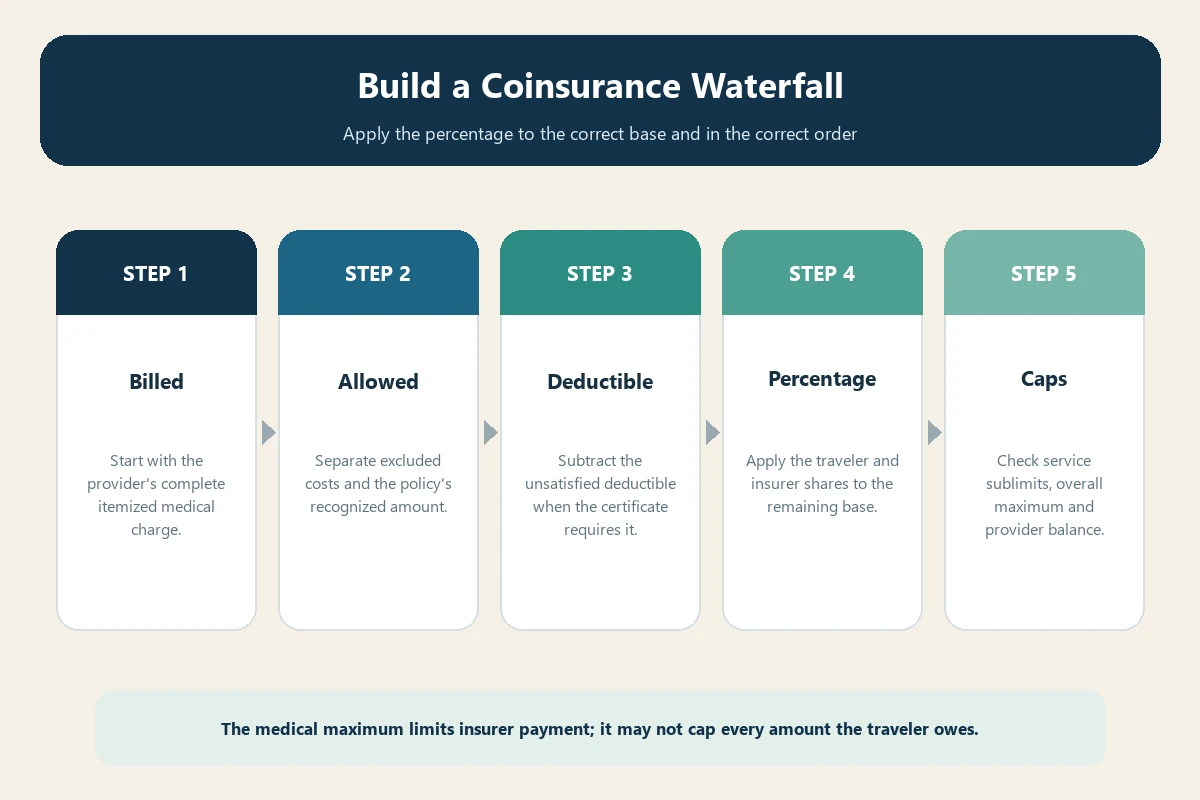
A common sequence is: remove excluded charges, determine the allowed amount, subtract other insurance, apply the deductible, calculate coinsurance and then apply a benefit sublimit or maximum. The actual certificate may use another order.
Write each step as a separate line. This prevents an 80/20 split from being applied to the full invoice when the policy recognizes a different base. The deductible guide explains the cost-sharing layer immediately before the percentage.
Work a basic 80/20 illustration
Assume a $1,000 bill is fully eligible, the deductible has already been met and the traveler pays 20% coinsurance. Under those assumptions, the traveler share is $200 and the insurer share is $800, before any other limit or payer.
This calculation is deliberately simple. It does not show a network adjustment, provider balance, sublimit or excluded service. Use it only to confirm which party owns each percentage.
Add a deductible to the illustration
Now assume the same $1,000 eligible amount and a $100 unsatisfied deductible. If the policy applies coinsurance after the deductible, $900 remains for the split. A 20% traveler share is $180, making the illustrated traveler cost $280 plus any excluded amount.
Do not apply this sequence unless the certificate supports it. A per-incident deductible can repeat. A service-specific deductible can create a different result for hospital, prescription or dental claims.
Add an allowed-amount adjustment
Assume the provider bills $1,200 but the policy recognizes $1,000. With the prior $100 deductible and 20% coinsurance, the calculated cost sharing remains $280 on the recognized base. The separate $200 difference requires its own policy and provider analysis.
Ask whether a network contract removes that balance or whether the traveler remains responsible. Do not describe a claim as “20% out of pocket” when excluded and above-allowance charges can increase the actual amount.
Check network coinsurance
Some products show one percentage for preferred providers and another outside a network. Ask how the network operates in every destination and how a traveler identifies a participating facility before treatment. Foreign emergency care may not fit a U.S.-style network model.
Confirm whether emergency treatment receives an exception and whether assistance must arrange the provider. Save any directory result or assistance referral with the date. A directory listing does not guarantee continued participation or admission.
Check coinsurance caps
A certificate may limit the dollar amount or first tranche of expenses to which a percentage applies. After that threshold, the plan may pay another percentage up to the medical maximum. Another policy may leave the percentage in place for every eligible dollar.
Copy the exact threshold, reset period and service scope. Marketing language such as “100% after” is incomplete without the deductible, eligible-expense definition and overall maximum.
Do not invent an out-of-pocket maximum
HealthCare.gov’s out-of-pocket maximum explanation applies to Marketplace-plan rules and identifies costs that do not count. Short-term travel medical coverage is not automatically subject to the same design.
Search the issued certificate for an explicit cap. If none exists, calculate coinsurance across the full eligible claim up to policy limits and keep noncovered amounts separate. The medical maximum limits insurer payment, not necessarily patient liability.
Test service-specific percentages
Outpatient care, hospital admission, physician services, prescriptions, dental care and therapy can have different percentages or caps. Medical evacuation may have separate authorization and no coinsurance, or its own cost-sharing term.
Use the evacuation limits guide rather than applying a medical-treatment percentage automatically. Build one row for each benefit on the schedule.
Test multiple incidents
Two unrelated events can trigger separate deductibles while sharing one coinsurance percentage and aggregate maximum. Alternatively, one policy-period deductible may remain satisfied. Calculate each incident and the aggregate limit in date order.
Ask how follow-up care is grouped with the original diagnosis. Do not split or combine clinical events for a preferred claim result. The provider record should determine the accurate medical relationship.
Check primary and secondary coverage
If travel coverage is secondary, another insurer’s allowed amount and payment can affect the remaining eligible expense. The travel policy then applies its coordination rules, deductible and coinsurance. It may not simply pay the domestic plan’s patient share.
The primary versus secondary guide shows which explanation-of-benefits records to keep. Never submit the same unreduced expense to two payers as if neither had paid.
Verify the U.S. health-plan layer
The State Department’s insurance guidance recommends asking whether a U.S. plan covers care abroad. Record geographic limits, network treatment, prior authorization, deductible, coinsurance and foreign claim procedures.
The health insurance abroad guide turns that call into a payer map. Do not assume the domestic and travel-plan percentages coordinate neatly.
Account for upfront provider payment
The CDC’s travel insurance guidance notes that foreign care may require out-of-pocket payment and suggests checking for direct hospital payment. A provider can request the full bill before the insurer has calculated its share.
Ask assistance whether it can issue a guarantee for the estimated eligible portion and how the traveler pays cost sharing. Keep the provider’s final invoice because a deposit is not the same as the final coinsurance liability.
Verify activities before calculating
If an injury arises from an excluded activity, there may be no eligible amount to split. Check scuba, altitude, motorcycling, racing, organized sport, guide and equipment conditions. An optional activity endorsement can also use different cost sharing.
The activity exclusions guide separates rescue, treatment and evacuation. Confirm all three instead of applying one percentage to the entire response.
Compare plans with a cost waterfall
For each quote, create rows for billed charge, excluded charge, allowed amount, other insurance, deductible, coinsurance, service sublimit, overall maximum, insurer payment and traveler responsibility. Use the same three hypothetical claims for every plan.
A lower percentage can still yield a higher traveler cost when the allowed amount, deductible or sublimit is less favorable. Compare the complete waterfall and policy price, not one ratio.
Read the explanation of benefits
After processing, the insurer should show billed, eligible, deductible, coinsurance, excluded and paid amounts. Compare the document with the certificate and provider balance. Ask for the reason code behind every adjustment.
The assistance versus claims guide clarifies which team can explain coordination and which decides payment. A provider’s demand for payment does not change the policy calculation by itself.
Build an appeal-ready record
Keep the policy, schedule, clinical notes, itemized invoice, payment proof, network or assistance record and all other-payer decisions. Show the intended calculation in a one-page table without altering original documents.
The claim filing guide helps reconcile currency and refunds. If disputing coinsurance, identify the exact allowed amount, percentage, deductible status and service provision.
Recalculate after refunds or corrections
A provider refund, corrected invoice or other insurer payment can change the amount left for coinsurance. Preserve the original and revised records, then rerun the waterfall in the same order. Do not treat a refund as unrelated income.
If the claim spans currencies, retain the original amounts and the conversion used on each payment. A later exchange-rate movement should not be substituted silently. Ask the insurer for a revised explanation of benefits showing the updated eligible base, traveler share and policy payment.
Compare that revised document with the provider’s remaining balance. If the two do not reconcile, ask each party to identify the disputed service, amount and reason in writing before paying or appealing.
Bottom line
Coinsurance is not a standalone price tag. Confirm the traveler’s percentage, recognized expense, deductible sequence, network treatment, service-specific rules and any real out-of-pocket cap. A transparent cost waterfall is the best way to compare plans and audit a processed claim.
