
Travel insurance subrogation, supplier refund, and recovery language matters after a claim is paid, not just during the initial adjustment. An airline, cruise line, hotel, card issuer, medical provider, or another insurer may issue money months later. That payment can reduce the traveler’s net loss and trigger duties to notify the insurer, cooperate with recovery, or return an overpayment under the actual certificate and applicable law.
Subrogation and reimbursement are related but not identical. Subrogation commonly allows an insurer that paid a covered loss to pursue a responsible third party in the insured’s place. Reimbursement or recovery language can require the insured to account for money later received for the same loss. The exact rights, priority, costs, and treatment of deductibles are contract- and jurisdiction-specific.
Key takeaways
- Insurance generally indemnifies an eligible loss; it is not designed to create double recovery for the same expense.
- A later cash refund, credit, chargeback, settlement, or other-insurance payment can change the net claim.
- Do not waive claims, release a supplier, or settle overlapping rights without checking the policy.
- Notify the insurer promptly and provide a line-by-line reconciliation when money arrives later.
- Subrogation, reimbursement, salvage, and refund provisions vary; the issued certificate controls.
What subrogation means in a travel claim
After paying an eligible loss, an insurer may obtain a contractual or legal right to seek recovery from a party responsible for that loss. For example, if a third party should have refunded a canceled service, the insurer may pursue that party to the extent of its payment. The traveler may need to preserve documents, sign an authorization, provide testimony, or avoid impairing the claim.
This does not mean every payment produces a lawsuit. Recovery may occur through routine correspondence, a supplier refund, another insurer’s coordination process, a card dispute, or an agreement. The carrier decides whether to pursue rights under its policy, subject to law. The insured should not promise a particular recovery outcome.
Reimbursement is the more common traveler-facing issue
The practical issue for many travelers is reimbursement after a later payment. Suppose a policy pays a nonrefundable hotel cost, but the hotel later issues a cash refund. The traveler’s net loss is now smaller. A recovery clause may require reporting and returning some or all of the overlapping insurance payment.
The calculation is not always “send back the refund.” The insurer may consider which loss line the refund applies to, whether the policy paid that line, policy limits, deductible, partial credits, currency conversion, collection costs, and governing law. Ask for a written reconciliation rather than guessing.
No double recovery for the same loss
A traveler can have several potential payment sources: the supplier, travel insurer, health plan, credit-card benefit, chargeback, responsible third party, or another policy. Multiple sources do not automatically mean the traveler can retain more than the eligible loss. Policies frequently coordinate benefits or reserve recovery rights.
Keep separate rows for each expense. An airline refund for the base fare should not be casually applied to an unrelated hotel loss. Likewise, a medical-plan payment must be matched to the provider and service it covers. Line-level accounting prevents both overstatement and inappropriate offsetting.
Refund, voucher, credit, and chargeback are not identical
A cash refund returns money. A voucher or future-travel credit may be restricted, expire, be nontransferable, or have different policy treatment. A card chargeback is a provisional or final reversal under the card process, not a supplier refund. A goodwill payment may compensate inconvenience rather than reimburse a specific prepaid cost.
Describe each recovery accurately. Provide the terms, expiration, transferability, amount, currency, and status. Do not call a disputed or unusable voucher “no refund” without giving the insurer the actual document. Do not call a provisional card credit final until the issuer confirms the dispute outcome.
Airline refunds can arrive after the claim starts
U.S. Department of Transportation refund rights can apply when an airline cancels or significantly changes a flight and the passenger does not accept the offered alternative, subject to current rules and the itinerary. Enforcement details can change, so check the DOT’s current refund page. An insurance claim filed before the airline completes its process should disclose that a refund is requested or pending.
When the airline pays, upload the confirmation and revised card statement. Identify whether taxes, fees, seat charges, baggage fees, or only the fare were refunded. The travel insurer can then update the corresponding loss lines.
Supplier refunds after trip cancellation
Cancellation claims usually begin with the prepaid trip cost minus refunds, credits, and other recoveries recognized by the policy. Ask every airline, cruise line, hotel, vacation rental, tour operator, and ticket seller for a final cancellation statement. Save the original terms and the supplier’s response.
If a supplier changes its decision after the insurer pays, report it. A bankruptcy distribution, class settlement, estate payment, or merchant refund can also be a later recovery. The fact that it arrives in a different tax year or after the claim closes does not necessarily remove the reporting duty.
Medical refunds and other insurance
Medical providers can refund deposits after a health plan processes the bill. Medicare, Medicare Advantage, Medigap, employer insurance, or a travel carrier can reprocess claims and change the patient balance. Use the full Explanation of Benefits workflow and match every revised EOB to the provider ledger.
A secondary travel insurer may have paid based on an earlier zero-payment decision. If the first plan later pays, notify the travel insurer and send the revised EOB. Our Medicare coordination guide explains why another payer’s later action can reopen the arithmetic.
Credit-card disputes and travel insurance
A billing dispute and an insurance claim can proceed on separate tracks, but both should disclose the other. A card issuer may give temporary credit while investigating. If travel insurance pays the same charge, tell the adjuster about the pending dispute. If the chargeback becomes final, update the insurer; if reversed, provide the final statement.
Do not submit inconsistent narratives. A card dispute might claim the service was not provided, while an insurance submission might say the traveler voluntarily canceled a provided service for a covered reason. Explain the complete facts and let each program apply its rules.
Do not impair recovery rights
A release, settlement, waiver, or acceptance of restrictive supplier terms can affect an insurer’s ability to recover. Before signing a document that releases a potentially responsible party for an expense already submitted to insurance, review the recovery clause and contact the carrier. Obtain written instructions when possible.
Preserve contracts, terms in effect on the booking date, cancellation notices, messages, invoices, receipts, card statements, medical ledgers, EOBs, and supplier identities. Do not delete an account merely because the trip ended. Recovery teams may need records long after the initial claim decision.
What the duty to cooperate can include
- providing original documents and a factual chronology;
- identifying suppliers, other insurers, card issuers, or responsible parties;
- forwarding later refunds, credits, settlement offers, or collection messages;
- signing reasonable recovery authorizations required by the contract;
- notifying the carrier before a release or overlapping settlement; and
- preserving evidence without altering invoices or communications.
Cooperation does not require the traveler to invent facts or surrender rights beyond the contract and law. Ask questions about broad authorizations, disputed allocations, or material repayment demands. For significant legal issues, obtain independent advice.
How to reconcile a later recovery
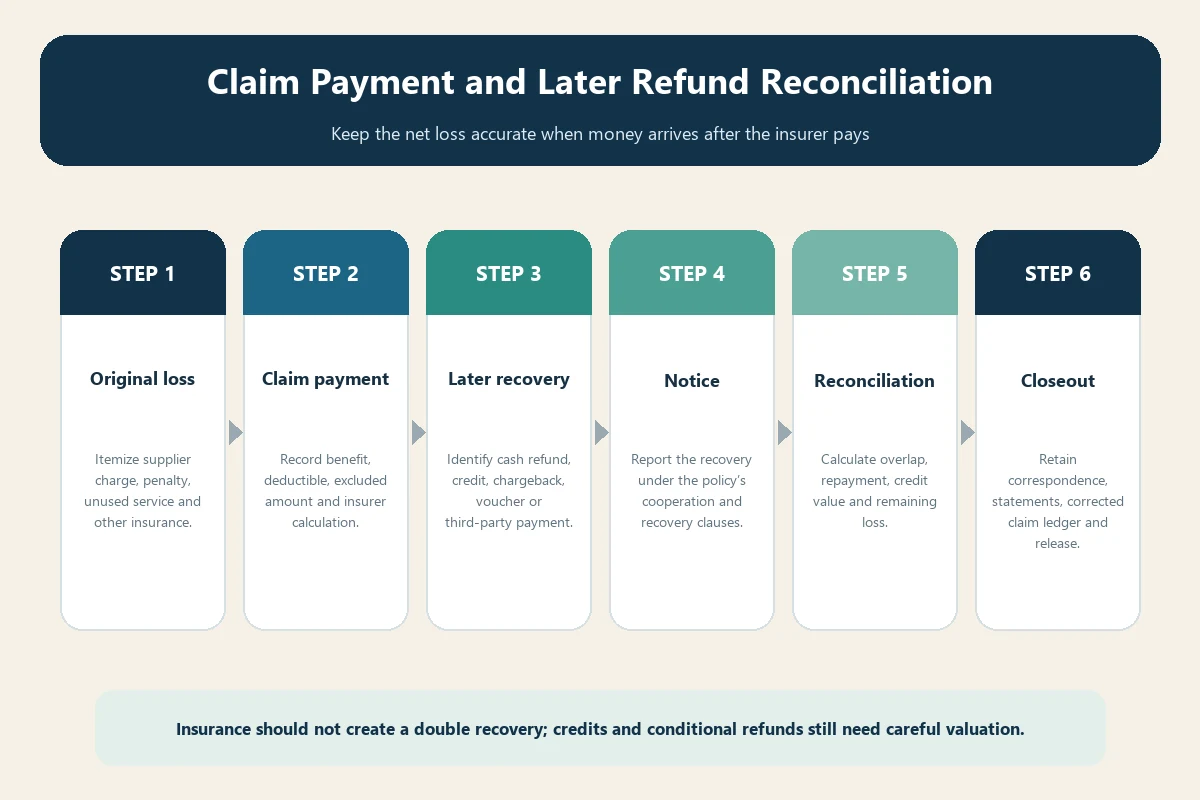
- Locate the original claim payment statement and identify the exact covered loss lines.
- Download the supplier, card, provider, or payer record showing the later amount and date.
- State whether the payment is final, provisional, restricted, partial, or in another currency.
- Match it to the corresponding cost rather than the trip total.
- Calculate the revised net loss without deciding the carrier’s legal allocation.
- Send the reconciliation through the claim portal and request written confirmation.
Use the same document controls described in our travel insurance claim guide. If an interrupted trip produced unused bookings and new return transportation, keep those categories separate.
Example: partial overlapping refund
A traveler paid $1,200 for a covered booking and initially received no supplier refund. The policy paid $900 after a $300 deductible. Later, the supplier returns $500. The revised net loss is $700, but the traveler should not assume the entire $500 automatically belongs to the insurer or that only $200 is due. Deductible priority, recovery costs, policy wording, and state law can affect allocation. Send the figures and request the carrier’s written calculation.
Example: refund for a different expense
A cancellation claim includes a $600 flight and $1,000 tour. The insurer pays only the tour line because the flight was excluded or pending. A later $400 airline refund does not necessarily reduce the tour loss. The reconciliation should show which line received the recovery and what the insurer previously paid. Clear attribution prevents a trip-level credit from being applied twice.
Deadlines still matter
Do not wait for every supplier to decide before notifying the insurer. Open the claim, disclose pending refund requests, and supplement the file. Follow the separate clocks in our notice-of-claim and proof-of-loss guide. Record when each supplier response is due and when each recovery actually posts.
If the insurer requests repayment
Ask for the policy provision, original payment breakdown, recovery record, allocation method, and amount due. Compare the demand with the actual claim and later refund. Correct factual errors promptly. Do not ignore the letter, spend disputed funds without planning, or send sensitive information through an unverified contact.
Confirm the request through the insurer’s published phone number or authenticated portal. If the amount or legal basis remains disputed, use the internal review process and consider the state insurance department or qualified legal counsel. Fraudulent recovery demands can imitate real insurer communications.
FAQ
Can I keep an airline refund after travel insurance paid?
Do not assume so. Report the refund and let the carrier apply the certificate, its payment breakdown, and applicable law.
Does a voucher count as a refund?
Policy treatment varies. Provide the voucher terms, restrictions, expiration, and whether it was accepted or used.
Can the insurer contact the supplier?
A recovery or subrogation clause may permit contact or require cooperation. Review the issued certificate and any authorization request.
Will I recover my deductible if the insurer collects?
Possibly, but priority and allocation vary by contract and law. Ask for the carrier’s written recovery calculation.
Bottom line
A travel claim is not always finished when the insurer pays. Later supplier refunds, chargebacks, medical reprocessing, and third-party recoveries can change the net loss. Preserve rights, disclose pending and completed recoveries, match every payment to the correct expense, and obtain a written reconciliation before returning or retaining disputed funds.
Sources
- NAIC — What to Know About Travel Insurance
- NAIC — Travel Insurance Model Act
- New York DFS — Travel Insurance
- California Department of Insurance — Travel Insurance Guide
- U.S. Department of Transportation — Airline Refunds
- CFPB — Disputing a Credit Card Charge
Reviewed August 16, 2026. This guide is general educational information, not legal advice. Recovery rights and duties depend on the issued policy and applicable law.
