
A travel insurance claim payment to a foreign bank account requires more than entering an overseas account number. Confirm that the insurer supports the country and currency, that the account belongs to the approved payee, and that the receiving bank has supplied the exact incoming international-transfer instructions.
Do not substitute an IBAN, SWIFT BIC, wire routing number, ACH routing number, card number, or correspondent-bank account for another field. This U.S.-focused guide is general information, not banking, sanctions, legal, tax, foreign-exchange, cybersecurity, or insurance advice.
Ask whether foreign-bank payment is supported
Before sending sensitive details, ask the claim administrator to confirm in writing:
- countries and territories it can pay;
- supported bank-account types and currencies;
- whether it uses wire, EFT, ACH, check, card, wallet, or a payment vendor;
- who must own the receiving account;
- minimum or maximum transfer amounts;
- sender, intermediary, receiving-bank, and currency fees;
- required identity, residency, tax, and bank verification;
- expected value date, tracking record, and return process.
Approval of the claim does not prove that every delivery method is available. Obtain the written claim decision and net amount separately.
| Payment term | What it identifies | Common mistake |
|---|---|---|
| ACH routing number | U.S. automated-clearing route | Using it as an international wire code |
| Wire routing number | Bank route for domestic wire | Assuming it equals ACH routing |
| SWIFT/BIC | International bank or branch identifier | Treating it as the beneficiary account |
| IBAN | Standardized international account identifier in participating countries | Inventing one for a country that does not use it |
| Correspondent bank | Intermediary in the transfer path | Naming it as final beneficiary bank |
| Value date | Date funds are applied in the payment chain | Confusing it with claim approval date |
ACH and international wire are different routes
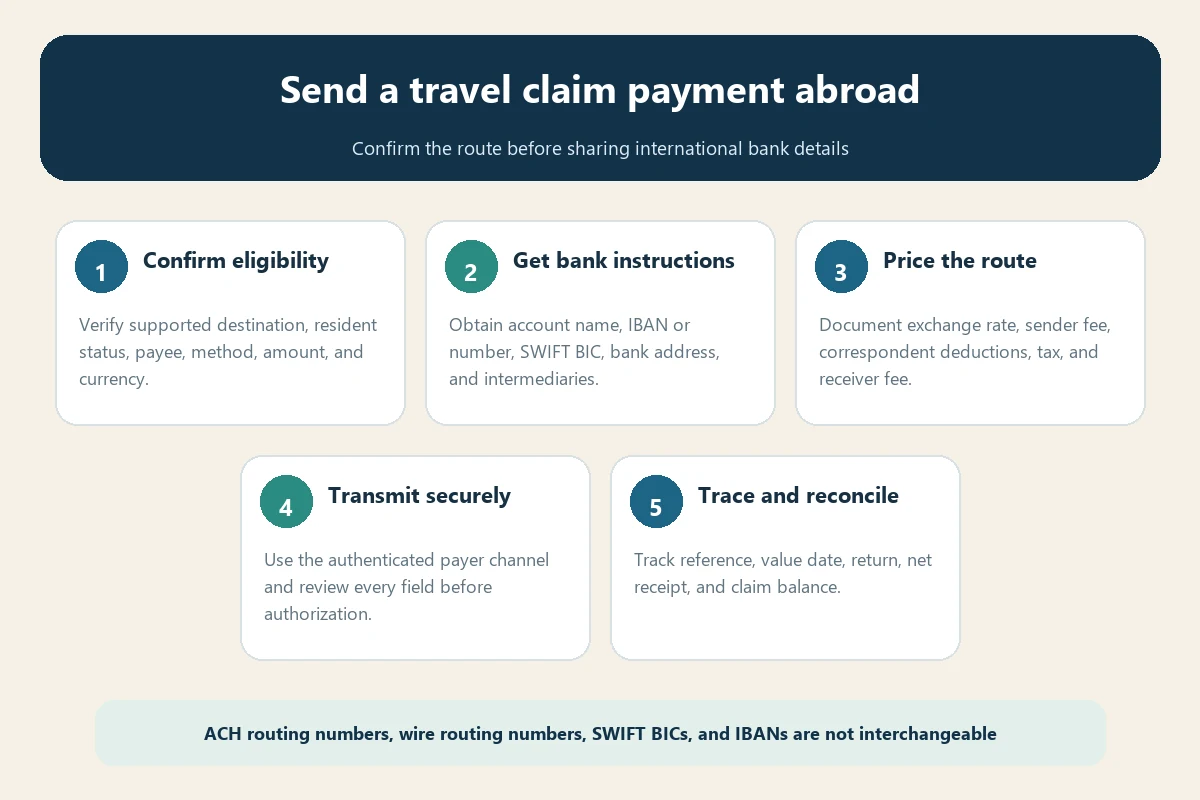
ACH is a U.S. payment network. An international payment may instead use a wire network, a correspondent bank, a local clearing partner, or a specialized disbursement platform. Even a bank with a U.S. brand may provide different instructions for its foreign affiliate.
Use the claim payment method guide for the basic check-versus-transfer decision. For foreign payment, add country, currency, correspondent, beneficiary-bank, and cross-border compliance fields.
Get official incoming instructions from the receiving bank
Ask the receiving bank for a written incoming international wire or transfer instruction sheet. It may include the beneficiary’s exact legal name and address, account number or IBAN, bank name and address, SWIFT BIC, branch code, currency, intermediary bank, correspondent account, payment purpose, and reference format.
Confirm which fields are mandatory and whether the account can receive the proposed currency. Do not rely on a blog, old transfer receipt, or instructions for a different branch. Review every character, including zeros, letters, spaces, and country-specific check digits.
Match the beneficiary to the approved payee
The insured traveler, policy purchaser, claimant, person who paid the loss, provider, beneficiary, estate, employer, or assignee may differ. A convenient overseas account owned by a relative does not automatically become an authorized claim destination.
Ask whether the account title must exactly match the claim payee and what transliteration or name evidence is accepted. The claim name mismatch guide helps align passport, policy, claim, bank, and payment-vendor identities.
If another person or provider is to receive payment, use a documented alternate-payee or assignment process. Do not misstate account ownership to pass automated verification.
Confirm country and legal restrictions
A payer or bank may be unable or unwilling to send funds to a country, institution, person, or currency because of sanctions, licensing, internal risk, correspondent availability, capital controls, or local law. Do not use an intermediary person or false address to evade a restriction.
Ask the payer to identify the practical restriction and approved alternatives. For a material issue, obtain advice from professionals familiar with the relevant U.S. and destination-country rules.
Policy wording can define an alternate payee route
An actual U.S. travel protection policy form illustrates why wording matters: its foreign-national payment section describes an alternative involving a U.S. bank account or payment to another insured when direct payment is unavailable because of legal restrictions. This is one contract, not a universal rule. Review the cited Zurich American travel protection form only as an example, then read the policy actually issued for the claim.
If the payer proposes payment to another insured, ask about authority, receipt, transfer obligation, fees, exchange risk, tax reporting, and proof that the intended beneficiary ultimately received the funds. Obtain legal advice before accepting an indemnity or release.
Choose the payment currency deliberately
The claim may be calculated in U.S. dollars even when expenses and the receiving account use another currency. Ask whether the insurer sends USD or local currency, who performs conversion, which rate and time apply, and where the spread appears.
The claim currency exchange-rate guide helps reconcile expense-date conversion, policy calculation, payment conversion, and bank conversion as separate events.
A USD account abroad can avoid one conversion but may still incur wire and correspondent fees. A local-currency account may involve conversion by the sender, processor, intermediary, or receiving bank.
Calculate the expected net receipt
Build a before-and-after payment statement:
- approved claim amount and currency;
- sender transfer fee;
- exchange rate and currency spread;
- intermediary or correspondent deductions;
- receiving-bank fee;
- foreign tax or levy, if applicable;
- expected amount and currency credited.
The CFPB explains that recipients of international money transfers can receive less because of third-party, receiving-bank, or foreign-tax deductions and that covered remittance transfers can have disclosure and error rights. See the official CFPB international transfer amount guidance.
A claim payout is not necessarily a consumer remittance transfer covered in the same way; ask which entity initiated the transfer and which law or agreement governs. The disclosure logic remains useful for reconciliation.
Use the payer’s secure submission channel
International instructions contain high-risk financial data. Submit them through an authenticated claim portal or another verified protected channel. Confirm the legal payment vendor before following an email link.
Do not provide a bank password, PIN, card security code, one-time authentication code, or remote device access. The claim payment scam guide covers changed bank details, impersonation, urgent verification, and fake release fees.
Review the final instruction before authorization
Ask for a masked confirmation showing beneficiary, bank, account ending, SWIFT BIC, currency, amount, reference, and expected date. Compare it with the receiving bank’s instruction sheet. Correct errors before release.
A current U.S. university travel-insurance claim guide illustrates the data fields: country, currency, account holder, account number, SWIFT code, bank address, and other relevant codes, while warning that a bank or intermediary may withhold fees. See the official University of California claim portal guidance. Its process is not binding on other insurers.
Obtain a usable transfer trace
After release, obtain the transfer reference, sending institution, value date, amount and currency sent, beneficiary data used, and any bank message or trace document available. Ask the receiving bank which reference it needs to research nonreceipt.
Track scheduled, sent, intermediary, credited, returned, held, rejected, and recalled as separate states. “Paid” in the claim portal does not prove final receipt.
Investigate a short or missing payment
If the net credit is short, compare sender amount, disclosed fees, correspondent deductions, receiving fee, exchange rate, and tax. Ask each institution to identify its own entry rather than attributing the difference generally to “bank fees.”
If nothing arrives, provide the trace to the receiving bank and ask whether the transfer is pending, held for information, posted elsewhere, rejected, or returned. Then ask the payer’s treasury team for the matching outbound or return record.
If a bank rejects and returns the payment, follow the returned claim payment guide for reconciliation and secure reissue, while recognizing that international wire return references can differ from ACH.
Consider a U.S. account or check alternative
If foreign transfer is unsupported or disproportionately costly, ask whether the claimant’s own eligible U.S. account, a mailed check, or another approved disbursement method is available. Confirm whether a U.S. check can actually be deposited abroad before selecting it.
Do not open or use another person’s account solely to bypass payee controls. For a mailed instrument, confirm international delivery, tracking, expiration, foreign collection time, fees, and replacement.
Preserve tax and reporting records
Keep the claim decision, transfer instruction, exchange disclosure, trace, bank credit, fees, conversion, and any tax form. The country of the account does not by itself decide the claimant’s tax treatment, residence, or reporting obligations.
If a W-9, W-8 series form, 1099, withholding, or foreign reporting issue arises, consult qualified tax professionals. Do not rely on a bank service representative for the insurance payment’s tax characterization.
Escalate with the complete payment chain
If the payer will not trace or correct a foreign transfer, send one timeline containing the decision, supported method, bank instructions, masked confirmation, transfer reference, fees, receiving-bank response, return or hold, and requested remedy.
The NAIC state insurance department directory links to U.S. insurance regulators. Banking, remittance, sanctions, or foreign-institution disputes may require different authorities. Identify which party made the contested decision.
Bottom line
For a travel insurance claim payment to a foreign bank account, confirm support before sending financial data. Match the beneficiary to the approved payee, use the bank’s official international instructions, document currency and deductions, transmit securely, obtain a trace, and reconcile the net credit. If the route fails, replace it only after the original transfer is located or returned.
