
If a travel insurance claim W-8BEN expired, do not simply change the date on the old file. Confirm the beneficial owner, current foreign status, payment category, treaty claim, signature date, ordinary validity period, changes in circumstances, correct replacement form, secure submission, withholding, and Form 1042-S follow-up.
A certificate can become unreliable before its ordinary expiry if relevant facts change. Conversely, some documentation arrangements may have special validity rules. This U.S.-focused guide is general information, not tax, legal, immigration, accounting, or insurance advice.
Obtain the exact certificate the payer has
Ask the insurer or withholding agent for the form version, beneficial owner, claim reference, payment component, signature date, received date, expiry recorded in its system, and reason it now considers the certificate expired or unreliable.
| Review field | Evidence | Question |
|---|---|---|
| Signature | Final signed certificate | When did validity begin? |
| Recipient | Beneficial-owner and payee records | Does the form cover this payment? |
| Purpose | Chapter and income documentation | Which rule is the payer applying? |
| Treaty | Country, article, rate, conditions | Is the claim still supportable? |
| Changed facts | Address, status, ownership timeline | Did reliability end early? |
| Payment | Hold, withholding, and reporting record | What practical action followed? |
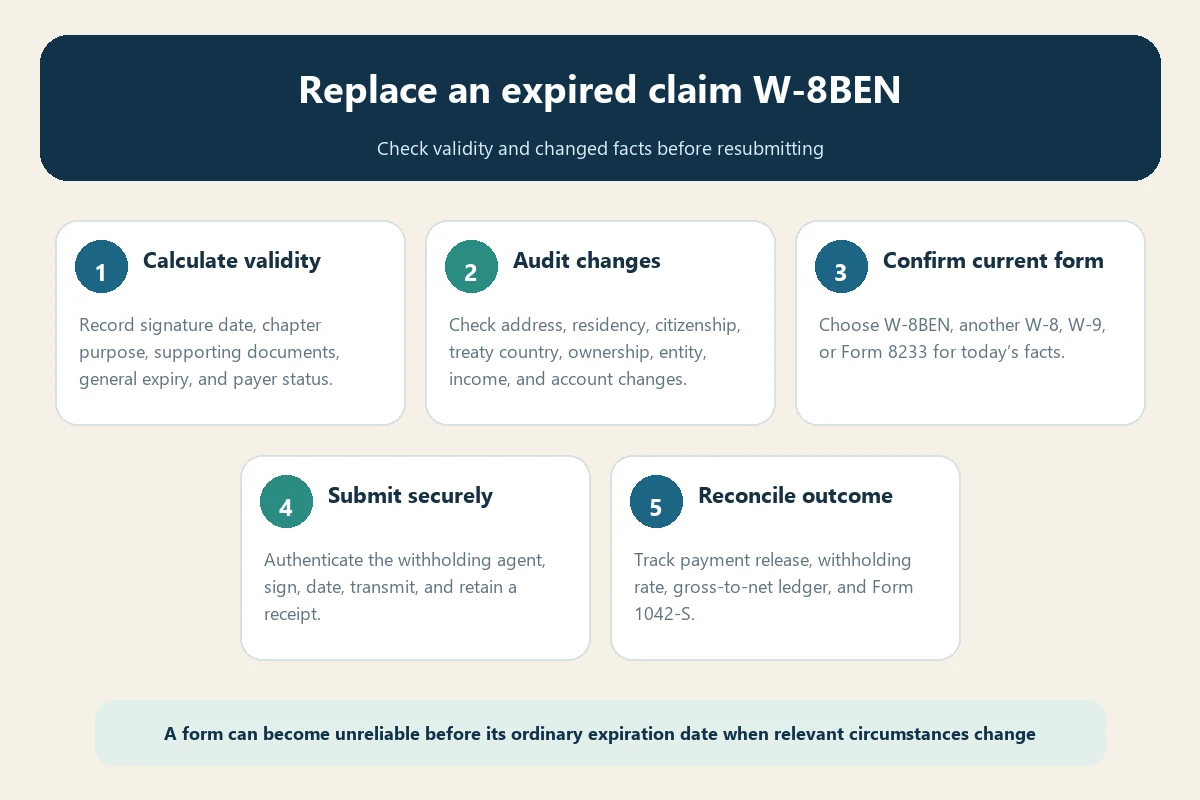
Calculate the general validity period correctly
The IRS Instructions for Form W-8BEN state that the form generally remains effective from its signature date through the last day of the third succeeding calendar year, unless a change in circumstances makes information incorrect.
That is not the same as three years from the signature anniversary. For example, a form signed during a calendar year generally runs through December 31 of the third succeeding year under the general rule. Ask the payer to show its date calculation.
Do not assume every W-8BEN expires on the same schedule
The requester instructions describe circumstances in which specified forms and documentary evidence can remain valid differently, subject to conditions and changes in circumstances. Chapter 3 and chapter 4 purposes can also matter.
Do not tell the payer its record is wrong based only on a generic expiry calculator. Ask which rule, payment, documentation package, and chapter it applies, then have a cross-border adviser confirm the result.
A change in circumstances can end validity early
A certificate that has not reached its ordinary calendar expiry may still become unreliable. Changes can affect foreign status, treaty residence, beneficial ownership, entity classification, income connection, or other certified facts.
The IRS instructions state that when a change makes information incorrect, the person must notify the withholding agent, payer, or relevant financial institution within 30 days and provide a new W-8BEN or other appropriate form.
Review address changes carefully
A move to a U.S. address can be a change in circumstances for a certificate of foreign status. A move between foreign countries can affect a treaty claim even when it does not by itself change every aspect of foreign status.
Record the actual move date, tax residency, mailing address, permanent residence address, and date the payer was notified. Do not use a mail-forwarding or bank address to conceal the facts.
Check whether the claimant became a U.S. person
Citizenship, residency, substantial presence, elections, and other rules can affect whether Form W-8BEN remains appropriate. A U.S. citizen living abroad generally does not use W-8BEN merely because the address is foreign.
If the current recipient is a U.S. person, the claim W-9 request guide explains the separate verification route. Obtain qualified advice before replacing one certification with another.
Recheck the beneficial owner
A claim may pass from an individual to an estate, trust, business, provider, attorney, or another traveler. Marriage, death, assignment, settlement, subrogation, or joint ownership can change who owns the payment.
The original individual W-8BEN should not automatically be reused when the legal recipient changes. Ask the payer to identify the beneficial owner and form required for the current disbursement.
Joint ownership requires current documents
When two travelers or owners share the payment, the payer may need documentation for each. One owner’s expired or changed certificate can affect the payer’s treatment of the account or payment.
Request a written allocation and owner list. Do not sign for another owner without documented legal authority or assume a joint bank account establishes beneficial ownership.
Reevaluate the treaty claim
A move outside the treaty country, change in tax residency, different income category, new treaty article, or loss of a required condition can invalidate the old reduced-rate claim even before ordinary expiry.
The IRS page on claiming treaty benefits provides general guidance. Confirm the current country, article, rate, TIN requirement, beneficial ownership, and limitations with a professional.
The payment component may have changed
An original claim reimbursement can later become a settlement with interest, attorney-related proceeds, or another component. A certificate used for one category may not support a new treaty or withholding position.
The claim interest guide separates delayed-payment interest from principal. Ask which exact amount the replacement certificate will cover.
Confirm the correct replacement form
Do not assume the replacement must be another W-8BEN. Current facts may call for W-8BEN-E, W-8ECI, W-8EXP, W-8IMY, W-9, Form 8233, or other permitted documentation.
The IRS Instructions for Requesters of Forms W-8 explain when a withholding agent should request a new form, including expiry, incomplete reduced-rate claims, and known changes in circumstances.
Never alter the old signed form
Do not overwrite the signature date, edit treaty fields, or reuse an old PDF under a new filename. Complete the current official form using current facts, sign and date it properly, and retain the prior certificate as historical evidence.
An altered tax certificate can create serious accuracy and fraud concerns. If the payer’s portal prepopulates stale data, require a correction before certification.
Authenticate a renewal request
Tax-form renewal messages are useful phishing lures because they create urgency and request valuable identity data. Independently verify the legal payer, withholding agent, domain, claim reference, contact, and secure portal.
The claim W-8BEN request guide covers requester authentication, form selection, treaty fields, electronic signature, and submission receipts.
Submit through a secure channel
A completed W-8BEN can contain legal name, address, foreign TIN, U.S. TIN, birth date, treaty details, and signature. Do not send it through ordinary email or an unverified file-sharing link.
Use the authenticated portal, approved encrypted transfer, or verified postal process. Keep a receipt showing form type, signature date, receiving entity, and claim reference without exposing full taxpayer identifiers.
Ask how expiration affected payment
Determine whether the payer placed the claim on hold, applied a presumption, changed the withholding rate, released a partial payment, or created a tax form. Request the exact event date and system status.
A documentation hold should be separated from the merits of the insurance claim. Ask for a written claim decision, payment approval, tax-document deficiency, cure steps, and expected release date.
Do not accept an unexplained withholding rate
If the payer says expiration requires 30% or another rate, ask it to identify the reportable payment, gross base, source, withholding chapter, presumption rule, and why the replacement documentation was not accepted in time.
The claim tax withholding guide helps reconcile rate, base, tax, form, and net funds. An expired certificate does not prove the entire claim amount belongs in the withholding base.
Track the Form 1042-S record
Ask whether the payer has issued or will issue Form 1042-S and which gross amount, income code, exemption code, rate, tax, country, recipient, and year it will report.
The claim Form 1042-S guide explains how to reconcile the certificate and payment. A replacement W-8BEN may not automatically correct a form already filed.
Request a formal correction when needed
If the payer used stale status, the wrong treaty country, incorrect recipient, gross amount, rate, exemption, or tax, ask its international tax-reporting team for the formal correction procedure.
Obtain written confirmation when payer records and the recipient statement are updated. Keep both versions and the replacement certificate to preserve the audit trail.
Send a precise renewal response
Ask the payer to confirm:
- the old form’s signature and calculated expiry dates;
- the change in circumstances, if any;
- the current beneficial owner and payment component;
- the correct replacement certificate;
- treaty article, rate, and required identifiers;
- secure submission route and receipt;
- payment hold and release timeline;
- withholding calculation; and
- Form 1042-S and correction plan.
Watch for fake expiry notices
A scammer may claim the form expires within hours, demand passport and banking credentials, or require a tax-release fee. Verify the insurer independently and never provide remote access, one-time codes, gift cards, wire, or cryptocurrency.
The IRS warns about fake W-8BEN scams. Compare any attachment with the official form and avoid links in unexpected renewal messages.
Keep a certificate history
Retain every W-8 certificate, supporting documentation, signature and receipt dates, expiry calculations, change notices, residency and treaty advice, payment holds, withholding ledgers, Forms 1042-S, corrections, and tax workpapers.
The file should show which certificate governed each payment, when circumstances changed, when the payer was notified, and how withholding and reporting were resolved.
Bottom line
When a W-8BEN expires during a travel insurance claim, calculate validity accurately and audit current facts before resubmitting. Replace the certificate securely when required, document changes within the applicable timeframe, and reconcile the payment hold, withholding, and Form 1042-S with qualified cross-border advice.
