

Travel insurance illusory coverage arbitration disputes ask whether a promised benefit can ever result in claim payment or whether exclusions and conditions completely erase it. They also ask who decides that coverage question when the policy contains an arbitration provision.
This U.S. guide provides a document-first method for testing alleged illusory coverage without confusing a narrow benefit with no benefit at all. It separately addresses arbitration formation, scope, delegation, procedure, and remedies. It is educational, not legal advice.
Start with the exact alleged promise
Identify the specific benefit claimed to be illusory: trip cancellation, interruption, delay, baggage, emergency medical, evacuation, accidental death, rental car, or another coverage. Quote the insuring agreement and benefit limit.
State the theory precisely. Does an exclusion eliminate every possible covered event, does a condition make payment impossible, or does risk never attach during the period for which premium was charged?
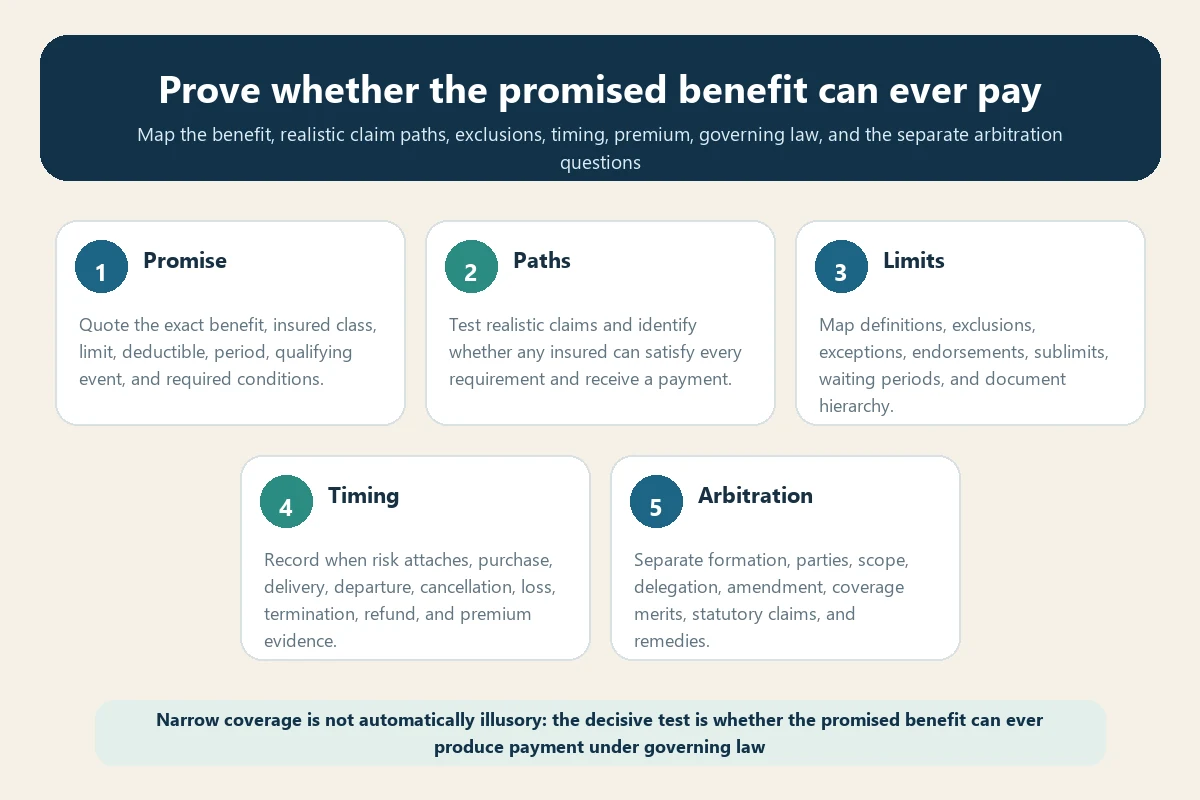
Do not equate limited coverage with illusory coverage
A policy can cover only named events, impose deductibles, cap payment, exclude pre-existing conditions, or require documentation and still provide real value. An unfavorable result on one claim does not prove the benefit could never pay. First compare the actual rationale with the travel-insurance claim-denial guide.
The inquiry generally requires testing the benefit across the full set of events it purports to cover, not only the traveler’s facts.
Collect the complete policy package
Preserve the certificate, declarations or schedule, benefit table, definitions, exclusions, conditions, endorsements, amendments, application, confirmation, and incorporated documents. Match form numbers, revision dates, state, plan, insureds, and coverage dates.
An endorsement may restore, narrow, or replace printed terms. Use the incorporation-by-reference guide for external terms and arbitral rules.
Build a benefit-to-exclusion map
Place the insuring promise in the first column. In later columns list every definition, exclusion, exception, condition, sublimit, deductible, waiting period, and eligibility rule that can affect it.
For each restriction, identify what remains covered. If realistic claim scenarios survive, the provision may be narrow rather than completely nullified.
Test at least three plausible claim scenarios
Create examples inside the benefit’s stated purpose: a qualifying illness, covered carrier delay, documented baggage theft, or ordered medical evacuation. Apply all policy requirements to each scenario.
Do not invent facts to force payment. The purpose is to see whether a genuine path to coverage exists under the issued words.
Identify when risk attaches
Separate pre-departure and post-departure benefits. Record purchase, effective date, scheduled departure, actual departure, cancellation, expiry, and termination. Determine when each risk begins and ends.
A traveler who never departs may not experience post-departure risks. That fact alone does not prove the promise was impossible when issued, but premium and attachment allegations require careful chronology.
Allocate the premium only with evidence
Preserve the total premium, taxes, fees, plan components, refund provision, review period, and any filed rate material available through lawful channels. Do not assume the premium was divided equally among benefits.
If the theory concerns premium for a risk that never attached, identify the legal and actuarial basis for allocation. A bundled price does not reveal each component’s value by itself.
Check state travel-insurance statutes
Travel insurance is regulated primarily through state law. Definitions and prohibited sales practices can be unusually specific, so use the law applicable to the purchaser and issued form.
South Dakota’s official statute identifies offering or selling illusory travel insurance as an unfair trade practice and defines it as a policy that could never result in payment of any claims for any insured. Review the current text in the South Dakota codified laws.
Compare another state without generalizing
Delaware’s official travel-insurance legislation similarly addresses a policy that could never result in claim payment and also discusses consistency between pre-purchase marketing and the policy. See the Delaware General Assembly session law.
These sources demonstrate statutory treatment, not a universal definition. Confirm codification, effective date, amendments, regulator guidance, and the governing state.
Use judicial doctrine for the correct proposition
An official Eleventh Circuit insurance decision applying Georgia law discusses whole-contract construction and warns against interpretations that provide largely illusory coverage.
Another official Eleventh Circuit decision applying Florida law distinguishes an exclusion that removes a subset of claims from one that retracts the same right supposedly granted. Confirm jurisdiction and later history before relying on either.
Distinguish contradiction from ordinary exclusion
An exclusion normally defines the boundary of insurance. The stronger illusory-coverage argument arises when one clause expressly grants a benefit and another completely takes that same benefit away.
Quote both provisions side by side. Test whether they can be harmonized and whether any covered scenario survives without rewriting either clause.
Test ambiguity separately
Illusory coverage and ambiguity are not identical. Clear words might allegedly eliminate a promised benefit, while ambiguous words might still permit real payment under either reasonable reading.
Use the policy-ambiguity arbitration guide to apply the governing interpretive sequence before asserting uncertainty.
Keep contra proferentem distinct
Construing unresolved ambiguity against a drafter may preserve coverage, but the canon’s trigger and order vary by jurisdiction. It does not itself prove that coverage was illusory.
The contra proferentem arbitration guide separates authorship, genuine ambiguity, extrinsic evidence, and forum questions.
Audit marketing and policy consistency
Save the benefit summary, advertisements, comparison tables, sales scripts, checkout pages, and fulfillment materials. Identify statements that describe a benefit the contract allegedly makes impossible.
Marketing evidence can support a separate statutory or misrepresentation theory, but it should not silently replace the policy. Record speaker, date, audience, exact words, authority, and reliance. The reasonable-expectations arbitration guide provides the separate transaction-evidence analysis.
Separate policy coverage from arbitration promises
A benefit may allegedly be illusory while the arbitration agreement remains supported by the broader transaction. Conversely, an arbitration promise may be challenged as illusory because one party retains unrestricted power to change or avoid it.
Analyze the coverage promise and arbitration promise independently. They involve different words, consideration questions, actors, and remedies.
Apply the Federal Arbitration Act accurately
9 U.S.C. §2 addresses enforcement of written arbitration provisions involving commerce, subject to generally applicable contract grounds and other statutory terms.
It does not answer whether an insurance benefit is illusory. Determine FAA applicability, state contract law, insurance regulation, and any reverse-preemption issue with qualified counsel.
Test arbitration formation first
Preserve the offer, assent mechanism, delivery, incorporation, signatures or clicks, identity, authority, and version. Formation asks whether the relevant parties agreed to arbitrate.
A strong merits theory cannot substitute for missing formation evidence, and a formed arbitration agreement does not decide the merits.
Map scope clause by clause
Quote the claims covered, parties, transaction, carve-outs, survival terms, and forum language. Compare each pleaded claim—contract, statute, refund, misrepresentation, unjust enrichment, or declaratory relief—with the text.
Do not assume every dispute connected to a policy shares one arbitrability answer.
Keep delegation separate
Identify any provision assigning gateway questions to the arbitrator. Preserve incorporated rules, availability, clarity, and the specific challenge to delegation.
Map who decides formation, scope, enforceability, coverage, statutory claims, and remedies. The result can differ by issue.
Review unilateral amendment language
If one party can change arbitration terms, quote the exact power, notice requirement, effective date, limits, retroactivity, termination right, and any duty of good faith. Determine whether the challenged version was ever changed.
A reserved amendment power is not evaluated identically in every jurisdiction. Avoid declaring the promise illusory without applying the governing consideration and contract rules.
Preserve the claim chronology
Record purchase, delivery, review period, deposit, departure or cancellation, loss, notice, claim, requests, decision, appeal, refund request, arbitration demand, and court filing. Save complete communications and attachments.
The chronology reveals when risk attached, which form governed, whether premium was refunded, and when a dispute became subject to any amended arbitration term.
Create an impossibility matrix
Use columns for benefit promise, qualifying event, insured class, coverage dates, prerequisites, exclusions, exceptions, remaining payment path, governing law, evidence, decision-maker, and remedy.
Mark each path possible, impossible, disputed, or unknown. A conclusion of “never” requires stronger proof than evidence that payment is uncommon.
Connect the theory to a remedy
Specify whether the requested result is policy construction, benefit payment, premium refund, statutory relief, damages, severance, reformation, rescission, or an order concerning arbitration.
Even proof that one benefit is illusory may not invalidate unrelated benefits or the entire agreement. Analyze severability and causation under governing law.
Questions for qualified counsel
- Which state’s insurance and contract law governs?
- Can any insured ever receive payment under the disputed benefit?
- Does an exclusion completely nullify the insuring promise?
- When did risk attach, and what premium evidence exists?
- Who decides formation, scope, delegation, merits, and remedies?
- Which limitation and preservation deadlines apply?
Practical takeaway
Do not label travel insurance illusory merely because coverage is conditional, narrow, or denied on one set of facts. Identify the promised benefit, test realistic claim paths, map every exclusion, determine when risk attaches, and apply the governing state’s exact rule.
Then analyze arbitration as a separate contract problem. Formation, scope, delegation, amendment, forum, and remedies require their own evidence before the coverage merits can be assigned to the correct decision-maker.
A condition precedent may govern policy formation, attachment of risk, claim payment, or the timing of arbitration, and those categories produce different consequences. Use this travel insurance condition precedent arbitration guide to classify the clause, document compliance, identify the decision-maker, and test excuse, prejudice, waiver, and remedies.
Late notice does not have one nationwide consequence; the result can depend on governing state law, policy type, wording, reason for delay, actual prejudice, and burden of proof. Use this travel insurance notice prejudice arbitration guide to preserve the timeline, test harm, and separate coverage forfeiture from arbitration waiver and procedure.