
A travel insurance complaint closed with no violation usually means the state insurance department did not identify a breach of the insurance law, regulation, or policy term it reviewed on the available record. It does not automatically prove that every fact is correct, that the claim decision is economically fair, or that every private contractual or legal remedy has ended.
Read the closure letter together with the insurer’s response, the department’s stated authority, your issued policy, and the submitted evidence. Then decide whether a permitted rebuttal, internal appeal, corrected claim record, legal consultation, or simple file closure is appropriate. This guide is general information, not legal advice.
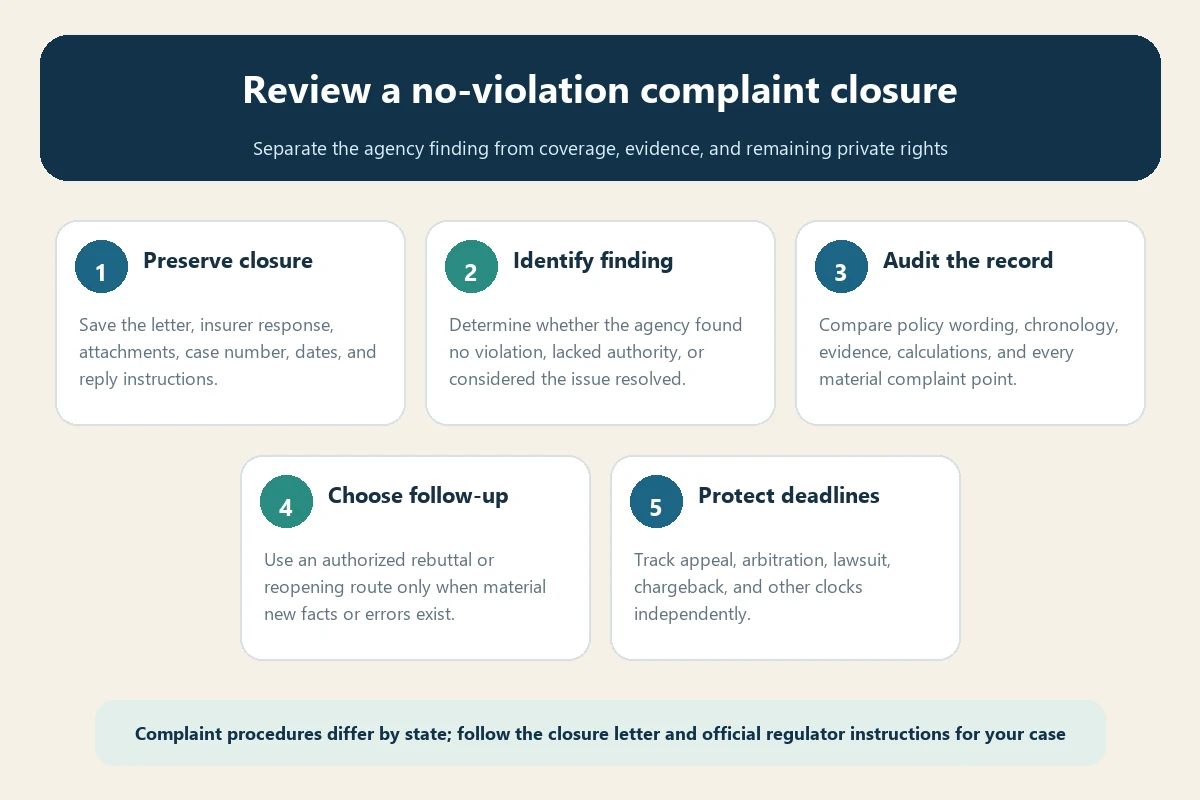
Preserve the complete closure package
Save the department letter or email, insurer response, attachments, complaint, rebuttals, portal messages, case number, delivery dates, and any instructions for adding information. Export the portal record before access expires and keep original files unchanged.
Create a one-page index showing who issued each document, its date, its purpose, and the exhibit number. The travel insurance claim status guide provides a practical format for tracking contacts, promises, submissions, and outstanding actions.
Identify exactly what the department decided
Do not reduce every adverse closure to “the regulator sided with the insurer.” The letter may state that no violation was found, the matter was resolved, the company followed the policy, the agency lacks jurisdiction, the evidence is inconclusive, another process controls, or the insurer must answer an omitted question.
The Illinois Department of Insurance complaint process distinguishes several outcomes. It explains that the department may request corrective action for a legal or policy violation, require a more complete company investigation, close a resolved matter, or issue an explanation when no violation is found.
No violation is not the same as no loss
A traveler can suffer a serious, documented financial loss while the policy excludes the cause or limits payment. A department may find no regulatory violation even when the result feels harsh. The question is generally whether regulated conduct and the issued contract were followed within the agency’s authority.
Separate the human impact, the coverage result, the handling conduct, and the legal finding. They can point in different directions without any one of them being fabricated.
Check whether the agency had jurisdiction
Confirm the state of policy delivery, purchaser residence, licensed underwriting company, producer, administrator, and the conduct under review. A state department may not control a policy issued elsewhere, a non-insurance travel waiver, an airline refund, a self-funded plan, or a private dispute already in litigation.
If the closure cites jurisdiction, ask which agency or process may be appropriate and whether the file can be transferred. The original state travel insurance complaint guide explains how to identify the licensed entity and correct regulator.
Read the insurer response line by line
Mark every statement as supported, disputed, irrelevant, or unanswered. Record the response page, policy citation, evidence citation, and the exact correction needed. Do not rely on tone or length as proof that the company answered the complaint.
Use the insurer complaint response review guide to build an issue matrix. A closure is easier to evaluate when each original question is paired with the insurer’s answer and the department’s treatment of that answer.
Confirm the correct policy form
Compare the form number, edition date, state endorsement, schedule, definitions, benefit, covered reasons, exclusions, limitations, deductible, proof requirements, and appeal clause. Check whether the insurer quoted the issued contract or a summary, sample, or later edition.
If the cited text is incomplete, quote the surrounding provision and attach the complete page. A different interpretation is not automatically a violation, but the actual contract must anchor the analysis.
Rebuild the chronology
List purchase, policy delivery, loss, notice, claim submission, each document request, each upload, complete-file date, decision, appeal, complaint, insurer response, and closure. Compare these dates with delivery receipts and portal confirmations.
Correct only material discrepancies. State the inaccurate date, the correct date, the exhibit, and why the difference affects the finding. Avoid alleging intentional falsification when the record supports only a clerical error.
Determine whether evidence was missing or rejected
A closure may rely on a record that lacked a medical statement, carrier confirmation, refund ledger, proof of purchase, or complete policy. Alternatively, the insurer may have received the document but found that it did not satisfy a definition or timing condition.
Those situations require different responses. Prove delivery when receipt is disputed; address the substantive objection when the document was reviewed and rejected. The travel insurance claim filing guide helps reconstruct the original evidence trail.
Recalculate every disputed amount
Build a worksheet for claimed cost, eligible cost, refunds, credits, other insurance, deductible, sublimit, currency conversion, depreciation if applicable, prior payment, and remaining difference. Match each reduction to a policy provision or documented recovery.
A mathematical or factual correction may be possible even when the broader coverage position remains unchanged. Ask for a reproducible calculation rather than asserting that the final number is wrong without showing why.
Understand what regulators generally can and cannot do
The NAIC complaint guide explains that state departments forward complaints, obtain insurer explanations, assess conduct under the policy, and can require correction when improper conduct is found. Authority and procedure still vary by state.
A department generally does not serve as the claimant’s attorney, rewrite unambiguous coverage, determine every contested fact, award all private damages, or pause court and contract deadlines. The exact closure letter controls what was—and was not—reviewed.
Look for a rebuttal or reopening route
Some departments allow additional written information; others treat closure as final unless the consumer supplies material new evidence or identifies a factual error. Follow the assigned analyst’s instructions instead of assuming a universal appeal process.
The Georgia insurance complaint instructions expressly state that a consumer who disagrees may send a written rebuttal and additional documentation to the assigned analyst, after which the agency may seek another detailed company response. That Georgia procedure is an example, not a nationwide right.
Use a materiality test before responding
A follow-up is most useful when it identifies a wrong policy version, demonstrably incorrect date, omitted decisive exhibit, arithmetic error, unanswered complaint point, new company rationale, or relevant evidence that could not reasonably be supplied earlier.
A repeat submission that restates disappointment without new facts or a specific error is less likely to change the review. Ask: if the reviewer accepts this correction, could the finding or required action change?
Write a concise closure rebuttal
Start with the case number, closure date, and one-sentence request. Number each disputed point. For each, cite the closure or company-response page, state the correction, attach the controlling exhibit, and explain the regulatory relevance.
- Identify the department case, policy, claim, and insurer.
- State which parts of the closure you accept.
- List material factual or record errors only.
- Quote short policy text with form and page.
- Identify new evidence and why it was not previously available.
- Request a specific review permitted by the department.
- Confirm that separate deadlines are being tracked independently.
Do not send unredacted banking credentials, passwords, one-time codes, or unrelated third-party medical records. Use the authorized secure channel and preserve proof of submission.
Do not confuse a complaint with an internal appeal
A regulator complaint examines conduct within public authority. An internal appeal asks the insurer to reconsider the claim under its contract and process. One does not necessarily replace or extend the other.
If the insurer’s appeal period remains open, use the denied travel insurance claim appeal guide to answer the exact denial reason with targeted evidence. Record both tracks separately.
Preserve every independent deadline
Do not assume the complaint, rebuttal, or request to reopen stops a contractual limitation period, statute of limitation, arbitration deadline, chargeback period, tax deadline, internal appeal clock, or supplier refund window.
The Texas Department of Insurance complaint guidance notes limits on its help, including cases where a lawsuit has been filed. That illustrates why regulatory and legal routes must be coordinated rather than treated as interchangeable.
Know when legal advice is warranted
Consult a qualified attorney promptly when a substantial amount is disputed, a deadline is near, the closure raises jurisdiction or preemption, fraud or bad faith is alleged, litigation or arbitration is contemplated, or the policy contains a suit-limitation clause.
Provide counsel with the complete indexed file, not a summary alone. The legal significance of a closure varies with the jurisdiction, wording, record, and procedural posture.
Close the file deliberately when no further action is justified
Not every adverse result supports another submission. If the policy wording is clear, the facts are accurate, the evidence was considered, the calculation is reproducible, and no authorized review route offers a material correction, record the outcome and stop accumulating repetitive correspondence.
Retain the policy, claim, appeal, complaint, insurer response, closure, payment record, and final chronology for tax, audit, renewal, or legal purposes. Note the date on which each remaining deadline expires.
Bottom line
When a travel insurance complaint is closed with no violation, identify the exact finding and authority, audit the insurer response against the policy and evidence, correct only material errors, use a rebuttal route only when the regulator permits it, and preserve every separate appeal or legal deadline. A disciplined closure review is more useful than treating the letter as either meaningless or conclusive.