

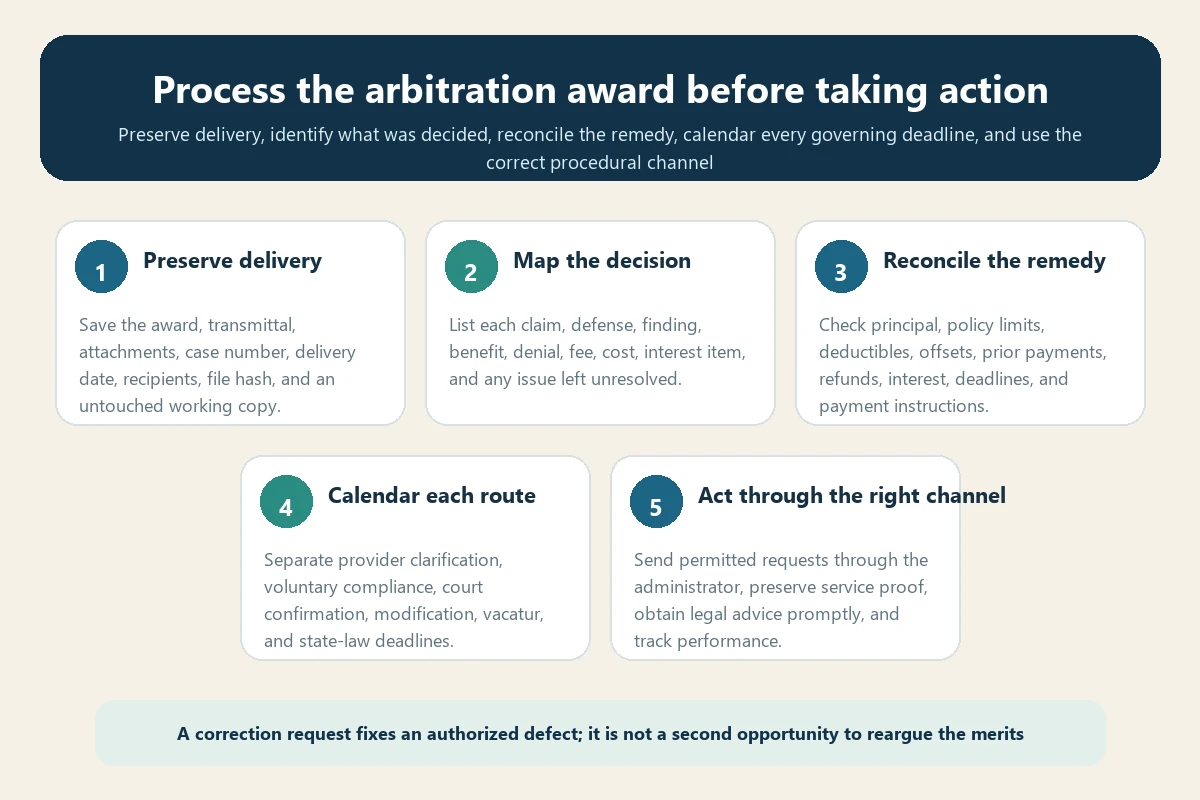
A travel insurance arbitration award is the arbitrator’s written decision on the submitted dispute. Receiving it is not the moment to send an emotional response or assume that “final” answers every procedural question. Preserve delivery, identify exactly what was decided, reconcile the remedy, and calendar each possible next step under the agreement, provider rules, governing law, and case-specific notices.
This guide explains a disciplined U.S. post-award workflow. It is general information, not legal advice. Arbitration and court deadlines can be short, jurisdiction-specific, and unforgiving, so obtain qualified advice promptly when correction, confirmation, modification, vacatur, collection, appeal, or settlement performance is in question.
Preserve the award and its delivery record
Save the original email or portal notice, every attachment, the case number, sender, recipients, transmission date and time, time zone, download history, and any electronic signature information. Keep the award in its native format and create a separate working copy for highlighting.
Record when the award was transmitted, filed, delivered, received, or served. Those words can start different clocks under different rules. Do not rename or overwrite the only copy, and do not forward confidential material outside the authorized team.
Confirm which rules govern the award
Collect the issued insurance policy, arbitration clause, amendments, submission agreement, administrator’s applicable rules, scheduling orders, hearing-closing notice, and award transmittal. The provider’s current public rules may differ from the version incorporated into the dispute.
For an AAA consumer matter, the current AAA Consumer Arbitration Rules address timing, form, scope, delivery, clarification, correction, confidentiality, and court applications. Other providers, state statutes, or contract terms may use different procedures.
Check the award date against the closing date
Under the May 2025 AAA consumer rules, an award is generally due no later than 30 calendar days after the hearing closes, or 14 calendar days in a documents-only procedure, unless the parties agree otherwise or law specifies another period. The AAA may extend that limit only in unusual and extreme circumstances.
Do not calculate this period only from the final live hearing. Authorized briefs, a transcript, record completion, or reopening can affect the closing date. The post-hearing brief guide explains how record closure differs from the last witness date, while the arbitration hearing guide shows which final orders, exhibits, and objections belong in the preserved case file.
Verify the form without guessing at the result
Check that the decision is written, signed as required, identifies the arbitration and parties, and contains the form of explanation required by the governing rules and agreement. Current AAA consumer rules generally call for a brief written explanation unless all parties agreed otherwise before the hearings closed.
A short explanation is not automatically defective, and a long explanation is not automatically complete. Compare the award with the required form rather than with a court opinion or a preferred writing style.
Build an issue-by-issue decision map
Create one row for every claim, counterclaim, defense, requested remedy, fee request, cost request, and reserved issue. For each row, record the amount or relief requested, what the award says, the disposition, the stated reason, and any ambiguity.
| Item | Question | Evidence |
|---|---|---|
| Coverage claim | Granted, denied, reduced, or not addressed? | Award page and paragraph |
| Contract defense | Accepted, rejected, or unnecessary to reach? | Finding or explanation |
| Principal amount | Exact amount and recipient? | Operative relief section |
| Interest | Rate, base, start date, and end date? | Award and governing authority |
| Fees and costs | Granted, denied, reserved, or allocated? | Final cost assessment |
| Performance | Deadline, method, condition, or reporting duty? | Ordered action |
Distinguish a final award from other decisions
An arbitration record can contain interim measures, procedural orders, partial awards, consent awards, and a final award. Do not assume every signed decision disposes of the entire case. Look for language identifying what remains open and whether the administrator considers the case concluded.
If a settlement was converted into a consent award, compare the operative terms with the signed settlement and allocation of arbitration costs. If the award is partial, track the remaining merits or remedy schedule separately.
Reconcile the dollar amount independently
Rebuild the arithmetic from source documents. List covered benefits, policy limits, deductibles, coinsurance, supplier refunds, credits, prior insurer payments, other recoveries, exchange rates, interest, attorney fees, arbitration costs, and the net amount ordered.
The partial-payment guide helps separate a previous undisputed payment from the remaining amount. Do not count an offset twice or treat the amount claimed as the amount awarded.
Separate clarification from reargument
Under current AAA consumer Rule R-49, the arbitrator or a party may request clarification or correction of clerical, typographical, technical, or computational errors within 20 calendar days after transmission. The other parties receive 10 calendar days to respond, and the arbitrator generally decides within 20 calendar days after receiving the request and responses through AAA.
That rule does not authorize the arbitrator to redetermine the merits of a claim already decided. A wrong total produced by an identifiable addition error differs from disagreement with how the arbitrator weighed evidence or interpreted coverage.
Write a precise correction request
Identify the award page and paragraph, quote only the necessary language, describe the exact defect, show the correct calculation or reference, state the narrow requested clarification, and explain why it does not reopen the merits. File through the case administrator and serve every required recipient.
Do not attach new proof unless expressly permitted. Do not contact the arbitrator directly. Preserve the submission receipt, service list, response, and modified or clarified award.
Do not merge provider and court deadlines
A provider-rule request and a court motion are different procedural routes. A pending clarification request may or may not affect another deadline. Never assume that asking AAA to correct a number pauses a statutory deadline.
The federal statute is only one possible framework. State arbitration law, federal jurisdiction rules, the agreement, the place of arbitration, and the nature of the transaction can change the analysis.
Understand the federal confirmation route
9 U.S.C. § 9 describes confirmation when the parties agreed that judgment may be entered on the award. It includes a one-year application period and court-location and notice provisions, but federal subject-matter jurisdiction is a separate question.
Confirmation converts an award into an enforceable judgment when the legal requirements are met. It is not the same as asking the administrator to transmit the decision or asking the insurer when it will pay.
Know that vacatur is a narrow legal route
9 U.S.C. § 10 lists federal grounds such as corruption or fraud, evident partiality, specified prejudicial misconduct, or an arbitrator exceeding powers. It does not provide a general appeal because a party believes the facts or policy were decided incorrectly.
Preserve the agreement, orders, objections, hearing record, exhibit rulings, disclosures, and award. The arbitrator selection guide explains why disclosure and conflict records should be kept from appointment through the final decision.
Calendar the federal service deadline immediately
9 U.S.C. § 12 states that notice of a federal motion to vacate, modify, or correct must be served within three months after the award is filed or delivered. Service rules matter; merely drafting or filing something somewhere may not satisfy the statute.
Do not treat “three months” as 90 days, and do not wait to resolve jurisdiction, venue, governing law, or service questions. Obtain advice as soon as the award arrives.
Request voluntary compliance in writing
If the award orders payment or another act, identify the responsible party, amount, deadline, payment method, tax documentation, release condition, account details, and contact. Send sensitive banking data only through a verified secure channel.
Ask for written acknowledgment and expected performance date. A payment inquiry should not waive rights, change the award, create an unauthorized release, or imply that a short payment fully satisfies the decision.
Track payment like a claim ledger
Record principal, interest through the payment date, fees, costs, offsets, payment reference, settlement date, cleared date, and remaining balance. Save remittance advice and bank evidence without publishing account information.
If the insurer pays less than the award, request an itemized explanation. Compare the shortfall with the operative language before deciding whether it is arithmetic, withholding, offset, timing, or noncompliance.
Protect confidential information
The arbitration confidentiality guide explains that provider confidentiality, party duties, public court access, and award publication are different issues. Current AAA consumer rules allow redacted publication of some awards and permit confidentiality orders, but applicable law or court proceedings can alter exposure.
Create a public-record strategy before filing an award, medical exhibit, policy, or bank document in court. Use lawful redaction and sealing procedures rather than assuming the arbitration label keeps every later filing private.
Preserve the complete post-award file
- Agreement, policy, endorsements, governing rules, and case orders.
- Closing notice, final transcript status, briefs, and proof of service.
- Original award, transmittal, metadata, signatures, and attachments.
- Issue map, arithmetic reconciliation, and deadline calendar.
- Clarification or correction request, response, and resulting decision.
- Payment demand, acknowledgment, remittance, cleared funds, and balance.
- Legal analysis, court papers, service proof, and judgment if applicable.
Use a calm first-48-hours sequence
- Preserve the original transmission and restrict access.
- Identify the governing agreement, rules, law, and delivery event.
- Map each claim, defense, remedy, fee, cost, and unresolved item.
- Recalculate the award and flag only objective discrepancies.
- Calendar provider, contract, statutory, and performance deadlines separately.
- Obtain qualified legal advice where court action or waiver risk exists.
- Send any permitted request through the correct channel with service proof.
- Track compliance without altering or releasing rights unintentionally.
Questions to answer before acting
- Is this the final award, a partial award, or another order?
- When and how was it transmitted, delivered, filed, and received?
- What did the arbitrator grant, deny, reduce, reserve, or omit?
- Does the arithmetic match the operative relief?
- Is the concern a correctable technical defect or disagreement with the merits?
- Which provider, contract, federal, state, and court clocks apply?
- What payment or performance is due, by whom, and when?
- What confidentiality, redaction, jurisdiction, venue, and service rules matter?
Bottom line
A travel insurance arbitration award should be processed as a controlled legal and financial record. Preserve delivery, confirm the governing framework, map every issue, reconcile the remedy, and calendar each procedural route independently.
Use clarification only for its authorized purpose, do not assume it pauses court deadlines, and distinguish voluntary payment from confirmation or enforcement. Fast, precise review protects more options than an immediate merits argument.
