
Before you appeal a state travel insurance complaint decision, determine what the state insurance department actually issued. A consumer-services closure letter, an informal explanation, a formal determination, and an administrative order can have very different review rights.
Do not assume every unfavorable complaint outcome can be appealed to a hearing officer or court. The available procedure comes from state law, the type of insurance, the agency’s authority, and the specific notice. Sometimes the practical next step is clarification or reopening; sometimes it is an insurer appeal, external review, formal administrative hearing, or legal action. This guide is general information, not legal advice.
Classify the document before choosing a remedy
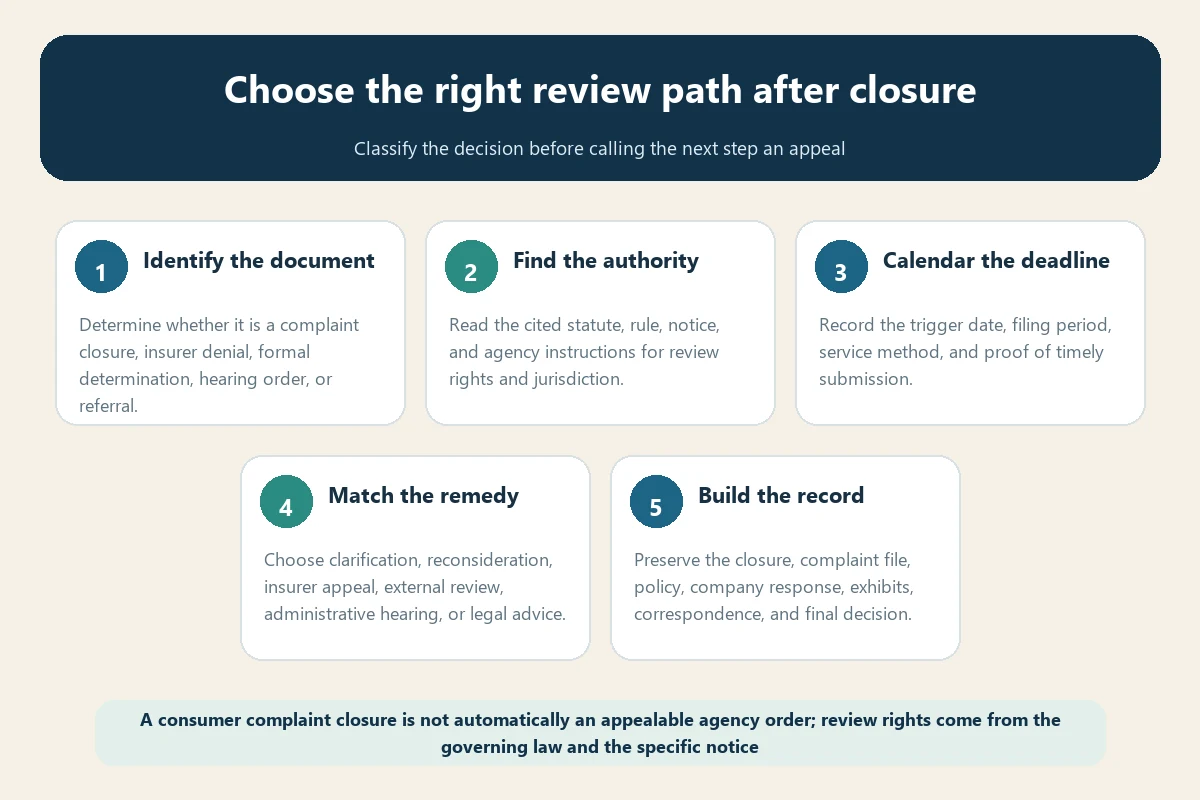
Read the heading, sender, signature, cited authority, findings, disposition, effective date, and review-rights paragraph. Look for terms such as “consumer complaint closure,” “informal assistance,” “determination,” “initial decision,” “final order,” “notice of hearing,” or “right to judicial review.” Do not rename the document yourself.
A routine complaint unit may collect the facts, obtain a company response, and assess compliance without adjudicating a private contract dispute. Washington’s Office of the Insurance Commissioner explains that its complaint process reviews whether a company follows state law and fair claims practices, but cannot act as the consumer’s lawyer or interpret policy language. The agency also adds complaints to the company’s official record.
Five documents that are often confused
- Insurer claim denial: the company’s decision under the travel policy, generally addressed first through the policy’s appeal or reconsideration process.
- Complaint closure: the regulator’s communication describing its consumer-assistance review and disposition.
- External review decision: a decision in a specialized process, most commonly associated with eligible health-plan disputes rather than ordinary travel insurance.
- Administrative determination or order: a document issued under specific statutory authority that may carry a hearing or appeal procedure.
- Court judgment: a judicial decision governed by court rules, not the department’s ordinary complaint portal.
The correct route follows the document, not the word “decision.” If the regulator merely relayed the insurer’s position, an administrative appeal may not exist. If the notice is a formal order, an informal email asking the examiner to reconsider may not preserve the formal deadline.
Read the review-rights notice line by line
Find who may seek review, what decisions qualify, where to file, the deadline, the triggering event, required form, service requirements, filing fee, signature, attachments, and whether representation is allowed. Preserve the envelope, portal timestamp, and email headers because receipt or service may start the clock.
If the notice is silent, ask the issuing office in writing whether the communication is final, whether a reconsideration or hearing procedure applies, and where the controlling rule is published. Ask procedural questions without assuming staff can give legal advice.
Why state examples cannot be generalized
California’s Administrative Hearing Bureau maintains an electronic portal for consumers and others who received certain decisions from an insurer, rating bureau, or Insurance Commissioner and wish to appeal or request a hearing. Its public portal also warns that submissions are public documents unless a judge orders otherwise.
That does not mean every California consumer complaint—or every travel insurance disagreement—belongs in the hearing bureau. California’s published “How to File an Appeal” page, for example, describes a specific workers’ compensation insurance policy appeal process with prerequisites, a defined form, and filing periods. Subject matter matters.
Michigan publishes another specialized route under its Essential Insurance Act complaint process. A party dissatisfied with a Review and Determination may request a formal appeal within the stated period, followed by a contested-case hearing before an administrative law judge and a final determination by the department director. Again, this is a defined Michigan eligibility process, not a nationwide appeal for ordinary complaint closures.
Review the official California Administrative Hearing Bureau portal, the California appeal instructions, and the Michigan Essential Insurance Act process as examples of why scope, prerequisites, and deadlines must be verified.
Separate an agency review from the insurer’s appeal
If the department found no apparent violation but the insurer still denies coverage, the policy appeal may remain the main path. Build it from the issued policy, denial language, chronology, benefit conditions, exclusions, and new evidence. The denied travel insurance claim appeal guide covers that insurer-facing record.
A regulator complaint does not automatically exhaust an insurer’s internal appeal. Conversely, finishing the insurer’s appeal does not automatically create a hearing right before the insurance department. Track each process independently.
Consider clarification before formal review
If the closure is ambiguous, ask the examiner to identify the disposition, issue reviewed, policy version, company response, and agency-authority limit. Point to any unanswered question without arguing the whole claim again. A clarification request can reveal whether the dispute concerns missing evidence, jurisdiction, contract interpretation, or conduct.
Clarification is not a substitute for a formal filing when a deadline is running. Send the required appeal or protective filing on time if applicable, even while asking for an explanation.
When a reopening request may fit better
If decisive evidence appeared after closure, the insurer failed to perform a promised resolution, or the closure relied on a demonstrable factual error, ask whether the existing complaint can be reopened or supplemented. The reopen travel insurance complaint guide explains how to connect the material change to the prior finding.
Reopening and appeal are not synonyms. Reopening asks the complaint unit to conduct more work in the same matter; an appeal asks an authorized reviewer to examine a decision under a governing procedure. Use the label chosen by the agency.
Build a decision-to-issue matrix
Create a table with one row per disputed point:
- Exact statement in the closure or order.
- Policy clause, statute, rule, or factual record involved.
- Why the point is wrong or incomplete.
- Exhibit that proves the correction.
- Requested finding or procedural action.
- Whether the issue falls within the reviewer’s authority.
A formal review is not improved by repeating every grievance. Lead with the strongest reviewable error and connect it to the record. Separate coverage disagreement, claims-handling conduct, jurisdiction, procedure, and remedy.
Assemble the administrative record
Preserve the original complaint, submission confirmation, all attachments, insurer response, department questions, your replies, closure letter, policy and endorsements, denial and appeal letters, claim notes you lawfully possess, and proof of service. Keep files in their original form and create a numbered working copy.
Ask what constitutes the official record and how to request it. Do not assume every internal agency note is available or that a public-record request pauses an appeal deadline. The complaint public-record and privacy guide explains retention, disclosure, redaction, and secure handling considerations.
Calculate the deadline conservatively
Write down the date on the decision, date sent, date received, service method, stated filing period, weekend or holiday rule, destination, and required proof. Do not guess whether the count begins on mailing, service, receipt, or issuance. Consult the governing rule and qualified counsel when necessary.
Some specialized state processes use very short periods. Their existence does not establish the period for your case, but it demonstrates why delay is risky. A phone call or reconsideration request may not extend the formal deadline unless the rule or agency confirms that effect.
Check standing, exhaustion, and finality
A review body may ask whether you are an affected party, whether required insurer procedures were completed, and whether the challenged document is final. It may reject a premature filing or one directed at a nonappealable communication.
Find the notice’s prerequisites. If exhaustion is required, document each insurer appeal level and final response. If immediate harm makes ordinary timing impractical, ask whether expedited or emergency relief exists; do not assume it does for travel insurance.
Use a precise filing statement
Re: [document title and case number], issued [date]. I request [the exact review authorized by the cited notice or rule]. The challenged finding is [brief quotation or description]. The record at Exhibits 1–3 shows [material fact or procedural error]. I request [defined outcome within the reviewer’s authority]. This filing is submitted under [cited authority] and within the stated period measured from [triggering event].
Only cite authority you have verified. If you cannot identify a formal appeal right, do not invent one; ask the department about available review and consider legal advice.
Protect privacy in a hearing or appeal
A complaint portal and hearing docket may have different disclosure rules. California’s hearing portal expressly warns that submissions are public documents unless otherwise ordered and tells users not to transmit confidential personal information through that interface.
Review redaction rules before filing medical, financial, passport, or identification records. Use only the evidence required, follow any protective-order procedure, and never assume a document remains confidential because it was confidential in the complaint unit.
Know the limits of the complaint process
The official Washington complaint-process explanation illustrates that regulators can review legal and fair-claims compliance while declining functions such as acting as counsel. Similar authority limits can shape the closure and the next forum.
The closed-no-violation complaint guide helps distinguish an agency’s enforcement conclusion from a judicial decision about private rights. A closure may still leave contractual remedies, but only timely action in the proper forum can preserve them.
If no formal appeal exists
Ask for clarification, correction, or reopening when supported; complete the insurer’s appeal; explore mediation or arbitration required by the policy; contact another agency with jurisdiction; or obtain legal advice about contract and judicial remedies. Choose based on authority and deadlines, not frustration.
If the department does not respond to a procedural inquiry, use the documented follow-up steps in the no state response guide. Keep the case number in every message and avoid duplicate submissions.
Frequently asked questions
Can every state insurance complaint closure be appealed?
No. Some closures are informal consumer-assistance outcomes rather than appealable orders. Review rights depend on the governing law and notice.
Is reopening the same as appealing?
No. Reopening asks for further work in the existing complaint; an appeal invokes a defined review process before an authorized decision-maker.
Does filing an appeal stop other deadlines?
Not necessarily. Continue tracking insurer appeals, contractual limitations, statutes of limitation, arbitration, and court deadlines unless controlling authority confirms otherwise.
Can I appeal directly to the Insurance Commissioner?
Only when a law or published procedure authorizes that route for the specific decision. A commissioner’s office is not a universal appellate forum for all claim disputes.
Should I send my entire claim file?
Follow the filing rules. Submit the required record and relevant exhibits, indexed and redacted. Excess material can obscure the reviewable issue and create privacy risk.
The safest approach is classification before escalation. Identify the document, verify the legal authority, calculate the deadline, match the remedy to the forum, preserve the record, and make a focused request. If the closure does not create a formal appeal right, choose an available alternative instead of filing into the wrong process.
