
A travel insurance arbitration closing argument should connect the evidence admitted at the hearing to each policy element, disputed fact, defense, damage calculation, and requested remedy. It is a synthesis of the completed record—not a second opening statement and not an opportunity to add a missing witness, document, or theory.
The arbitration agreement, governing rules, hearing order, and arbitrator’s directions control whether closing is oral, written, optional, timed, followed by rebuttal, or replaced by a post-hearing brief. Confirm the procedure before preparing. This U.S. consumer guide provides general information, not legal advice.
Confirm that the evidentiary presentation is complete
Before closing begins, confirm whether every intended witness has finished, every offered exhibit has a ruling, objections are resolved or reserved, and the arbitrator has addressed any authorized supplemental proof. Record which exhibits were admitted, limited, excluded, or withdrawn.
The FINRA single-arbitrator hearing script asks whether the parties have further evidence or testimony before closing and describes closing as a summation of what the party believes was proved. FINRA procedure does not govern an AAA travel insurance dispute, but its official hearing script illustrates the essential sequence: evidence first, summation after.
Use the final record, not the planned case
Rewrite the outline after the evidence closes. A witness may have answered differently than expected, an exhibit may have been limited, a stipulated fact may have removed an issue, or the arbitrator’s questions may reveal the real point requiring clarification.
Do not deliver the closing drafted before the hearing without checking it line by line. Replace “the evidence will show” with specific findings supported by the actual record.
Start with the decision the arbitrator must make
State the few questions that determine the result: whether the event is a covered reason, whether an exclusion applies, whether a condition or notice duty was satisfied, whether the event caused the loss, and what amount remains unreimbursed.
Then state the requested findings in the same order. This gives the arbitrator a direct path from contract language to facts and award.
Build an element-to-proof table
| Element or defense | Admitted proof | Requested finding |
|---|---|---|
| Policy and insured trip | Policy form and itinerary | Applicable coverage and dates |
| Covered event | Testimony and dated source record | Event falls within defined reason |
| Exclusion or condition | Policy language and chronology | Applies or does not apply |
| Causation | Cancellation and supplier records | Event caused the claimed loss |
| Amount | Payment, refund, and credit ledger | Net covered benefit |
Use exhibit numbers, page references, witness names, and testimony topics accurately. The witness testimony guide helps distinguish firsthand proof from assumption or repetition.
Anchor the analysis in the policy
Identify the issued form, relevant insuring agreement, covered reason, definition, exclusion, condition, proof requirement, benefit limit, and coordination provision. Explain how the admitted facts satisfy or fail each disputed component.
Do not quote only favorable fragments. Address linked definitions, exceptions, and limitations so the proposed interpretation is internally complete.
Cite testimony precisely
Summarize what the witness actually said and why it matters. If a transcript or agreed citation system exists, use it. Without a transcript, refer to the witness, topic, approximate hearing segment, and matching exhibit rather than inventing page numbers.
Distinguish a witness’s personal observation from an opinion, assumption, or statement attributed to someone else. Do not improve uncertain testimony in the retelling.
Use exhibits as proof, not decoration
For each anchor exhibit, state the admitted fact it proves and the relevant page or field. A cancellation email may prove date and reason; a ledger may prove payment and refund; a medical note may prove examination and advice.
Confirm the exhibit version matches the admitted record. The document exchange checklist helps preserve stable numbering and avoid citing a draft or unadmitted attachment.
Separate evidence from inference
Explain the reasonable step from record to requested finding. For example: the dated physician instruction preceded cancellation, the supplier record confirms cancellation immediately afterward, and the ledger shows no full refund. Label the conclusion as an inference rather than pretending a single document states it.
Address plausible competing inferences. Explain why the complete chronology, corroboration, or policy language supports the requested one.
Answer the strongest defense first
Do not bury the key exclusion, pre-existing-condition issue, late notice, missing document, supplier credit, or inconsistent date. State the defense fairly, identify its required elements, and cite the record that answers it.
If the record supports part of the defense, concede that limited point and show the correct effect on coverage or amount. Credibility is more useful than an all-or-nothing assertion the record contradicts.
Handle credibility disputes with restraint
Identify the exact inconsistency, its importance, surrounding records, correction, and whether it changes a material element. Avoid accusing a witness of dishonesty merely because memory differs on a minor date.
Focus on contemporaneous corroboration, opportunity to observe, consistency across statements, and whether the contested point affects the outcome.
Reconcile every damages component
Present a final ledger showing amount paid, covered item, refund, credit, chargeback, other insurance, deductible, sublimit, overall limit, and net request. Exclude unsupported or duplicate amounts.
State the arithmetic aloud or display an authorized demonstrative based solely on admitted figures. Identify the exhibit supporting each line. The total should match the requested award exactly.
Separate contractual benefits from other relief
List policy benefits, interest, filing costs, attorney fees, sanctions, declaratory relief, or other remedies separately. For each, identify the agreement, statute, rule, or order that may authorize it and the admitted facts supporting the amount.
Do not assume every expense of pursuing the claim is recoverable. A closing argument cannot create a remedy absent a valid basis.
Address arbitrator questions directly
Review questions asked during testimony and any issue the arbitrator requested the parties to cover. Organize the closing so those concerns receive clear answers supported by the record.
If the record does not answer a question, say so accurately. Do not fill the gap with unsworn factual assertions.
Do not introduce new evidence
Do not quote an unadmitted email, announce a new conversation, recalculate from a new receipt, or offer fresh testimony during closing. Current AAA consumer rules distinguish evidence, written statements, post-hearing evidence, and formal closing of the record.
Review the applicable AAA Consumer Arbitration Rules and the case order. If genuinely new material emerges, raise it through the authorized process and allow the other side an opportunity to review and respond.
Distinguish closing argument from a post-hearing brief
An oral closing occurs at or near the end of the hearing and usually synthesizes the existing record. A post-hearing brief is a written submission governed by an authorization, scope, page limit, citation format, and deadline.
Do not assume an oral closing can be supplemented later. If written briefing is ordered, use the post-hearing brief guide and follow the arbitrator’s specific instructions.
Plan the order and rebuttal
Confirm who closes first, whether rebuttal is allowed, whether time may be reserved, and whether new points raised by the other side may be answered. Do not infer procedure from court practice or another arbitration forum.
Prepare a primary closing and a short rebuttal outline containing only likely response topics. Listen to the opposing closing and answer material points rather than repeating the entire case.
Use a clear closing structure
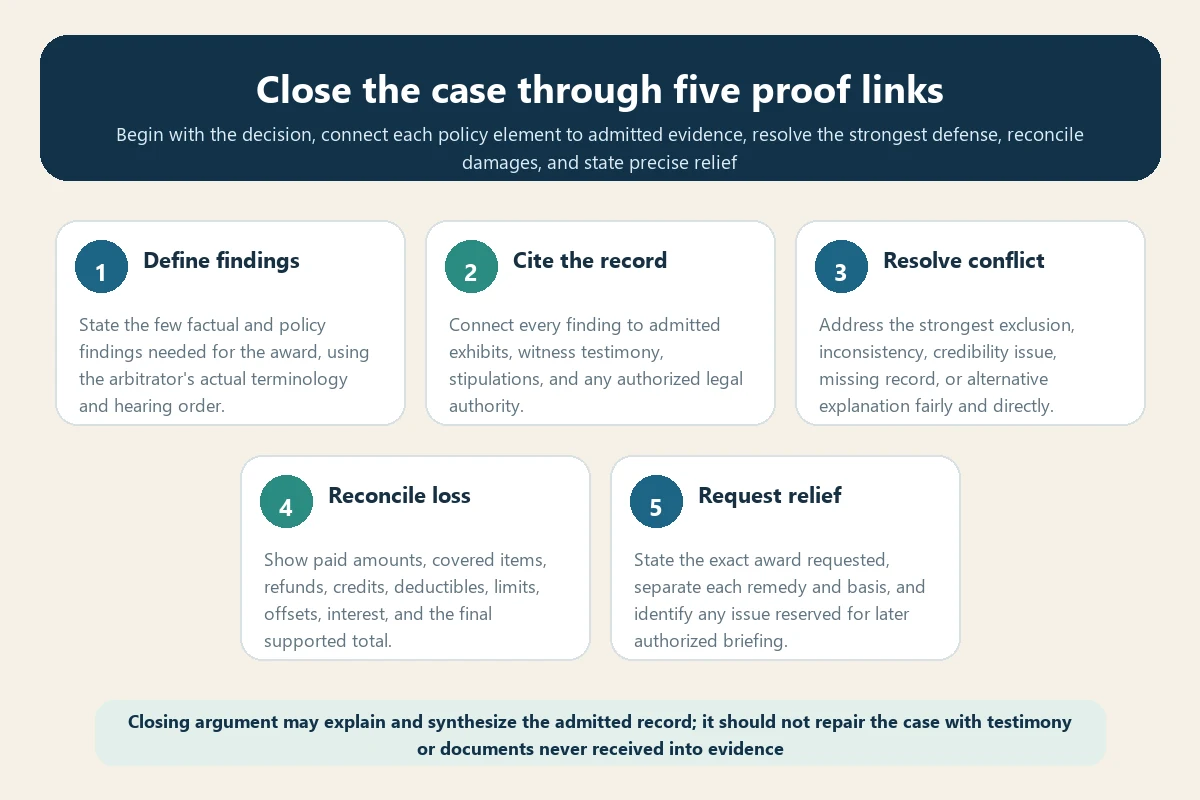
- Decision: state the controlling questions and requested findings.
- Policy: identify the provisions that govern those questions.
- Proof: connect testimony and exhibits to each element.
- Defense: answer the strongest exclusion or factual conflict.
- Damages: reconcile every payment, refund, credit, limit, and offset.
- Relief: request the precise award and separate basis for each remedy.
The official AAA arbitration preparation guide emphasizes coherent case theory, organized evidence, careful witness preparation, and development of closing statements. The closing should make the decision path easier to follow, not overwhelm the arbitrator with repetition.
Prepare a one-page closing map
List the requested findings, policy sections, two or three record citations for each, the strongest defense, final damages table, and exact relief. Mark any exhibit limitation or unresolved ruling.
Use the map as navigation, not a script to read rapidly. Prepare a shorter version if time is reduced.
Deliver with accuracy and restraint
Speak in short sections, pause at transitions, use stable references, and answer interruptions directly. Avoid personal attacks, unsupported motive claims, theatrical language, and repetition.
Correct a mistaken exhibit number or calculation immediately. Precision at closing protects credibility and the usability of the record.
Common closing argument mistakes
- Repeating the opening instead of analyzing the evidence received.
- Citing documents, testimony, or calculations outside the admitted record.
- Ignoring an exclusion, inconsistent fact, or arbitrator question.
- Misstating witness testimony or an exhibit’s status.
- Asking for a round number without a reconciled damages ledger.
- Combining policy benefits with fees or other remedies without separate authority.
- Assuming rebuttal or later briefing will be allowed.
- Exceeding the assigned time and losing the final relief request.
Final closing checklist
- Confirm the record, exhibit rulings, order, time, and rebuttal procedure.
- Match every requested finding to policy language and admitted proof.
- Address the strongest defense and material credibility issue fairly.
- Reconcile damages to exact record citations and offsets.
- Separate each remedy and identify its authority.
- Remove every unsupported fact, new document, and unproved promise.
- End with the exact award requested.
Coordinate the closing with the arbitration hearing preparation checklist and the live arbitration timeline. A strong closing does not add to the record; it makes the existing record usable for a precise decision.