

Travel insurance suit limitation clause disputes concern the policy’s deadline for bringing legal action against an insurer. That contractual clock can differ from the ordinary statute of limitations, the claim-notice period, proof-of-loss deadline, internal appeal window, or arbitration deadline.
This U.S. guide explains how to find the issued clause, identify its trigger, compare governing law, preserve tolling and waiver evidence, and protect the earliest plausible filing date. It is educational, not legal advice.
Find every deadline in the issued policy
Collect the policy, certificate, schedule, endorsements, state notices, claim conditions, legal-action provision, arbitration clause, and delivery record. Search for legal action, suit, limitation, time barred, commencement, proof of loss, appeal, arbitration, and service.
Do not rely on a generic sample. Record the form number, edition, certificate number, purchase date, and policy period.
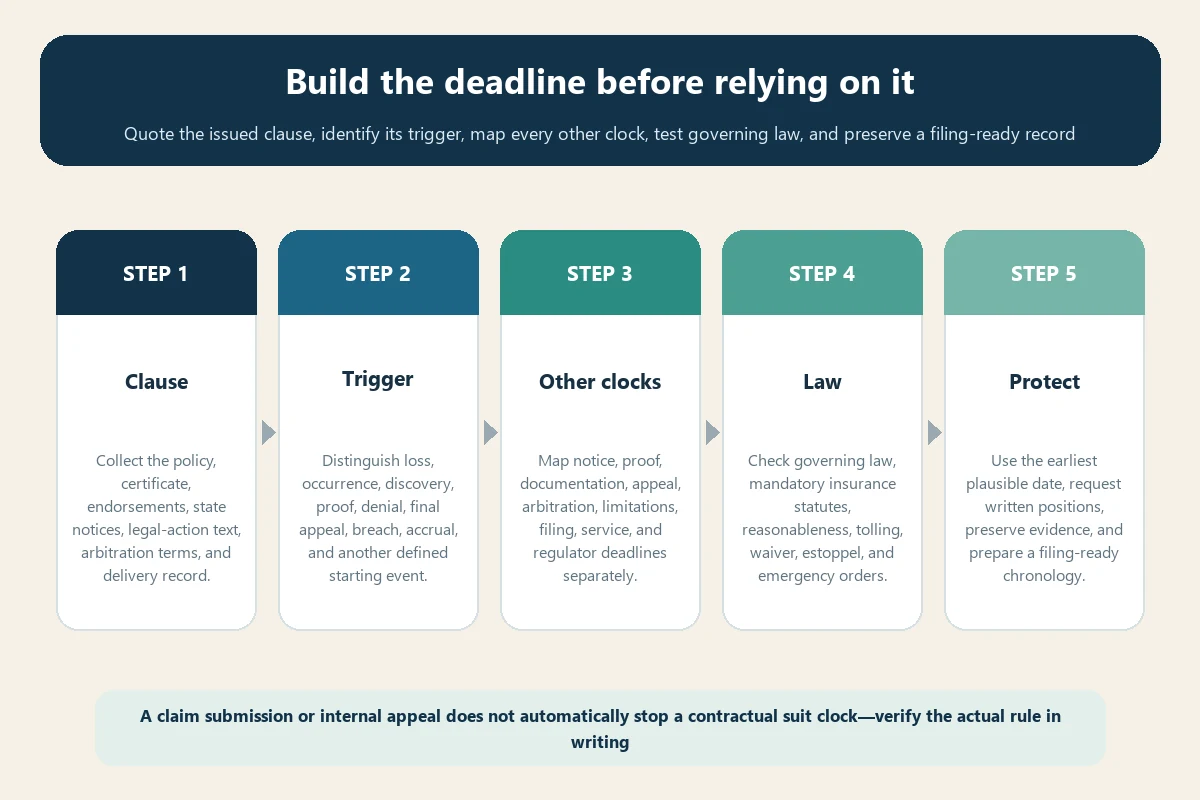
Separate suit limitation from claim notice
Claim notice tells the insurer that a covered event may have occurred. A suit limitation provision addresses when a legal action must be commenced. Timely notice does not necessarily make a later lawsuit timely.
Use the notice-of-claim and proof-of-loss deadline guide to keep those pre-suit duties in separate calendar rows.
Quote the starting event exactly
The clause may run from loss, occurrence, accident, discovery, proof, denial, final appeal, breach, or another defined event. Those dates can be months apart.
Never replace contractual wording with a shorthand such as “two years to sue.” A duration without its trigger is not a usable deadline.
Build a trigger-date evidence file
Preserve booking, purchase, departure, cancellation, illness, treatment, delay, baggage loss, carrier report, notice, proof, information request, decision, appeal, and final-response dates. Link each date to an email, letter, receipt, portal export, or report.
When discovery is the trigger, record what was known, by whom, and when—not merely when the claim was denied.
Calculate the period transparently
Show the trigger date, contract duration, nominal expiration, weekend or holiday rule, time zone, filing method, service requirement, and any argued extension. Preserve the calculation rather than entering only a final date.
Calendar advance warnings and use the earliest reasonable interpretation while unresolved.
Compare the ordinary statute of limitations
A state may provide a longer period for a contract action, yet permit a written contract to shorten it if legal requirements are met. Other statutes may restrict shortening for a particular insurance product or remedy.
Identify governing law before borrowing another state’s deadline. The choice-of-law clause guide provides a contact and issue matrix for that analysis.
Remember why state insurance law matters
15 U.S.C. §1012 recognizes state regulation of the business of insurance and limits displacement by federal laws that do not specifically relate to insurance.
It does not supply a travel-claim deadline. It explains why the issued state form and applicable state rules require specific review.
Use Heimeshoff only for its actual setting
In Heimeshoff v. Hartford Life & Accident Insurance Co., the U.S. Supreme Court addressed an ERISA plan’s contractual limitations provision and discussed enforcement absent a controlling statute, unreasonableness, or recognized equitable doctrines.
ERISA benefits are not ordinary retail travel insurance. Use the decision as analytical context, not as a universal travel-policy rule.
Test whether the period leaves a real opportunity to sue
Map every condition that must be completed before legal action: proof, records, examination, appeal, waiting period, appraisal, or another prerequisite. Compare the time consumed with the contractual expiration.
A short period and a late accrual date create different issues. Document both duration and practical opportunity.
Study Executive Plaza cautiously
In Executive Plaza, LLC v. Peerless Insurance Co., New York’s highest court held a fire-policy limitation unreasonable when the policy required replacement before recovery but replacement could not reasonably occur before the period expired.
The case concerns New York fire insurance, not a standard travel policy. Its lesson is to test the interaction between the deadline and conditions, then apply controlling authority for the actual contract.
Review claim-processing time
Create a ledger of insurer requests, traveler responses, review intervals, appeal dates, extensions, and inactivity. Identify which delays were required, requested, agreed, avoidable, or disputed.
Ongoing adjustment does not automatically suspend a suit limitation clock. Obtain a written tolling or extension position where appropriate.
Do not assume an appeal tolls the clock
Read whether appeal is mandatory or optional, whether it is a condition before suit, and whether the policy or law pauses time. Calendar both the appeal deadline and court deadline.
The travel-insurance claim-denial guide helps organize the denial grounds while deadline analysis proceeds independently.
Separate arbitration deadlines
An arbitration clause may impose a demand deadline, conditions, administrator filing rules, or a limitations defense. Filing a court action may not satisfy an arbitration demand requirement, and the reverse may also be true.
Use the arbitration deadline and tolling guide to preserve those clocks separately.
Analyze waiver with concrete conduct
Preserve statements about extensions, future review, additional documents, reopening, negotiation, and rights. Identify who made each statement and whether that person had authority.
Routine willingness to consider more information may not be a clear relinquishment of a limitations defense. Governing law controls.
Analyze estoppel separately
Record the representation or concealment, reasonable reliance, resulting delay, diligence, and prejudice. General silence or claim processing may be insufficient.
Do not merge waiver, estoppel, equitable tolling, statutory tolling, and contractual extension into one label.
Review Sportsinsurance as a non-travel example
An official Northern District of New York decision in Sportsinsurance.com v. Hanover discusses a contractual limitations clause, reconsideration, and interlocutory review in a commercial crime-policy dispute.
It is not about travel insurance. It shows why the defined trigger, scope of covered legal actions, and alleged waiver or estoppel conduct must be preserved precisely.
Check emergency orders and enacted extensions
Government emergencies can generate statutes, court orders, or regulatory directives affecting filing or claim deadlines. Confirm jurisdiction, covered period, affected proceeding, and expiration.
A travel restriction, disaster declaration, or insurer accommodation does not automatically extend every contractual limitation.
Distinguish filing from service
Some procedural systems treat commencement as filing; others may require service or another act. Arbitration administrators can have their own receipt and fee rules.
Confirm the forum, filing system, time zone, payment, signature, exhibits, summons, and service obligations before the last day.
Identify every claim and remedy
List breach of contract, declaratory relief, statutory claims, bad faith, unfair practices, restitution, and other asserted remedies. Determine whether the clause says action under the policy, involving loss, on the contract, or uses broader language.
Do not assume re-labeling an untimely coverage claim creates a new clock. Do not assume one limitation necessarily governs every independent statutory claim.
Preserve proof that the clause was delivered
Keep checkout screens, disclosures, consent, confirmation, certificate, policy link, downloaded PDF, email headers, and amendments. Record whether purchase occurred through an airline, cruise line, hotel, tour operator, agent, or insurer.
Formation and notice questions require evidence; they should not be guessed after expiration.
Request a written deadline position
Ask the insurer to identify the clause, trigger date, calculated expiration, any tolling, and whether ongoing review changes its position. State that the request does not waive an earlier date or other argument.
Silence is not an extension. Protect the earliest plausible date unless qualified counsel confirms otherwise.
Document any extension or tolling agreement
A useful agreement identifies the parties, policy, claim, clause, original trigger, original expiration, new date, covered claims, reserved defenses, effective period, and authorized signers. Confirm whether it extends filing only or also affects service, arbitration, appeal, and other conditions.
Do not assume an email acknowledging a deadline request grants it. Obtain an unambiguous written response and preserve headers, attachments, signatures, and delivery. If the insurer declines or does not answer, continue preparing under the unextended date.
Where multiple insurers, administrators, or benefits are involved, secure a position from each relevant party. An extension by one entity may not bind another or change a credit-card, carrier, or arbitration deadline. Enter each agreement as a separate matrix row and schedule a safety margin before the revised date.
Build a filing-ready claim file
Organize the issued policy, proof of purchase, benefit claim, supporting evidence, communications, decision, appeal, deadline matrix, governing-law research, requested extensions, and service information. Keep native files and a dated index.
The claim-filing guide provides a foundation for the underlying benefit record.
Create a deadline matrix
Use columns for obligation, source, trigger, evidence, duration, nominal expiration, tolling argument, extension, responsible person, action required, filing method, service, and status. Add one row for each plausible governing law.
Mark assumptions visibly and resolve them before relying on the calendar.
Questions for qualified counsel
- Was the suit limitation clause incorporated and delivered?
- Which event starts the contractual period?
- Does governing law permit this duration and trigger?
- Do mandatory appeals or conditions leave a reasonable filing opportunity?
- Is there provable tolling, waiver, estoppel, or written extension?
- What filing and service acts must occur before the earliest plausible date?
Practical takeaway
Treat a travel-insurance suit limitation clause as one clock in a larger system. Quote the issued text, prove the trigger, separate notice, proof, appeal, arbitration, filing, and service, and compare the governing state law with current primary authority.
Preserve the full timeline and any extension conduct, but do not assume claim review pauses time. Calendar the earliest plausible deadline and prepare a filing-ready record well before it arrives.
A mistake, disputed estimate, omission, and intentional material false statement are not interchangeable. Use this travel insurance concealment or fraud clause guide to identify the exact statement, speaker, timing, knowledge, materiality, reliance, evidence, and claimed consequence before responding.
A damaged-baggage claim needs an airport report, condition evidence, repair or replacement analysis, carrier outcome, policy valuation, and a clear record of who keeps the damaged property. Use this travel insurance damaged baggage claim guide to coordinate airline, TSA, card, and policy recovery without surrendering evidence or seeking duplicate payment.
